
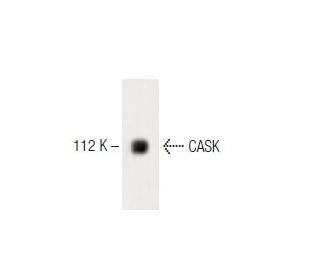

CASK Anticuerpo (7): sc-135857
- CASK Anticuerpo 7 es un monoclonal de ratón IgG1 proporcionado como 50 µg/0.5 ml
- producido contra los amino ácidos 353-486 de CASK de origen rat
- recomendado para detectarCASK de mouse, rat, human y canine origen, mediante WB, IP y IF; no recomendado para IP
- Actualmente, aún no hemos completado la identificación de los reactivos de detección secundaria preferidos para CASK Anticuerpo (7). Este trabajo está en progreso.

ENLACES RÁPIDOS
VER TAMBIÉN ....
La familia de proteínas MAGUK (homólogos de la quinasa guanilato asociada a la membrana) contiene múltiples dominios de unión a proteínas y está involucrada en la organización de las uniones celulares, la supresión de tumores y la señalización. CASK (también designada LIN-2) pertenece a una subfamilia de MAGUK que se caracteriza por una estructura de dominio novedosa que consiste en un dominio de quinasa de proteína dependiente de calcio/calmodulina seguido por dominios PDZ, SH3 y guanilato quinasa-símil (GUK). CASK se expresa en el cerebro de la rata donde se une a proteínas de la superficie celular, como neurexina y sindecán, y se piensa que está involucrada en la señalización en las sinapsis neuronales. CASK se transloca al núcleo e interactúa con Tbr-1 para formar un complejo, que se une a una secuencia específica de ADN (el elemento T), e induce la expresión de genes específicos, incluyendo Reelin. CASK muestra una función de regulación de la transcripción, que parece crucial para el desarrollo cerebrocortical.
Alexa Fluor® es una marca registrada de Molecular Probes Inc., OR., USA
REIVEW LI-COR® y Odyssey® son marcas registradas de LI-COR Biosciences.
CASK Anticuerpo (7) Referencias:
- El papel de la proteína MAGUK CASK en el desarrollo neuronal y la función sináptica. | Hsueh, YP. 2006. Curr Med Chem. 13: 1915-27. PMID: 16842202
- Restricciones estructurales y divergencias funcionales en la evolución de CASK. | LaConte, L. and Mukherjee, K. 2013. Biochem Soc Trans. 41: 1017-22. PMID: 23863172
- CASK regula la autofosforilación de CaMKII en el crecimiento neuronal, la señalización del calcio y el aprendizaje. | Gillespie, JM. and Hodge, JJ. 2013. Front Mol Neurosci. 6: 27. PMID: 24062638
- Disfunción presináptica en los trastornos del neurodesarrollo relacionados con CASK. | Becker, M., et al. 2020. Transl Psychiatry. 10: 312. PMID: 32929080
- CASK regula la vía Notch y funciona como promotor tumoral en el cáncer de páncreas. | Qu, J., et al. 2021. Arch Biochem Biophys. 701: 108789. PMID: 33548214
- Análisis funcional de las variantes de transcripción de CASK expresadas en el cerebro humano. | Tibbe, D., et al. 2021. PLoS One. 16: e0253223. PMID: 34133460
- La deleción específica de CASK en las células β pancreáticas afecta a la homeostasis de la glucosa y mejora la sensibilidad a la insulina en ratones obesos al reducir la hiperinsulinemia Título en ejecución: La deleción de CASK en células β reduce la hiperinsulinemia. | Liu, X., et al. 2021. Diabetes.. PMID: 34675005
- La deleción específica de CASK en las células β pancreáticas afecta a la homeostasis de la glucosa y mejora la sensibilidad a la insulina en ratones obesos al reducir la hiperinsulinemia Título en ejecución: La deleción de CASK en células β reduce la hiperinsulinemia. | Liu, X., et al. 2021. Diabetes.. PMID: 34957476
- La pérdida de función de CASK regula de forma diferencial la maduración neuronal y la función sináptica en neuronas excitadoras corticales inducidas humanas. | McSweeney, D., et al. 2022. iScience. 25: 105187. PMID: 36262316
- Evidencia genética de la plasticidad estructural y funcional dependiente del splicing en la proteína CASK. | Patel, PA., et al. 2024. J Med Genet. 61: 759-768. PMID: 38670634
Información sobre pedidos
| Nombre del producto | Número de catálogo | UNIDAD | Precio | CANTIDAD | Favoritos | |
CASK Anticuerpo (7) | sc-135857 | 50 µg/0.5 ml | $322.00 |