
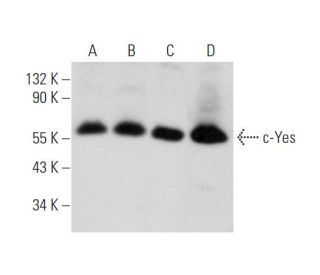


Yes Antibody (B-11): sc-515336
- Yes Antibody (B-11) is a mouse monoclonal IgG1 provided at 200 µg/ml
- specific for an epitope mapping between amino acids 19-43 near the N-terminus of c-Yes of human origin
- recommended for detection of c-Yes of human origin by WB, IP, IF and ELISA
- At present, we have not yet completed the identification of the preferred secondary detection reagent(s) for Yes Antibody (B-11). This work is in progress.

QUICK LINKS
SEE ALSO...
c-Yes Antibody (B-11) is a mouse monoclonal IgG1 antibody that detects c-Yes in human samples through applications such as western blotting (WB), immunoprecipitation (IP), immunofluorescence (IF), and enzyme-linked immunosorbent assay (ELISA). c-Yes is a critical member of the Src family of non-receptor tyrosine kinases, which play a pivotal role in various cellular processes, including cell proliferation, differentiation, motility, and adhesion. c-Yes, encoded by the human c-Yes gene located on chromosome 18p11.31-p11.21, consists of 543 amino acids and shares over 80% homology with c-Src outside of their unique amino-terminal regions. This structural similarity allows c-Yes to engage in specific interactions with various substrates, facilitated by SH3 and SH2 domains, which are essential for modular association and activation. The ability of c-Yes to transduce signals effectively makes c-Yes a vital player in cellular signaling pathways, influencing not only normal cellular functions but also contributing to oncogenic processes when dysregulated. Anti-c-Yes antibody (B-11) is an invaluable tool for researchers aiming to explore the intricate roles of c-Yes in health and disease, providing insights into its function and potential as a therapeutic target.
Alexa Fluor® is a trademark of Molecular Probes Inc., OR., USA
LI-COR® and Odyssey® are registered trademarks of LI-COR Biosciences
Yes Antibody (B-11) References:
- Expression of c-yes oncogene product in various animal tissues and spontaneous canine tumours. | Rungsipipat, A., et al. 1999. Res Vet Sci. 66: 205-10. PMID: 10333460
- QM, a putative tumor suppressor, regulates proto-oncogene c-yes. | Oh, HS., et al. 2002. J Biol Chem. 277: 36489-98. PMID: 12138090
- Alternatively spliced FGFR-1 isoforms differentially modulate endothelial cell activation of c-YES. | Zhang, P., et al. 2006. Arch Biochem Biophys. 450: 50-62. PMID: 16631103
- Characterization of the promoter region of the c-yes proto-oncogene: the importance of the GC boxes on its promoter activity. | Matsuzawa, Y., et al. 1991. Oncogene. 6: 1561-7. PMID: 1923523
- The naturally processed CD95L elicits a c-yes/calcium/PI3K-driven cell migration pathway. | Tauzin, S., et al. 2011. PLoS Biol. 9: e1001090. PMID: 21713032
- Monoclonal antibodies to the amino-terminal sequence of the c-yes gene product as specific probes of its expression. | Sukegawa, J., et al. 1990. Oncogene. 5: 611-4. PMID: 2183163
- Characterization of cDNA clones for the human c-yes gene. | Sukegawa, J., et al. 1987. Mol Cell Biol. 7: 41-7. PMID: 2436037
- c-yes and bcl-2 genes located on 18q21.3 in a follicular lymphoma cell line carrying a t(14;18) chromosomal translocation. | Ohno, H., et al. 1987. Int J Cancer. 39: 785-8. PMID: 3034807
- Nucleotide sequence and chromosomal mapping of the human c-yes-2 gene. | Semba, K., et al. 1988. Jpn J Cancer Res. 79: 710-7. PMID: 3137198
- Amplification of c-yes-1 proto-oncogene in a primary human gastric cancer. | Seki, T., et al. 1985. Jpn J Cancer Res. 76: 907-10. PMID: 3935622
Ordering Information
| Product Name | Catalog # | UNIT | Price | Qty | FAVORITES | |
Yes Antibody (B-11) | sc-515336 | 200 µg/ml | $322.00 | |||
Yes (B-11) Neutralizing Peptide | sc-515336 P | 100 µg/0.5 ml | $69.00 |