
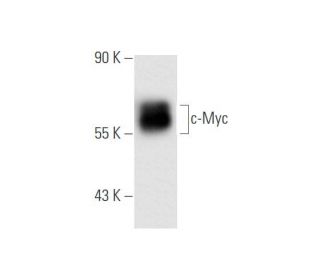
Myc Antibody (1.N.2): sc-70469
- Myc Antibody (1.N.2) is a mouse monoclonal IgG1 κ, cited in 16 publications, provided at 200 µg/ml
- raised against full length c-Myc of human origin
- recommended for detection of c-Myc p67 and c-Myc tagged fusion proteins of mouse, rat, human and avian origin by WB, IP and IF
- See Myc (9E10): sc-40 for Myc antibody conjugates, including AC, HRP, FITC, PE, Alexa Fluor® 488, 594, 647, 680 and 790.
- At present, we have not yet completed the identification of the preferred secondary detection reagent(s) for Myc Antibody (1.N.2). This work is in progress.

c-Myc Antibody (1.N.2) is a mouse monoclonal IgG1 kappa light chain antibody raised against full-length human c-Myc, a vital transcription factor involved in regulating numerous cellular processes, including cell proliferation, metabolism, and apoptosis. c-Myc mouse monoclonal antibody (1.N.2) recognizes an epitope within the c-Myc immunogen sequence. Anti-c-Myc monoclonal antibody (1.N.2) has proven crucial for advancing research on c-Myc′s role in oncogenic pathways and the development of therapeutic strategies for c-Myc-driven cancers. The c-Myc protein, encoded by the MYC gene, belongs to the Myc family along with N-Myc and L-Myc. c-Myc exerts influence on gene expression by binding to specific E-box sequences in DNA, regulating numerous genes involved in cell cycle control and metabolic pathways. The activity of c-Myc depends on heterodimerization with Max protein, facilitated by the basic helix-loop-helix leucine zipper (bHLH-Zip) domain. The c-Myc/Max complex binds to DNA in a sequence-specific manner, driving the transcription of genes necessary for the G1 to S phase transition, as well as genes regulating cellular growth, metabolism, and mitochondrial function. This transcriptional control maintains normal cellular homeostasis, but overexpression or dysregulation of c-Myc frequently occurs in cancers such as lung, breast, and colon carcinomas, contributing to unchecked cell proliferation, resistance to apoptosis, and tumor progression. Regarding subcellular localization, c-Myc predominantly resides in the nucleus, where c-Myc functions as a transcriptional regulator. Nuclear localization proves crucial for c-Myc′s ability to interact with DNA and orchestrate the transcriptional programs controlling cell growth and division. c-Myc can shuttle between the nucleus and cytoplasm, a dynamic localization important for regulation. Under certain conditions, c-Myc may undergo sequestration in the cytoplasm, altering availability for DNA binding and transcriptional activity. This ability to transition between cellular compartments allows for tight regulation of c-Myc′s role in cellular function and transformation.
Ordering Information
| Product Name | Catalog # | UNIT | Price | Qty | FAVORITES | |
Myc Antibody (1.N.2) | sc-70469 | 200 µg/ml | $322.00 |