
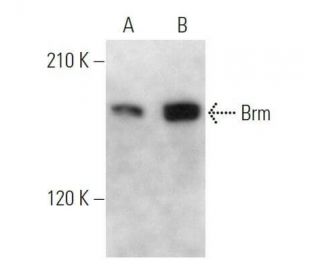


Brm Antibody (E-1): sc-17828
- Brm Antibody (E-1) is a mouse monoclonal IgM κ Brm antibody, cited in 12 publications, provided at 200 µg/ml
- specific for an epitope mapping between amino acids 2-20 at the N-terminus of Brm of human origin
- recommended for detection of Brm of mouse, rat, human and origin by WB, IP, IF and ELISA; also reactive with additional species, including equine and avian
- available conjugated to agarose for IP
- TransCruz reagent for Gel Supershift and ChIP applications (sc-17828 X, 200 µg/0.1 ml)
- m-IgGκ BP-HRP is the preferred secondary detection reagent for Brm Antibody (E-1) for WB applications. This reagent is now offered in a bundle with Brm Antibody (E-1) (see ordering information below). For additional m-IgGκ BP conjugates see our complete list of Mouse IgG Binding Proteins.

QUICK LINKS
SEE ALSO...
Brm Antibody (E-1) is a mouse monoclonal IgM antibody that detects Brm protein of mouse, rat, and human origin by western blotting (WB), immunoprecipitation (IP), immunofluorescence (IF), and enzyme-linked immunosorbent assay (ELISA). anti-Brm antibody (E-1) is available in both non-conjugated and various conjugated forms, including agarose, to suit diverse experimental needs. The Brahma protein (Brm) serves as an ATPase subunit of the Drosophila melanogaster Brm complex, which is closely related to the mammalian SWI/SNF chromatin-remodeling complex, playing a crucial role in gene regulation. Brm functions as a transcriptional activator of Hox genes, interacting with nearly all transcriptionally active chromatin while maintaining a non-overlapping pattern with Polycomb, a known repressor of Hox gene transcription. This unique interaction is vital for proper expression of homeotic genes, as the Brm complex acts as an essential coactivator for the trithorax group protein Zeste, which binds to DNA and activates these genes. Notably, a reduction in Brm function significantly decreases the association of RNA polymerase II with Drosophila salivary gland chromosomes, indicating that chromatin remodeling activity of the Brm complex is fundamental for facilitating transcription by RNA polymerase II. Furthermore, Brm acts as a dominant suppressor of the rough eye phenotype caused by a hypomorphic mutation of Drosophila cyclin E, inhibiting S phase entry by acting downstream of cyclin E protein accumulation. The interaction of the Brm complex with chromatin may also be influenced by BAP111, which is highly associated with the Brm complex in Drosophila embryos through an HMG domain. Brm is predominantly expressed in unfertilized eggs and early embryos, underscoring its importance in early developmental processes.
Ordering Information
| Product Name | Catalog # | UNIT | Price | Qty | FAVORITES | |
Brm Antibody (E-1) | sc-17828 | 200 µg/ml | $322.00 | |||
Brm Antibody (E-1): m-IgGκ BP-HRP Bundle | sc-552299 | 200 µg Ab; 40 µg BP | $361.00 | |||
Brm Antibody (E-1) AC | sc-17828 AC | 500 µg/ml, 25% agarose | $424.00 | |||
Brm (E-1) Neutralizing Peptide | sc-17828 P | 100 µg/0.5 ml | $69.00 | |||
Brm Antibody (E-1) X | sc-17828 X | 200 µg/0.1 ml | $322.00 |