
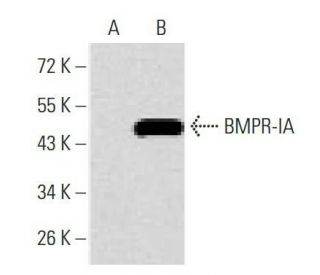


BMPR-IA Antibody (4B7B2): sc-293175
- BMPR-IA Antibody (4B7B2) is a mouse monoclonal IgG1, cited in 1 publications, provided at 50 µg/0.5 ml
- raised against a partial recombinant protein corresponding to amino acids 179-378 of BMPR-IA of human origin
- recommended for detection of BMPR-IA of human origin by WB, IP, IF, IHC(P), FCM and ELISA
- At present, we have not yet completed the identification of the preferred secondary detection reagent(s) for BMPR-IA Antibody (4B7B2). This work is in progress.

BMPR-IA Antibody (4B7B2) is a mouse monoclonal IgG1 antibody that detects BMPR-IA in human samples through various applications including western blotting (WB), immunoprecipitation (IP), immunofluorescence (IF), immunohistochemistry with paraffin-embedded sections (IHCP), flow cytometry (FCM), and enzyme-linked immunosorbent assay (ELISA). BMPR-IA, also known as SKR5, ALK-3, and BRK-1, plays a crucial role in the bone morphogenetic protein (BMP) signaling pathway, which regulates various biological processes such as cell differentiation, proliferation, and apoptosis. BMPR-IA is primarily located on the cell membrane, where BMPR-IA forms a complex with type II BMP receptors, facilitating the transmission of extracellular signals that influence gene expression and developmental processes. BMPR-IA (4B7B2) antibody recognizes a protein vital for maintaining normal cellular functions and tissue homeostasis, as dysregulation of this pathway has been implicated in various diseases, including cancer and fibrotic disorders. BMPR-IA is expressed in human glioma cell lines, highlighting BMPR-IA′s potential role in tumor biology and making anti-BMPR-IA antibody (4B7B2) a valuable tool for therapeutic interventions. Through interactions with other BMP family members, BMPR-IA is integral to the intricate network of signaling pathways that govern cellular behavior, underscoring BMPR-IA monoclonal antibody (4B7B2)′s importance in research and clinical applications.
Alexa Fluor® is a trademark of Molecular Probes Inc., OR., USA
LI-COR® and Odyssey® are registered trademarks of LI-COR Biosciences
BMPR-IA Antibody (4B7B2) References:
- Overexpression of BMP-2/4, -5 and BMPR-IA associated with malignancy of oral epithelium. | Jin, Y., et al. 2001. Oral Oncol. 37: 225-33. PMID: 11287276
- Germline mutations in BMPR1A/ALK3 cause a subset of cases of juvenile polyposis syndrome and of Cowden and Bannayan-Riley-Ruvalcaba syndromes. | Zhou, XP., et al. 2001. Am J Hum Genet. 69: 704-11. PMID: 11536076
- Prenatal lung epithelial cell-specific abrogation of Alk3-bone morphogenetic protein signaling causes neonatal respiratory distress by disrupting distal airway formation. | Sun, J., et al. 2008. Am J Pathol. 172: 571-82. PMID: 18258849
- The solution structure of BMPR-IA reveals a local disorder-to-order transition upon BMP-2 binding. | Klages, J., et al. 2008. Biochemistry. 47: 11930-9. PMID: 18937504
- Anti-Müllerian hormone recruits BMPR-IA in immature granulosa cells. | Sèdes, L., et al. 2013. PLoS One. 8: e81551. PMID: 24312319
- Alk3 mediated Bmp signaling controls the contribution of epicardially derived cells to the tissues of the atrioventricular junction. | Lockhart, MM., et al. 2014. Dev Biol. 396: 8-18. PMID: 25300579
- Differential requirement of bone morphogenetic protein receptors Ia (ALK3) and Ib (ALK6) in early embryonic patterning and neural crest development. | Schille, C., et al. 2016. BMC Dev Biol. 16: 1. PMID: 26780949
- Strontium doping promotes bioactivity of rhBMP-2 upon calcium phosphate cement via elevated recognition and expression of BMPR-IA. | Huang, B., et al. 2017. Colloids Surf B Biointerfaces. 159: 684-695. PMID: 28869829
- P2RY1/ALK3-Expressing Cells within the Adult Human Exocrine Pancreas Are BMP-7 Expandable and Exhibit Progenitor-like Characteristics. | Qadir, MMF., et al. 2018. Cell Rep. 22: 2408-2420. PMID: 29490276
- ALK3-SMAD1/5 Signaling Mediates the BMP2-Induced Decrease in PGE2 Production in Human Endometrial Stromal Cells and Decidual Stromal Cells. | Zhang, Y., et al. 2020. Front Cell Dev Biol. 8: 573028. PMID: 33043005
Ordering Information
| Product Name | Catalog # | UNIT | Price | Qty | FAVORITES | |
BMPR-IA Antibody (4B7B2) | sc-293175 | 50 µg/0.5 ml | $322.00 |