
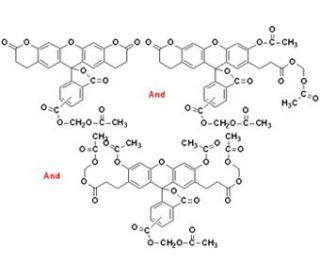

BCECF/AM (CAS 117464-70-7)
See product citations (6)
QUICK LINKS
BCECF/AM, with the CAS number 117464-70-7, is a widely used fluorescent compound in the field of cellular biology for analyzing intracellular pH levels. The chemical is an acetoxymethyl ester derivative of BCECF, which stands for 2′,7′-bis-(2-carboxyethyl)-5-(and-6)-carboxyfluorescein. As an AM ester, BCECF/AM is non-polar and membrane-permeable, allowing it to diffuse passively across cell membranes into the intracellular environment. Once inside the cell, intracellular esterases cleave the AM ester groups, converting it into BCECF, which is polar and thus remains trapped within the cell. This conversion is crucial for its function as BCECF is highly fluorescent and its fluorescence emission can shift depending on the pH of its surroundings. This property of pH-dependent fluorescence change makes BCECF ideal for monitoring intracellular pH dynamics, a pivotal aspect of numerous cellular processes including cell metabolism, cell signaling, and ion transport. Researchers utilize BCECF/AM in live cell imaging to study pH regulation and alterations in various physiological and pathological conditions. The ability to quantitatively measure intracellular pH changes in real time provides valuable insights into the fundamental aspects of cellular function and is particularly useful in studies related to cellular stress, drug action, and disease pathology, all without the use of invasive techniques.
BCECF/AM (CAS 117464-70-7) References
- A rapid method for measuring intracellular pH using BCECF-AM. | Ozkan, P. and Mutharasan, R. 2002. Biochim Biophys Acta. 1572: 143-8. PMID: 12204343
- Regulation mechanisms of intracellular pH of Xenopus laevis oocyte. | Sasaki, S., et al. 1992. Biochim Biophys Acta. 1137: 45-51. PMID: 1327152
- Drug efflux transport properties of 2',7'-bis(2-carboxyethyl)-5(6)-carboxyfluorescein acetoxymethyl ester (BCECF-AM) and its fluorescent free acid, BCECF. | Bachmeier, CJ., et al. 2004. J Pharm Sci. 93: 932-42. PMID: 14999730
- Intracellular Ca2+ concentration and pHi during metabolic inhibition. | Hayashi, H., et al. 1992. Am J Physiol. 262: C628-34. PMID: 1550207
- Use of fluorescent dye BCECF to measure intracellular pH in cortical collecting tubule. | Weiner, ID. and Hamm, LL. 1989. Am J Physiol. 256: F957-64. PMID: 2719125
- Dual loading of the fluorescent indicator fura-2 and 2,7-biscarboxyethyl-5(6)-carboxyfluorescein (BCECF) in isolated myocytes. | Miyata, H., et al. 1989. Biochem Biophys Res Commun. 163: 500-5. PMID: 2775282
- Multienzyme-Like Polyoxometalate-Based Single-Atom Enzymes for Cancer-Specific Therapy Through Acid-Triggered Nontoxicity-to-Toxicity Transition. | Ge, X., et al. 2024. Small. e2401073. PMID: 38644232
- Phage defence system CBASS is regulated by a prokaryotic E2 enzyme that imitates the ubiquitin pathway. | Yan, Y., et al. 2024. Nat Microbiol. 9: 1566-1578. PMID: 38649411
- SGLT2-independent effects of canagliflozin on NHE3 and mitochondrial complex I activity inhibit proximal tubule fluid transport and albumin uptake. | Albalawy, WN., et al. 2024. Am J Physiol Renal Physiol. 326: F1041-F1053. PMID: 38660713
- Measurement of the intracellular pH of Propionibacterium acnes: comparison between the fluorescent probe BCECF and 31P-NMR spectroscopy. | Futsaether, CM., et al. 1993. Can J Microbiol. 39: 180-6. PMID: 8467419
Ordering Information
| Product Name | Catalog # | UNIT | Price | Qty | FAVORITES | |
BCECF/AM, 1 mg | sc-202492 | 1 mg | $121.00 |