
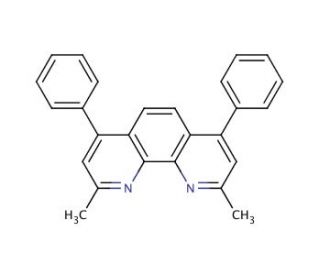

Bathocuproine (CAS 4733-39-5)
QUICK LINKS
Bathocuproine (BCP) has been a valuable synthetic compound in scientific research for several decades. This cationic dye finds extensive applications in various scientific studies, including fluorescence microscopy and histochemical staining. Bathocuproine plays a role in biochemical and physiological investigations, primarily due to its remarkable affinity for proteins and other molecules. It is frequently employed as a fluorescent marker in cell biology and histology. This paper aims to delve into the synthesis method, scientific research applications, mechanism of action, biochemical and physiological effects, advantages, limitations, and future directions concerning Bathocuproine research. Bathocuproine boasts a wide array of applications within the scientific research realm. It is utilized as a fluorescent marker in cell biology and histology due to its strong binding capacity with proteins and other molecules. Fluorescence microscopy benefits from the high affinity of Bathocuproine for DNA and RNA. Moreover, it has been employed as a histochemical stain to identify the presence of proteins, lipids, and carbohydrates. The binding mechanism of Bathocuproine involves a cation-exchange process. This cationic dye readily binds to negatively charged molecules like proteins and DNA, forming a stable covalent bond. This exceptional covalent bond formation enables Bathocuproine to effectively bind to proteins and other molecules, thus serving as useful as a fluorescent marker.
Bathocuproine (CAS 4733-39-5) References
- Highly selective simultaneous determination of Cu(ii), Co(ii), Ni(ii), Hg(ii), and Mn(ii) in water samples using microfluidic paper-based analytical devices. | Kamnoet, P., et al. 2021. Analyst. 146: 2229-2239. PMID: 33595555
- The Influence of Helium Dielectric Barrier Discharge Jet (DBDjet) Plasma Treatment on Bathocuproine (BCP) in p-i-n-Structure Perovskite Solar Cells. | Shih, CY., et al. 2021. Polymers (Basel). 13: PMID: 34833316
- Photo-activated proflavine degrades protein and impairs enzyme activity: Involvement of hydroxyl radicals. | Ghatasheh, MK., et al. 2022. Toxicol Rep. 9: 78-86. PMID: 35024344
- Copper-mediated DNA damage caused by purpurin, a natural anthraquinone. | Kobayashi, H., et al. 2022. Genes Environ. 44: 15. PMID: 35527257
- Simple approach for an electron extraction layer in an all-vacuum processed n-i-p perovskite solar cell. | Kim, BS., et al. 2022. Energy Adv. 1: 252-257. PMID: 35747761
- Flavin Metallaphotoredox Catalysis: Synergistic Synthesis in Water. | Chilamari, M., et al. 2022. ACS Catal. 12: 4175-4181. PMID: 35865831
- Oxidative DNA Damage by N4-hydroxycytidine, a Metabolite of the SARS-CoV-2 Antiviral Molnupiravir. | Kobayashi, H., et al. 2023. J Infect Dis. 227: 1068-1072. PMID: 36461940
- Simultaneous Cross-type Detection of Water Quality Indexes via a Smartphone-App Integrated Microfluidic Paper-Based Platform. | Xiong, X., et al. 2022. ACS Omega. 7: 44338-44345. PMID: 36506192
- Experimental evidence of the anti-bacterial activity pathway of copper ion treatment on Mycobacterium avium subsp. paratuberculosis. | Tejeda, C., et al. 2023. Braz J Microbiol. 54: 407-413. PMID: 36572823
- Investigation of Cross-Linked Chitosan-Based Membranes as Potential Adsorbents for the Removal of Cu2+ Ions from Aqueous Solutions. | Vlachou, I. and Bokias, G. 2023. Materials (Basel). 16: PMID: 36903041
- LARP-assisted synthesis of CsBi3I10 perovskite for efficient lead-free solar cells. | Vijaya, S., et al. 2023. RSC Adv. 13: 9978-9982. PMID: 37006347
- Selective determination of cuprous ion in copper dissolving solution based on bathocuproine-modified expanded graphite electrode. | Chen, X., et al. 2023. Anal Sci.. PMID: 37280484
- Optical Quantification of Metal Ions Using Plasmonic Nanostructured Microbeads Coated with Metal-Organic Frameworks and Ion-Selective Dyes. | Zorlu, T., et al. 2023. ACS Nanosci Au. 3: 222-229. PMID: 37360844
Ordering Information
| Product Name | Catalog # | UNIT | Price | Qty | FAVORITES | |
Bathocuproine, 500 mg | sc-257115 | 500 mg | $52.00 |