
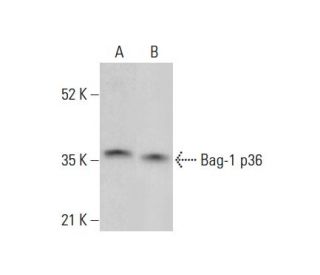
Bag-1 Antibody (E-11): sc-376848
- Bag-1 Antibody (E-11) is a mouse monoclonal IgG2b κ, cited in 4 publications, provided at 200 µg/ml
- specific for an epitope mapping between amino acids 117-155 within an internal region of Bag-1 of human origin
- Anti-Bag-1 Antibody (E-11) is recommended for detection of Bag-1 of mouse, rat and human origin by WB, IP, IF, IHC(P) and ELISA
- Anti-Bag-1 Antibody (E-11) is available conjugated to agarose for IP; HRP for WB, IHC(P) and ELISA; and to either phycoerythrin or FITC for IF, IHC(P) and FCM
- also available conjugated to Alexa Fluor® 488, Alexa Fluor® 546, Alexa Fluor® 594 or Alexa Fluor® 647 for WB (RGB), IF, IHC(P) and FCM, and for use with RGB fluorescent imaging systems, such as iBright™ FL1000, FluorChem™, Typhoon, Azure and other comparable systems
- also available conjugated to Alexa Fluor® 680 or Alexa Fluor® 790 for WB (NIR), IF and FCM; for use with Near-Infrared (NIR) detection systems, such as LI-COR®Odyssey®, iBright™ FL1000, FluorChem™, Typhoon, Azure and other comparable systems
- At present, we have not yet completed the identification of the preferred secondary detection reagent(s) for Bag-1 Antibody (E-11). This work is in progress.

Bag-1 Antibody (E-11) is a mouse monoclonal IgG2b kappa light chain antibody that detects Bag-1 protein of mouse, rat, and human origin by western blotting (WB), immunoprecipitation (IP), immunofluorescence (IF), immunohistochemistry, and enzyme-linked immunosorbent assay (ELISA). anti-Bag-1 antibody (E-11) is available in both non-conjugated and various conjugated forms, including agarose, horseradish peroxidase (HRP), phycoerythrin (PE), fluorescein isothiocyanate (FITC), and multiple Alexa Fluor® conjugates. Bag-1 plays a crucial role in regulating apoptosis, acting as a protective factor that enhances the anti-apoptotic effects of Bcl-2. By binding to Bcl-2, Bag-1 stabilizes its function, thereby preventing cell death under stress conditions. This interaction is particularly important in the context of cancer, where dysregulation of apoptosis can lead to tumor survival and resistance to therapy. Furthermore, Bag-1 has been implicated in various cellular processes, including cell proliferation and differentiation, highlighting its significance in both normal physiology and disease states. The ability of Bag-1 to modulate the apoptotic pathway suggests potential therapeutic targeting for enhancing cancer treatment efficacy, making Bag-1 (E-11) monoclonal antibody an essential tool for researchers studying apoptosis and related signaling pathways.
Alexa Fluor® is a trademark of Molecular Probes Inc., OR., USA
LI-COR® and Odyssey® are registered trademarks of LI-COR Biosciences
Bag-1 Antibody (E-11) References:
- Ubiquitylation of BAG-1 suggests a novel regulatory mechanism during the sorting of chaperone substrates to the proteasome. | Alberti, S., et al. 2002. J Biol Chem. 277: 45920-7. PMID: 12297498
- Regulation of BAG-1 IRES-mediated translation following chemotoxic stress. | Dobbyn, HC., et al. 2008. Oncogene. 27: 1167-74. PMID: 17700523
- BAG-1 is up-regulated in colorectal tumour progression and promotes colorectal tumour cell survival through increased NF-kappaB activity. | Clemo, NK., et al. 2008. Carcinogenesis. 29: 849-57. PMID: 18204076
- Overexpressed nuclear BAG-1 in human hepatocellular carcinoma is associated with poor prognosis and resistance to doxorubicin. | Ni, W., et al. 2013. J Cell Biochem. 114: 2120-30. PMID: 23553841
- Bag-1 promotes cell survival through c-Myc-mediated ODC upregulation that is not preferred under apoptotic stimuli in MCF-7 cells. | Ozfiliz, P., et al. 2015. Cell Biochem Funct. 33: 293-307. PMID: 26178413
- Silencing Bag-1 gene via magnetic gold nanoparticle-delivered siRNA plasmid for colorectal cancer therapy in vivo and in vitro. | Huang, W., et al. 2016. Tumour Biol. 37: 10365-74. PMID: 26846101
- BAG-1/SODD, HSP70, and HSP90 are potential prognostic markers of poor survival in node-negative breast carcinoma. | Davidson, B., et al. 2016. Hum Pathol. 54: 64-73. PMID: 27038683
- An increase in BAG-1 by PD-L1 confers resistance to tyrosine kinase inhibitor in non-small cell lung cancer via persistent activation of ERK signalling. | Lin, PL., et al. 2017. Eur J Cancer. 85: 95-105. PMID: 28892778
- Bcl-2 interacting protein, BAG-1, binds to and activates the kinase Raf-1. | Wang, HG., et al. 1996. Proc Natl Acad Sci U S A. 93: 7063-8. PMID: 8692945
- Role of Bag-1 in the survival and proliferation of the cytokine-dependent lymphocyte lines, Ba/F3 and Nb2. | Clevenger, CV., et al. 1997. Mol Endocrinol. 11: 608-18. PMID: 9139804
Ordering Information
| Product Name | Catalog # | UNIT | Price | Qty | FAVORITES | |
Bag-1 Antibody (E-11) | sc-376848 | 200 µg/ml | $322.00 | |||
Bag-1 Antibody (E-11) AC | sc-376848 AC | 500 µg/ml, 25% agarose | $424.00 | |||
Bag-1 Antibody (E-11) HRP | sc-376848 HRP | 200 µg/ml | $322.00 | |||
Bag-1 Antibody (E-11) FITC | sc-376848 FITC | 200 µg/ml | $336.00 | |||
Bag-1 Antibody (E-11) PE | sc-376848 PE | 200 µg/ml | $349.00 | |||
Bag-1 Antibody (E-11) Alexa Fluor® 488 | sc-376848 AF488 | 200 µg/ml | $364.00 | |||
Bag-1 Antibody (E-11) Alexa Fluor® 546 | sc-376848 AF546 | 200 µg/ml | $364.00 | |||
Bag-1 Antibody (E-11) Alexa Fluor® 594 | sc-376848 AF594 | 200 µg/ml | $364.00 | |||
Bag-1 Antibody (E-11) Alexa Fluor® 647 | sc-376848 AF647 | 200 µg/ml | $364.00 | |||
Bag-1 Antibody (E-11) Alexa Fluor® 680 | sc-376848 AF680 | 200 µg/ml | $364.00 | |||
Bag-1 Antibody (E-11) Alexa Fluor® 790 | sc-376848 AF790 | 200 µg/ml | $364.00 | |||
Bag-1 (E-11) Neutralizing Peptide | sc-376848 P | 100 µg/0.5 ml | $69.00 |