
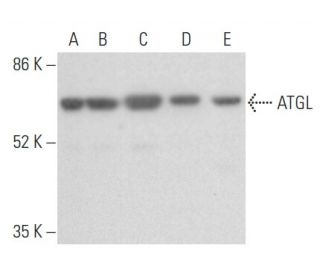
ATGL Antibody (F-7): sc-365278
- ATGL Antibody (F-7) is a mouse monoclonal IgG1 κ ATGL antibody, cited in 44 publications, provided at 200 µg/ml
- raised against amino acids 361-504 mapping at the C-terminus of ATGL of human origin
- ATGL Antibody (F-7) is recommended for detection of ATGL of mouse, rat and human origin by WB, IP, IF and ELISA
- Anti-ATGL Antibody (F-7) is available conjugated to agarose for IP; HRP for WB, IHC(P) and ELISA; and to either phycoerythrin or FITC for IF, IHC(P) and FCM
- also available conjugated to Alexa Fluor® 488, Alexa Fluor® 546, Alexa Fluor® 594 or Alexa Fluor® 647 for WB (RGB), IF, IHC(P) and FCM, and for use with RGB fluorescent imaging systems, such as iBright™ FL1000, FluorChem™, Typhoon, Azure and other comparable systems
- also available conjugated to Alexa Fluor® 680 or Alexa Fluor® 790 for WB (NIR), IF and FCM; for use with Near-Infrared (NIR) detection systems, such as LI-COR®Odyssey®, iBright™ FL1000, FluorChem™, Typhoon, Azure and other comparable systems
- m-IgGκ BP-HRP is the preferred secondary detection reagent for ATGL Antibody (F-7) for WB applications. This reagent is now offered in a bundle with ATGL Antibody (F-7) (see ordering information below). For additional m-IgGκ BP conjugates see our complete list of Mouse IgG Binding Proteins.

QUICK LINKS
SEE ALSO...
ATGL Antibody (F-7) is a mouse monoclonal IgG1 kappa light chain antibody that detects ATGL protein of mouse, rat, and human origin by western blotting (WB), immunoprecipitation (IP), immunofluorescence (IF), and enzyme-linked immunosorbent assay (ELISA). anti-ATGL antibody (F-7) is available in both non-conjugated and various conjugated forms, including agarose, horseradish peroxidase (HRP), phycoerythrin (PE), fluorescein isothiocyanate (FITC), and multiple Alexa Fluor® conjugates. ATGL, also known as adipose triglyceride lipase or patatin-like phospholipase domain-containing protein 2 (PNPLA2), plays a crucial role in lipid metabolism by catalyzing the hydrolysis of stored triglycerides in adipose tissue, thus facilitating the mobilization of fatty acids for energy production. This process is particularly important in energy homeostasis and metabolic regulation, as ATGL activity is tightly regulated by hormonal signals, such as insulin, which inversely modulates the expression of ATGL and adiponutrin (ADPN). ATGL consists of 486 amino acids and features a highly conserved N-terminal patatin domain, which is essential for lipase activity, along with a glycine-rich region and specific active site motifs that are critical for enzymatic function. Understanding ATGL dynamics and regulatory mechanisms is vital for elucidating the pathophysiology of metabolic disorders, including obesity and diabetes, where dysregulation of lipid metabolism is a key factor.
Alexa Fluor® is a trademark of Molecular Probes Inc., OR., USA
LI-COR® and Odyssey® are registered trademarks of LI-COR Biosciences
ATGL Antibody (F-7) References:
- Fat mobilization in adipose tissue is promoted by adipose triglyceride lipase. | Zimmermann, R., et al. 2004. Science. 306: 1383-6. PMID: 15550674
- Expression, regulation, and triglyceride hydrolase activity of Adiponutrin family members. | Lake, AC., et al. 2005. J Lipid Res. 46: 2477-87. PMID: 16150821
- ATGL-mediated fat catabolism regulates cardiac mitochondrial function via PPAR-α and PGC-1. | Haemmerle, G., et al. 2011. Nat Med. 17: 1076-85. PMID: 21857651
- ATGL Promotes Autophagy/Lipophagy via SIRT1 to Control Hepatic Lipid Droplet Catabolism. | Sathyanarayan, A., et al. 2017. Cell Rep. 19: 1-9. PMID: 28380348
- ATGL-dependent white adipose tissue lipolysis controls hepatocyte PPARα activity. | Fougerat, A., et al. 2022. Cell Rep. 39: 110910. PMID: 35675775
- ATGL is a biosynthetic enzyme for fatty acid esters of hydroxy fatty acids. | Patel, R., et al. 2022. Nature. 606: 968-975. PMID: 35676490
- Blocking Lipid Uptake Pathways Does not Prevent Toxicity in Adipose Triglyceride Lipase (ATGL) Deficiency. | Oluwadare, J., et al. 2022. J Lipid Res. 63: 100274. PMID: 36115595
Ordering Information
| Product Name | Catalog # | UNIT | Price | Qty | FAVORITES | |
ATGL Antibody (F-7) | sc-365278 | 200 µg/ml | $322.00 | |||
ATGL Antibody (F-7): m-IgGκ BP-HRP Bundle | sc-522189 | 200 µg Ab, 40 µg BP | $361.00 | |||
ATGL Antibody (F-7) AC | sc-365278 AC | 500 µg/ml, 25% agarose | $424.00 | |||
ATGL Antibody (F-7) HRP | sc-365278 HRP | 200 µg/ml | $322.00 | |||
ATGL Antibody (F-7) FITC | sc-365278 FITC | 200 µg/ml | $336.00 | |||
ATGL Antibody (F-7) PE | sc-365278 PE | 200 µg/ml | $349.00 | |||
ATGL Antibody (F-7) Alexa Fluor® 488 | sc-365278 AF488 | 200 µg/ml | $364.00 | |||
ATGL Antibody (F-7) Alexa Fluor® 546 | sc-365278 AF546 | 200 µg/ml | $364.00 | |||
ATGL Antibody (F-7) Alexa Fluor® 594 | sc-365278 AF594 | 200 µg/ml | $364.00 | |||
ATGL Antibody (F-7) Alexa Fluor® 647 | sc-365278 AF647 | 200 µg/ml | $364.00 | |||
ATGL Antibody (F-7) Alexa Fluor® 680 | sc-365278 AF680 | 200 µg/ml | $364.00 | |||
ATGL Antibody (F-7) Alexa Fluor® 790 | sc-365278 AF790 | 200 µg/ml | $364.00 |