
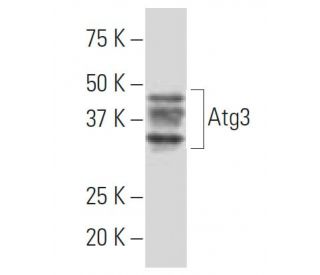

Atg3 Antibody (AA6): sc-100508
- Atg3 Antibody (AA6) is a mouse monoclonal IgG2b κ, cited in 3 publications, provided at 100 µg/ml
- raised against recombinant Atg3 of human origin
- recommended for detection of Atg3 of mouse, rat and human origin by WB, IP and ELISA
- At present, we have not yet completed the identification of the preferred secondary detection reagent(s) for Atg3 Antibody (AA6). This work is in progress.

Atg3 Antibody (AA6) is a mouse monoclonal IgG2b antibody that detects Atg3 in mouse, rat, and human samples through applications such as western blotting (WB), immunoprecipitation (IP), and enzyme-linked immunosorbent assay (ELISA). Atg3, also known as autophagy-related protein 3, plays a crucial role in the autophagy process by catalyzing the formation of the Atg8-phosphatidylethanolamine (Atg8-PE) conjugate, which is essential for the degradation of cellular components and organelles. Atg3 is predominantly expressed in tissues such as the kidney, placenta, liver, heart, and skeletal muscle, highlighting its importance in various physiological processes. The enzymatic activity of Atg3 is initiated by the removal of the C-terminal arginine residue of Atg8 by Atg4, a cysteine protease, which exposes a glycine residue that is subsequently activated by Atg7. The activated glycine is then transferred to Atg3, where conjugation to phosphatidylethanolamine (PE) occurs. Notably, the presence of the Atg12-Atg5 conjugate can enhance this final step, functioning similarly to an E3 enzyme, thereby underscoring the intricate regulatory mechanisms involved in autophagy. Anti-Atg3 antibody (AA6) serves as an invaluable tool for researchers studying autophagy and its implications in various diseases.
Alexa Fluor® is a trademark of Molecular Probes Inc., OR., USA
LI-COR® and Odyssey® are registered trademarks of LI-COR Biosciences
Atg3 Antibody (AA6) References:
- ATG12-ATG3 interacts with Alix to promote basal autophagic flux and late endosome function. | Murrow, L., et al. 2015. Nat Cell Biol. 17: 300-10. PMID: 25686249
- ATG12-ATG3 connects basal autophagy and late endosome function. | Murrow, L. and Debnath, J. 2015. Autophagy. 11: 961-2. PMID: 25998418
- Atg3 Overexpression Enhances Bortezomib-Induced Cell Death in SKM-1 Cell. | Zhuang, L., et al. 2016. PLoS One. 11: e0158761. PMID: 27391105
- Allosteric regulation through a switch element in the autophagy E2, Atg3. | Qiu, Y., et al. 2020. Autophagy. 16: 183-184. PMID: 31690182
- ATG3, a Target of miR-431-5p, Promotes Proliferation and Invasion of Colon Cancer via Promoting Autophagy. | Huang, W., et al. 2019. Cancer Manag Res. 11: 10275-10285. PMID: 31849517
- Multiple structural rearrangements mediated by high-plasticity regions in Atg3 are key for efficient conjugation of Atg8 to PE during autophagy. | Popelka, H. and Klionsky, DJ. 2021. Autophagy. 17: 1805-1808. PMID: 34338142
- Inhibition of ATG3 ameliorates liver steatosis by increasing mitochondrial function. | da Silva Lima, N., et al. 2022. J Hepatol. 76: 11-24. PMID: 34555423
- A novel long noncoding RNA SP100-AS1 induces radioresistance of colorectal cancer via sponging miR-622 and stabilizing ATG3. | Zhou, Y., et al. 2023. Cell Death Differ. 30: 111-124. PMID: 35978049
- Unique amphipathic α helix drives membrane insertion and enzymatic activity of ATG3. | Nishimura, T., et al. 2023. Sci Adv. 9: eadh1281. PMID: 37352354
- Multifaceted membrane interactions of human Atg3 promote LC3-phosphatidylethanolamine conjugation during autophagy. | Ye, Y., et al. 2023. Nat Commun. 14: 5503. PMID: 37679347
Ordering Information
| Product Name | Catalog # | UNIT | Price | Qty | FAVORITES | |
Atg3 Antibody (AA6) | sc-100508 | 100 µg/ml | $339.00 |