
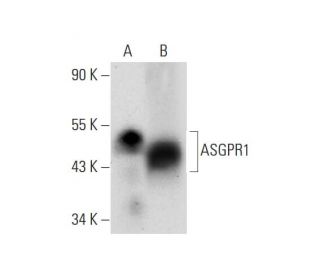
Nicht CRISPR-Daten: Das Bild veranschaulicht die Qualität von Antikörpern zur Visualisierung von CRISPR-Experimentergebnissen.
Nicht CRISPR-Daten: Das Bild veranschaulicht die Qualität von Antikörpern zur Visualisierung von CRISPR-Experimentergebnissen.
ASGPR1/Asialoglycoprotein Receptor 1/ASGR1 CRISPR/Cas9 KO Plasmid (h): sc-400429
- Zielspezies: human
- 20 µg transfektionsfertige, aufgereinigte Plasmid DNA; geeignet für 20 Transfektionen
- ASGPR1/Asialoglycoprotein Receptor 1/ASGR1 Das CRISPR/Cas9-Knockout (KO)-Plasmid (h) ist ein Pool von Plasmiden, von denen jedes für die Cas9-Nuklease und eine zielspezifische 20-nt-Guide-RNA (gRNA) kodiert, die für maximale Knockout-Effizienz unter Verwendung von Sequenzen aus der GeCKO v2-Bibliothek entwickelt wurde
- gRNA-Sequenzen lenken Cas9 so, dass es ortsspezifische Doppelstrangbrüche (DSBs) im ASGPR1/Asialoglycoprotein Receptor 1/ASGR1-Genomlokus induziert, was zu einem Gen-Knockout durch nicht-homologe Endverknüpfung (NHEJ) führt
- Die Puromycin-Resistenz- und RFP-Gene werden von LoxP-Stellen flankiert, was die Entfernung der Selektionsmarker mittels Cre-Rekombinase (Cre-Vektor: sc-418923) nach der Etablierung stabiler Knockout-Zelllinien ermöglicht
- Nach der Transfektion kann die Effizienz des Gen-Knockouts per Western Blot oder histologisch mit folgendem Antikörper überprüft werden: ASGPR1/Asialoglycoprotein Receptor 1/ASGR1: sc-393849

Bestellinformation
| Produkt | Katalog # | EINHEIT | Preis | ANZAHL | Favoriten | |
ASGPR1/Asialoglycoprotein Receptor 1/ASGR1 CRISPR/Cas9 KO Plasmid (h) | sc-400429 | 20 µg | $397.00 |
Übersicht
ASGR1 kodiert den Asialoglykoproteinrezeptor 1 (ASGPR1), ein in Hepatozyten stark angereichertes, Ca²⁺-abhängiges Lektin, das an der Plasmamembran den Asialoglykoproteinrezeptor-Komplex bildet und die clathrinabhängige Endozytose desialylierter Glykoproteine vermittelt. Durch die Bindung terminaler Galaktose- oder N‑Acetylgalaktosamin-Reste trägt ASGPR1 zur hepatischen Clearance zirkulierender Glykoproteine bei und beeinflusst Rezeptorrecycling- sowie lysosomale Transportwege. Dieses Rezeptor-Ligand-System wird weithin als Modell zur Untersuchung leberspezifischer Aufnahmemechanismen und der Glykoprotein-Qualitätskontrolle genutzt. Veränderte ASGPR1-Expression oder -Funktion wurde im Kontext metabolischer und entzündlicher Leberzustände untersucht und ist relevant für Studien zur Regulation von Oberflächenrezeptoren in Hepatozyten und zur endozytotischen Kapazität.
Das ASGPR1/Asialoglycoprotein Receptor 1/ASGR1 CRISPR/Cas9-KO-Plasmid (h) ist ein Pool von Plasmiden, die für die gezielte Disruption des ASGR1-Gens in human-Zelllinien entwickelt wurden. Jedes Plasmid koexprimiert eine einzigartige Single-Guide-RNA (sgRNA), die auf eine bestimmte Stelle innerhalb des ASGR1-Gens abzielt, zusammen mit der Streptococcus pyogenes Cas9-Nuklease. Die Plasmide kodieren zudem für GFP, was die fluoreszente Identifizierung und Anreicherung erfolgreich transfizierter Zellen mittels Fluoreszenzmikroskopie oder Durchflusszytometrie ermöglicht.
Das Multi-Guide-Design erhöht die Wahrscheinlichkeit, dass Insertionen oder Deletionen (Indels) entstehen, die den offenen Leserahmen von ASGR1 nach der Cas9-vermittelten Bildung von Doppelstrangbrüchen unterbrechen. Durch das CRISPR/Cas9-System verursachte DNA-Brüche werden über endogene NHEJ-Wege (Non-Homologous End Joining) repariert, was häufig zu Frameshift-Mutationen führt, die die ASGPR1/Asialoglycoprotein Receptor 1/ASGR1-Proteinexpression aufheben.
Dieses CRISPR-Knockout-System ermöglicht die effiziente Erzeugung von ASGR1-defizienten Zellmodellen zur Untersuchung der ASGPR1/Asialoglycoprotein Receptor 1/ASGR1-Signalübertragung, für funktionelle Genomstudien, in der Krebsbiologieforschung sowie zur Bewertung therapeutischer Reaktionen in menschlichen Zelllinien.
Hauptmerkmale
- sgRNAs, die auf ASGR1-Exone abzielen, die für die ASGPR1/Asialoglycoprotein Receptor 1/ASGR1-Funktion entscheidend sind
Ko-Expression von SpCas9 und sgRNA aus einem einzigen Plasmid zur vereinfachten Verabreichung
GFP-Reporter zur Identifizierung transfizierter Zellen
Pool von Plasmiden, die auf mehrere ASGR1-Genomstellen abzielen, um die Knockout-Effizienz zu verbessern
Kompatibel mit der Verabreichung durch Transfektion
Designvarianten
CRISPRs +/- HDRs
- gRNAs, die vom ASGPR1/Asialoglycoprotein Receptor 1/ASGR1 CRISPR/Cas9-KO-Plasmid (h) und vom ASGPR1/Asialoglycoprotein Receptor 1/ASGR1 CRISPR/Cas9-KO-Plasmid (h2) kodiert werden, zielen auf unterschiedliche Stellen innerhalb des ASGR1-Lokus ab. Es kann ein oder beide Targeting-Designs verfügbar sein. Siehe „Verwandte Produkte“ für Verfügbarkeit.
HDR-Donorkonstrukte, kodiert durch das ASGPR1/Asialoglycoprotein Receptor 1/ASGR1 HDR-Plasmid (h) und ASGPR1/Asialoglycoprotein Receptor 1/ASGR1 HDR-Plasmid (h2) kodiert, enthalten eine Puromycin-Resistenzkassette und einen RFP-Reporter, flankiert von ASGR1-Homologiearmen, um die homologe Reparatur an definierten ASGR1-Zielstellen entsprechend den CRISPR/Cas9-KO-Designs zu unterstützen. Die Verfügbarkeit von HDR-Donoren kann variieren. Siehe „Verwandte Produkte“ für Verfügbarkeit.
Nur für Forschungszwecke. Nicht für diagnostische oder therapeutische Zwecke bestimmt.