
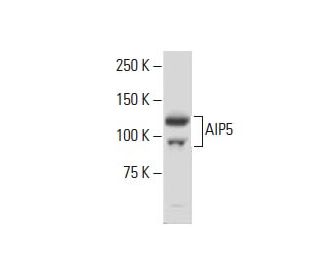


AIP5 Antibody (5AA): sc-100679
- AIP5 Antibody (5AA) is a mouse monoclonal IgG2a κ, cited in 4 publications, provided at 100 µg/ml
- raised against recombinant AIP5 of human origin
- recommended for detection of AIP5 of mouse, rat and human origin by WB, IP, IF, IHC(P) and ELISA
- At present, we have not yet completed the identification of the preferred secondary detection reagent(s) for AIP5 Antibody (5AA). This work is in progress.

QUICK LINKS
AIP5 Antibody (5AA) is a mouse monoclonal IgG2a antibody that detects AIP5 in mouse, rat, and human samples through various applications including western blotting (WB), immunoprecipitation (IP), immunofluorescence (IF), immunohistochemistry with paraffin-embedded sections (IHCP), and enzyme-linked immunosorbent assay (ELISA). AIP5, also known as WWP1, is a member of the atrophin interacting protein family and functions as an E3 ubiquitin ligase. AIP5 is primarily located in the cytoplasm, where AIP5 regulates protein degradation pathways essential for maintaining cellular homeostasis and stress response. AIP5′s ability to modulate target protein stability through ubiquitination is vital for various cellular functions, including signal transduction and cell cycle regulation. Dysregulation of AIP5 has been implicated in several neurodegenerative diseases, highlighting AIP5′s importance in both normal physiology and disease states. Anti-AIP5 antibody (5AA) provides a reliable tool for researchers exploring AIP5′s functional dynamics and interactions within the cellular environment.
Alexa Fluor® is a trademark of Molecular Probes Inc., OR., USA
LI-COR® and Odyssey® are registered trademarks of LI-COR Biosciences
AIP5 Antibody (5AA) References:
- Conformational flexibility underlies ubiquitin ligation mediated by the WWP1 HECT domain E3 ligase. | Verdecia, MA., et al. 2003. Mol Cell. 11: 249-59. PMID: 12535537
- Endogenous spartin (SPG20) is recruited to endosomes and lipid droplets and interacts with the ubiquitin E3 ligases AIP4 and AIP5. | Edwards, TL., et al. 2009. Biochem J. 423: 31-9. PMID: 19580544
- SPG20 protein spartin is recruited to midbodies by ESCRT-III protein Ist1 and participates in cytokinesis. | Renvoisé, B., et al. 2010. Mol Biol Cell. 21: 3293-303. PMID: 20719964
- Gene methylation in gastric cancer. | Qu, Y., et al. 2013. Clin Chim Acta. 424: 53-65. PMID: 23669186
- Feedback regulation of telomerase reverse transcriptase: new insight into the evolving field of telomerase in cancer. | Wu, XQ., et al. 2013. Cell Signal. 25: 2462-8. PMID: 23993966
- A nanotechnological, molecular-modeling, and immunological approach to study the interaction of the anti-tumorigenic peptide p28 with the p53 family of proteins. | Coppari, E., et al. 2014. Int J Nanomedicine. 9: 1799-813. PMID: 24748790
- Thr160 of Axin1 is critical for the formation and function of the β-catenin destruction complex. | Koyama-Nasu, R., et al. 2015. Biochem Biophys Res Commun. 459: 411-5. PMID: 25735981
- Polarisome scaffolder Spa2-mediated macromolecular condensation of Aip5 for actin polymerization. | Xie, Y., et al. 2019. Nat Commun. 10: 5078. PMID: 31699995
- FBXO5-mediated RNF183 degradation prevents endoplasmic reticulum stress-induced apoptosis and promotes colon cancer progression. | Ji, J., et al. 2024. Cell Death Dis. 15: 33. PMID: 38212299
- Atrophin-1, the DRPLA gene product, interacts with two families of WW domain-containing proteins. | Wood, JD., et al. 1998. Mol Cell Neurosci. 11: 149-60. PMID: 9647693
Ordering Information
| Product Name | Catalog # | UNIT | Price | Qty | FAVORITES | |
AIP5 Antibody (5AA) | sc-100679 | 100 µg/ml | $339.00 |