
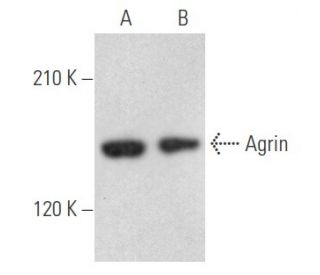
Agrin Antibody (D-2): sc-374117
- Agrin Antibody (D-2) is a mouse monoclonal IgM κ Agrin antibody, cited in 12 publications, provided at 200 µg/ml
- specific for an epitope mapping between amino acids 1913-1942 near the C-terminus of Agrin of rat origin
- recommended for detection of Agrin of mouse, rat and human origin by WB, IP, IF, IHC(P) and ELISA; also reactive with additional species, including and equine, canine and bovine
- available conjugated to agarose for IP; HRP for WB, IHC(P) and ELISA; phycoerythrin, FITC, Alexa Fluor® 488 or Alexa Fluor® 647 for IF, IHC(P) and FCM
- m-IgGκ BP-HRP is the preferred secondary detection reagent for Agrin Antibody (D-2) for WB and IHC(P) applications. This reagent is now offered in a bundle with Agrin Antibody (D-2) (see ordering information below). For additional m-IgGκ BP conjugates see our complete list of Mouse IgG Binding Proteins.

QUICK LINKS
SEE ALSO...
Agrin Antibody (D-2) is a mouse monoclonal IgM antibody that detects Agrin protein of mouse, rat, and human origin by western blotting (WB), immunoprecipitation (IP), immunofluorescence (IF), immunohistochemistry, and enzyme-linked immunosorbent assay (ELISA). Anti-Agrin antibody (D-2) is available in both non-conjugated and various conjugated forms, including agarose, horseradish peroxidase (HRP), phycoerythrin (PE), fluorescein isothiocyanate (FITC), and multiple Alexa Fluor® conjugates. Agrin plays a crucial role in the neuromuscular junction by facilitating the clustering of acetylcholine receptors (AChRs) on the muscle cell surface, which is essential for effective synaptic transmission and muscle contraction. This clustering is vital for the formation and maintenance of the neuromuscular junction, ensuring that signals from motor neurons are efficiently transmitted to muscle fibers. Agrin is primarily located in the basal lamina of muscle cells, where Agrin interacts with other proteins to orchestrate the assembly of the postsynaptic apparatus. Notably, Agrin exists in several splice variants, with specific forms exhibiting a high affinity for AChRs, which underscores the importance of post-translational modifications in regulating Agrin function. Additionally, the interaction between Agrin and the receptor tyrosine kinase MuSK is critical for the signaling pathways that lead to AChR aggregation, highlighting the intricate molecular mechanisms that govern neuromuscular junction formation and stability.
Alexa Fluor® is a trademark of Molecular Probes Inc., OR., USA
LI-COR® and Odyssey® are registered trademarks of LI-COR Biosciences
Agrin Antibody (D-2) References:
- The extracellular matrix protein agrin promotes heart regeneration in mice. | Bassat, E., et al. 2017. Nature. 547: 179-184. PMID: 28581497
- Structural insights into the assembly of the agrin/LRP4/MuSK signaling complex. | Xie, T., et al. 2023. Proc Natl Acad Sci U S A. 120: e2300453120. PMID: 37252960
- Deficiency of skeletal muscle Agrin contributes to the pathogenesis of age-related sarcopenia in mice. | Chen, J., et al. 2024. Cell Death Dis. 15: 201. PMID: 38461287
- Agrin-Lrp4 pathway in hippocampal astrocytes restrains development of temporal lobe epilepsy through adenosine signaling. | Liu, ZY., et al. 2024. Cell Biosci. 14: 66. PMID: 38783336
- Agrin-induced acetylcholine receptor clustering in mammalian muscle requires tyrosine phosphorylation. | Ferns, M., et al. 1996. J Cell Biol. 132: 937-44. PMID: 8603924
- Alternative splicing of agrin alters its binding to heparin, dystroglycan, and the putative agrin receptor. | Gesemann, M., et al. 1996. Neuron. 16: 755-67. PMID: 8607994
- Agrin binding to alpha-dystroglycan. Domains of agrin necessary to induce acetylcholine receptor clustering are overlapping but not identical to the alpha-dystroglycan-binding region. | Hopf, C. and Hoch, W. 1996. J Biol Chem. 271: 5231-6. PMID: 8617807
- Agrin signals at the junction. | Slater, CR. 1996. Nature. 381: 478-9. PMID: 8632818
- Agrin acts via a MuSK receptor complex. | Glass, DJ., et al. 1996. Cell. 85: 513-23. PMID: 8653787
- Defective neuromuscular synaptogenesis in agrin-deficient mutant mice. | Gautam, M., et al. 1996. Cell. 85: 525-35. PMID: 8653788
- Neural agrin activates a high-affinity receptor in C2 muscle cells that is unresponsive to muscle agrin. | Bowen, DC., et al. 1996. J Neurosci. 16: 3791-7. PMID: 8656273
- Alternative splicing of agrin regulates its binding to heparin alpha-dystroglycan, and the cell surface. | O'Toole, JJ., et al. 1996. Proc Natl Acad Sci U S A. 93: 7369-74. PMID: 8693000
Ordering Information
| Product Name | Catalog # | UNIT | Price | Qty | FAVORITES | |
Agrin Antibody (D-2) | sc-374117 | 200 µg/ml | $322.00 | |||
Agrin Antibody (D-2): m-IgGκ BP-HRP Bundle | sc-552385 | 200 µg Ab; 40 µg BP | $361.00 | |||
Agrin Antibody (D-2) AC | sc-374117 AC | 500 µg/ml, 25% agarose | $424.00 | |||
Agrin Antibody (D-2) Alexa Fluor® 488 | sc-374117 AF488 | 200 µg/ml | $364.00 | |||
Agrin Antibody (D-2) Alexa Fluor® 647 | sc-374117 AF647 | 200 µg/ml | $364.00 | |||
Agrin Antibody (D-2) FITC | sc-374117 FITC | 200 µg/ml | $336.00 | |||
Agrin Antibody (D-2) HRP | sc-374117 HRP | 200 µg/ml | $322.00 | |||
Agrin (D-2) Neutralizing Peptide | sc-374117 P | 100 µg/0.5 ml | $69.00 | |||
Agrin Antibody (D-2) PE | sc-374117 PE | 200 µg/ml | $349.00 |