
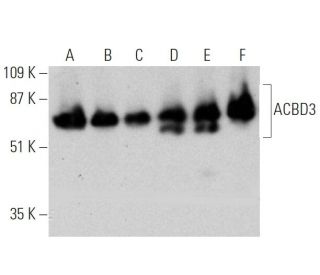
ACBD3 Antibody (518): sc-101277
- ACBD3 Antibody (518) is a mouse monoclonal IgG1 κ ACBD3 antibody, cited in 15 publications, provided at 100 µg/ml
- raised against amino acids 73-172 representing a partial length of ACBD3 of human origin
- recommended for detection of ACBD3 of mouse, rat and human origin by WB, IP, IF, IHC(P) and ELISA
- m-IgG Fc BP-HRP and m-IgG1 BP-HRP are the preferred secondary detection reagents for ACBD3 Antibody (518) for WB and IHC(P) applications. These reagents are now offered in bundles with ACBD3 Antibody (518) (see ordering information below).

QUICK LINKS
ACBD3 Antibody (518) is a mouse monoclonal IgG1 kappa light chain antibody that detects ACBD3 protein of mouse, rat, and human origin by western blotting (WB), immunoprecipitation (IP), immunofluorescence (IF), immunohistochemistry, and enzyme-linked immunosorbent assay (ELISA). Anti-ACBD3 antibody (518) is available as a non-conjugated format. ACBD3 protein, also known as acyl-CoA-binding domain-containing protein 3, GCP60, GOCAP1, PAP7, or GOLPH1, is a critical Golgi apparatus membrane protein characterized by the presence of one acyl-CoA-binding domain and one GOLD domain, which are essential for protein interactions. ACBD3 is expressed ubiquitously, with highest levels found in ovary and testis, and plays a vital role in maintaining Golgi structure. ACBD3 interacts with Giantin, a member of the golgin subfamily, to facilitate protein transport between Golgi and endoplasmic reticulum, thereby influencing cellular processes. Proper localization and function of ACBD3 are crucial, as alterations in subcellular distribution can initiate signaling cascades within Golgi that regulate cell fate and cycle progression. ACBD3 functions as a peripheral-type benzodiazepine receptor-associated protein, potentially impacting hormonal regulation and steroidogenesis, making ACBD3 an important target for research in cellular signaling and metabolism.
Alexa Fluor® is a trademark of Molecular Probes Inc., OR., USA
LI-COR® and Odyssey® are registered trademarks of LI-COR Biosciences
ACBD3 Antibody (518) References:
- Identification and characterization of a novel Golgi protein, GCP60, that interacts with the integral membrane protein giantin. | Sohda, M., et al. 2001. J Biol Chem. 276: 45298-306. PMID: 11590181
- Identification, localization, and function in steroidogenesis of PAP7: a peripheral-type benzodiazepine receptor- and PKA (RIalpha)-associated protein. | Li, H., et al. 2001. Mol Endocrinol. 15: 2211-28. PMID: 11731621
- Molecular cloning, genomic organization, chromosomal mapping and subcellular localization of mouse PAP7: a PBR and PKA-RIalpha associated protein. | Liu, J., et al. 2003. Gene. 308: 1-10. PMID: 12711385
- GCP60 preferentially interacts with a caspase-generated golgin-160 fragment. | Sbodio, JI., et al. 2006. J Biol Chem. 281: 27924-31. PMID: 16870622
- NMDA receptor-nitric oxide transmission mediates neuronal iron homeostasis via the GTPase Dexras1. | Cheah, JH., et al. 2006. Neuron. 51: 431-40. PMID: 16908409
- The mammalian Golgi regulates numb signaling in asymmetric cell division by releasing ACBD3 during mitosis. | Zhou, Y., et al. 2007. Cell. 129: 163-78. PMID: 17418793
- Identification of a redox-sensitive cysteine in GCP60 that regulates its interaction with golgin-160. | Sbodio, JI. and Machamer, CE. 2007. J Biol Chem. 282: 29874-81. PMID: 17711851
- ACBD3 is required for FAPP2 transferring glucosylceramide through maintaining the Golgi integrity. | Liao, J., et al. 2019. J Mol Cell Biol. 11: 107-117. PMID: 29750412
- Acyl-CoA-Binding Domain-Containing 3 (ACBD3; PAP7; GCP60): A Multi-Functional Membrane Domain Organizer. | Yue, X., et al. 2019. Int J Mol Sci. 20: PMID: 31022988
- ACBD3 modulates KDEL receptor interaction with PKA for its trafficking via tubulovesicular carrier. | Yue, X., et al. 2021. BMC Biol. 19: 194. PMID: 34493279
- ACBD3 Bioinformatic Analysis and Protein Expression in Breast Cancer Cells. | Houghton-Gisby, J., et al. 2022. Int J Mol Sci. 23: PMID: 36012147
- An A-kinase anchoring protein (ACBD3) coordinates traffic-induced PKA activation at the Golgi. | Jia, J., et al. 2023. J Biol Chem. 299: 104696. PMID: 37044218
Ordering Information
| Product Name | Catalog # | UNIT | Price | Qty | FAVORITES | |
ACBD3 Antibody (518) | sc-101277 | 100 µg/ml | $339.00 | |||
ACBD3 Antibody (518): m-IgG Fc BP-HRP Bundle | sc-539747 | 100 µg Ab; 10 µg BP | $361.00 | |||
ACBD3 Antibody (518): m-IgG1 BP-HRP Bundle | sc-541682 | 100 µg Ab; 20 µg BP | $361.00 |