
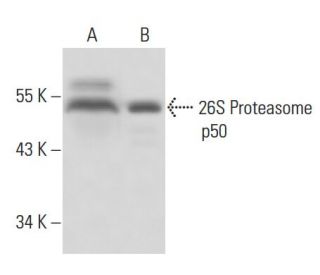

26S Proteasome p50 Antibody (112): sc-65745
- 26S Proteasome p50 Antibody (112) is a mouse monoclonal IgG2b 26S Proteasome p50 antibody, cited in 2 publications, provided at 200 µg/ml
- raised against 26S Proteasome purified from embryos of Drosophila melanogaster origin
- 26S Proteasome p50 Antibody (112) is recommended for detection of p50 subunit of the 19S regulatory base complex of the 26S Proteasome of d origin by WB and IP
- Anti-26S Proteasome p50 Antibody (112) is available conjugated to agarose for IP; HRP for WB, IHC(P) and ELISA; and to either phycoerythrin or FITC for IF, IHC(P) and FCM
- also available conjugated to Alexa Fluor® 488, Alexa Fluor® 546, Alexa Fluor® 594 or Alexa Fluor® 647 for WB (RGB), IF, IHC(P) and FCM, and for use with RGB fluorescent imaging systems, such as iBright™ FL1000, FluorChem™, Typhoon, Azure and other comparable systems
- also available conjugated to Alexa Fluor® 680 or Alexa Fluor® 790 for WB (NIR), IF and FCM; for use with Near-Infrared (NIR) detection systems, such as LI-COR®Odyssey®, iBright™ FL1000, FluorChem™, Typhoon, Azure and other comparable systems
- At present, we have not yet completed the identification of the preferred secondary detection reagent(s) for 26S Proteasome p50 Antibody (112). This work is in progress.

QUICK LINKS
SEE ALSO...
26S Proteasome p50 Antibody (112) is a mouse monoclonal IgG2b antibody that detects 26S Proteasome p50 protein of Drosophila melanogaster origin by western blotting (WB) and immunoprecipitation (IP). Anti-26S Proteasome p50 antibody (112) is available in both non-conjugated and various conjugated forms, including agarose, horseradish peroxidase (HRP), phycoerythrin (PE), fluorescein isothiocyanate (FITC), and multiple Alexa Fluor® conjugates. 26S proteasome is a crucial multi-subunit complex responsible for degrading ubiquitinated proteins, which maintains cellular homeostasis and regulates various biological processes such as cell cycle, apoptosis, and responses to oxidative stress. 26S proteasome p50, also known as Rpt5 in yeast and S6′ in humans, is one of six ATPase base subunits of 19S regulatory complex, which plays a pivotal role in recognizing ubiquitinated substrates, removing ubiquitin chains, and facilitating protein translocation into 20S core for degradation. This interaction is vital for proteolytic signal recognition, ensuring damaged or misfolded proteins are efficiently processed, preventing potential cellular dysfunction. Assembly of 26S proteasome is ATP-dependent, and due to large size, can disassociate into subcomplexes, including 20S core and two 19S regulatory complexes, highlighting dynamic nature of this essential proteolytic machinery.
Alexa Fluor® is a trademark of Molecular Probes Inc., OR., USA
LI-COR® and Odyssey® are registered trademarks of LI-COR Biosciences
26S Proteasome p50 Antibody (112) References:
- Assembly of the Drosophila 26 S proteasome is accompanied by extensive subunit rearrangements. | Kurucz, E., et al. 2002. Biochem J. 365: 527-36. PMID: 11945175
- A proteasomal ATPase subunit recognizes the polyubiquitin degradation signal. | Lam, YA., et al. 2002. Nature. 416: 763-7. PMID: 11961560
- The HALTED ROOT gene encoding the 26S proteasome subunit RPT2a is essential for the maintenance of Arabidopsis meristems. | Ueda, M., et al. 2004. Development. 131: 2101-11. PMID: 15073153
- ATP hydrolysis-dependent disassembly of the 26S proteasome is part of the catalytic cycle. | Babbitt, SE., et al. 2005. Cell. 121: 553-565. PMID: 15907469
- The proteasome regulatory particle alters the SAGA coactivator to enhance its interactions with transcriptional activators. | Lee, D., et al. 2005. Cell. 123: 423-36. PMID: 16269334
- The proteasome restricts permissive transcription at tissue-specific gene loci in embryonic stem cells. | Szutorisz, H., et al. 2006. Cell. 127: 1375-88. PMID: 17190601
- Mass spectrometric characterization of the affinity-purified human 26S proteasome complex. | Wang, X., et al. 2007. Biochemistry. 46: 3553-65. PMID: 17323924
- Aging perturbs 26S proteasome assembly in Drosophila melanogaster. | Vernace, VA., et al. 2007. FASEB J. 21: 2672-82. PMID: 17413001
- Rpn13p and Rpn14p are involved in the recognition of ubiquitinated Gcn4p by the 26S proteasome. | Seong, KM., et al. 2007. FEBS Lett. 581: 2567-73. PMID: 17499717
- Prognostic Implication and Immunological Role of PSMD2 in Lung Adenocarcinoma. | Zhao, H. and Lu, G. 2022. Front Genet. 13: 905581. PMID: 35754829
- PSMD2 promotes the progression of bladder cancer and is correlated with immune infiltration. | Wang, S., et al. 2022. Front Oncol. 12: 1058506. PMID: 36505799
- PSMD2 contributes to the progression of esophageal squamous cell carcinoma by repressing autophagy. | Liu, Y., et al. 2023. Cell Biosci. 13: 67. PMID: 36998052
Ordering Information
| Product Name | Catalog # | UNIT | Price | Qty | FAVORITES | |
26S Proteasome p50 Antibody (112) | sc-65745 | 200 µg/ml | $322.00 | |||
26S Proteasome p50 Antibody (112) AC | sc-65745 AC | 500 µg/ml, 25% agarose | $424.00 | |||
26S Proteasome p50 Antibody (112) HRP | sc-65745 HRP | 200 µg/ml | $322.00 | |||
26S Proteasome p50 Antibody (112) FITC | sc-65745 FITC | 200 µg/ml | $336.00 | |||
26S Proteasome p50 Antibody (112) PE | sc-65745 PE | 200 µg/ml | $349.00 | |||
26S Proteasome p50 Antibody (112) Alexa Fluor® 488 | sc-65745 AF488 | 200 µg/ml | $364.00 | |||
26S Proteasome p50 Antibody (112) Alexa Fluor® 546 | sc-65745 AF546 | 200 µg/ml | $364.00 | |||
26S Proteasome p50 Antibody (112) Alexa Fluor® 594 | sc-65745 AF594 | 200 µg/ml | $364.00 | |||
26S Proteasome p50 Antibody (112) Alexa Fluor® 647 | sc-65745 AF647 | 200 µg/ml | $364.00 | |||
26S Proteasome p50 Antibody (112) Alexa Fluor® 680 | sc-65745 AF680 | 200 µg/ml | $364.00 | |||
26S Proteasome p50 Antibody (112) Alexa Fluor® 790 | sc-65745 AF790 | 200 µg/ml | $364.00 |