
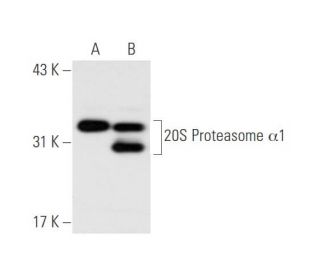

20S Proteasome α1 (h2): 293T Lysate: sc-112756
- human 20S Proteasome α1 transfected 293T lysate
- 100 µg protein in 200 µl SDS-PAGE buffer; suitable as Western Blotting control for 20S Proteasome α1 antibodies
- Suitable control antibody: 20S Proteasome α1 Antibody (C-7): sc-166073 is recommended as control antibody for monitoring of 20S Proteasome α1 expression knockdown by Western blotting or immunofluorescence
- should be stored at -20° C and repeated freezing and thawing should be minimized
- sample vial should be boiled once prior to use
- non-transfected control 293T lysate (sc-117752)

QUICK LINKS
The 20S Proteasome α1 (h2): 293T Lysate is derived from the 293T cell line, a human embryonic kidney cell line modified to express the SV40 large T antigen, which enhances its transfection efficiency and protein expression capabilities. This lysate is specifically enriched with the 20S proteasome α1 subunit, a critical component of the proteasome complex involved in degrading damaged or unneeded proteins via the ubiquitin-proteasome pathway. The 20S proteasome is essential for maintaining cellular homeostasis by regulating protein turnover and quality control. In research, the 20S Proteasome α1 (h2): 293T Lysate is utilized to investigate the mechanisms of protein degradation and the regulatory functions of the proteasome complex. This lysate is valuable in studying the proteolytic activity of the 20S proteasome and its role in various cellular processes, such as cell cycle regulation, signal transduction, and stress responses. Researchers use this lysate in assays such as Western blotting to detect and quantify the presence of the 20S proteasome α1 subunit and its interacting partners. Additionally, it is employed in co-immunoprecipitation experiments to identify proteins that interact with the proteasome, providing insights into the substrates and cofactors involved in proteasomal degradation. The use of 20S Proteasome α1 (h2): 293T Lysate allows for a detailed examination of the proteasome's function and its regulatory networks, contributing to our understanding of cellular proteostasis. The origin and quality of the 293T cell line are rigorously controlled, ensuring consistent and reproducible results in basic research focused on protein degradation and cellular regulation.
Ordering Information
| Product Name | Catalog # | UNIT | Price | Qty | FAVORITES | |
20S Proteasome α1 (h2): 293T Lysate | sc-112756 | 100 µg/200 µl | $236.00 |