
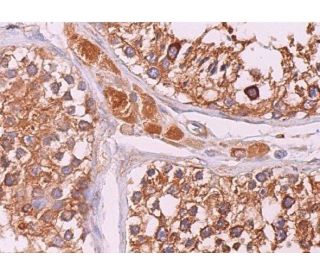
Wnt-1 Antibody (E-10): sc-514531
- Wnt-1 Antibody (E-10) is a mouse monoclonal IgM κ Wnt-1 antibody, cited in 25 publications, provided at 200 µg/ml
- specific for an epitope mapping between amino acids 41-65 at the N-terminus of Wnt-1 of human origin
- recommended for detection of Wnt-1 of mouse, rat and human origin by WB, IP, IF, IHC(P) and ELISA
- m-IgGκ BP-HRP is the preferred secondary detection reagent for Wnt-1 Antibody (E-10) for WB and IHC(P) applications. This reagent is now offered in a bundle with Wnt-1 Antibody (E-10) (see ordering information below). For additional m-IgGκ BP conjugates see our complete list of Mouse IgG Binding Proteins.

Wnt-1 Antibody (E-10) is a mouse monoclonal IgM antibody that detects Wnt-1 of mouse, rat, and human origin by western blotting (WB), immunoprecipitation (IP), immunofluorescence (IF), immunohistochemistry with paraffin-embedded sections (IHCP), and enzyme-linked immunosorbent assay (ELISA). Anti-Wnt-1 antibody (E-10) is available as a non-conjugated format. Wnt-1, a member of the highly conserved Wnt gene family, plays a crucial role in regulating cellular growth and differentiation, making Wnt-1 vital for various developmental processes. Wnt-1 is a cysteine-rich secreted glycoprotein that associates with cell membranes and is essential for normal development of the embryonic nervous system. Wnt-1 expression is typically restricted to the embryonic neural tube and adult spermatids, highlighting Wnt-1′s importance in developmental biology. Aberrant Wnt-1 expression in mammary tissue has been linked to hyperplasia and tumorigenic progression, underscoring Wnt-1′s role in cancer biology. Additionally, Wnt-1 interacts with β-catenin, a key player in cellular adhesion and a downstream target in the Wnt signaling pathway, which further emphasizes Wnt-1′s significance in both normal and pathological processes. Wnt family members, including Wnt-1, interact with other signaling pathways, such as Sonic hedgehog (Shh), to induce myogenesis in somitic tissue, illustrating the complex regulatory networks in which Wnt-1 is involved.
Alexa Fluor® is a trademark of Molecular Probes Inc., OR., USA
LI-COR® and Odyssey® are registered trademarks of LI-COR Biosciences
Wnt-1 Antibody (E-10) References:
- Inhibition by Wnt-1 or Wnt-3a of nerve growth factor-induced differentiation of PC12 cells is reversed by bisindolylmaleimide-I but not by several other PKC inhibitors. | Chou, AH. and Howard, BD. 2002. Oncogene. 21: 6348-55. PMID: 12214275
- Wnt genes. | Nusse, R. and Varmus, HE. 1992. Cell. 69: 1073-87. PMID: 1617723
- Wnt-1 dishevelled signaling functionally links calcium-calmodulin-dependent protein kinase II and cardiac dysfunction. | Lin, J. and Kirshenbaum, LA. 2015. Hypertension. 65: 287-8. PMID: 25489063
- MiR-130a-3p suppresses colorectal cancer growth by targeting Wnt Family Member 1 (WNT1). | Song, GL., et al. 2021. Bioengineered. 12: 8407-8418. PMID: 34657551
- Wnt family member 1 (Wnt1) overexpression-induced M2 polarization of microglia alleviates inflammation-sensitized neonatal brain injuries. | Gao, J., et al. 2022. Bioengineered. 13: 12409-12420. PMID: 35603707
- Association of Membranous WNT-1 and Nuclear mTOR with Endometrial Cancer Grade. | Pietrus, M., et al. 2023. Int J Mol Sci. 24: PMID: 37176048
- Combinatorial signaling by Sonic hedgehog and Wnt family members induces myogenic bHLH gene expression in the somite. | Münsterberg, AE., et al. 1995. Genes Dev. 9: 2911-22. PMID: 7498788
- Biochemical analysis of murine Wnt proteins reveals both shared and distinct properties. | Burrus, LW. and McMahon, AP. 1995. Exp Cell Res. 220: 363-73. PMID: 7556445
- Beta-catenin: a common target for the regulation of cell adhesion by Wnt-1 and Src signaling pathways. | Hinck, L., et al. 1994. Trends Biochem Sci. 19: 538-42. PMID: 7846766
- Differential transformation of mammary epithelial cells by Wnt genes. | Wong, GT., et al. 1994. Mol Cell Biol. 14: 6278-86. PMID: 8065359
- Properties of Wnt-1 protein that enable cell surface association. | Schryver, B., et al. 1996. Oncogene. 13: 333-42. PMID: 8710372
- Regulation of complexed and free catenin pools by distinct mechanisms. Differential effects of Wnt-1 and v-Src. | Papkoff, J. 1997. J Biol Chem. 272: 4536-43. PMID: 9020180
Ordering Information
| Product Name | Catalog # | UNIT | Price | Qty | FAVORITES | |
Wnt-1 Antibody (E-10) | sc-514531 | 200 µg/ml | $322.00 | |||
Wnt-1 Antibody (E-10): m-IgGκ BP-HRP Bundle | sc-551117 | 200 µg Ab; 40 µg BP | $361.00 | |||
Wnt-1 (E-10) Neutralizing Peptide | sc-514531 P | 100 µg/0.5 ml | $69.00 |