
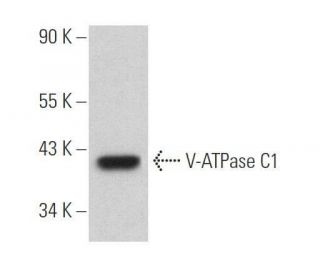
V-ATPase C1 Antibody (C-2): sc-376227. ヒト脳組織抽出液中の V-ATPase C1 発現をウエスタンブロットで解析.
V-ATPase C1抗体(C-2): sc-376227
- V-ATPase C1抗体 (C-2)はマウスモノクローナルIgG2b (kappa light chain)です。200 µg/mlで提供
- human由来のV-ATPase C1の内部領域内のアミノ酸131-169の間に位置するエピトープに特異的
- mouse, rat、humanと avian由来のV-ATPase C1 WB, IP, IF, IHC(P) と ELISAでの検出にはお勧めします; 以下追加動物種との反応性もあります: と equine, canine, bovine, porcine and avian
- 現在、V-ATPase C1 Antibody (C-2)に適した二次検出試薬の同定はまだ完了していません。この研究は進めています。

クイックリンク
サポート品
説明
Gene情報
データシートとプロトコル
研究情報
関連項目
追加のV-ATPase抗体(V-ATPase A1, V-ATPase α 1, V-ATPase B1, V-ATPase B2, V-ATPase C1, V-ATPase C2, V-ATPase D, V-ATPase D1, V-ATPase D2, V-ATPase G1, V-ATPase G2およびV-ATPase Hを含む
液胞型H+-ATPアーゼ(V-ATPアーゼ)は、真核生物の細胞内小器官の酸性化を担うマルチサブユニット酵素である。V-ATPアーゼは電気化学的勾配に逆らってプロトンを汲み上げ、F-ATPアーゼはそのプロセスを逆行させ、それによってATPを合成する。ATP加水分解を担う末梢のV1ドメインと、プロトンのトランスロケーションを担う末梢のV0ドメインがV-ATPaseを構成している。9つのサブユニット(A-H)がV1ドメインを構成し、5つのサブユニット(a、d、c、c'、c")がV0ドメインを構成する。F-ATPアーゼと同様、V-ATPアーゼも回転機構によって作動している可能性が高い。V-ATPase Cはユビキタスに発現する補助サブユニットである。ヒトのV-ATPase Cをコードする遺伝子は染色体8q22.3にマッピングされている。V-ATPase Dはもう一つの補助サブユニットである。
試験・研究用以外には使用しないでください。 臨床及び体外診断には使用できません。
Alexa Fluor® はMolecular Probes Inc., OR., USAの商標です。
LI-COR® and Odyssey® はLI-COR Biosciencesの登録商標です。
V-ATPase C1抗体(C-2) 参考文献:
- Atp6v1c1は破骨細胞のプロトンポンプとF-アクチン環形成に必須な成分である。 | Feng, S., et al. 2009. Biochem J. 417: 195-203. PMID: 18657050
- 口腔扁平上皮がんの診断および予後マーカーとしてのブラシ細胞診サンプルにおけるATP6V1C1発現の測定。 | Pérez-Sayáns, M., et al. 2010. Cancer Biol Ther. 9: 1057-64. PMID: 20404513
- Atp6v1c1のサイレンシングは、乳がんの増殖と骨転移を防止します。 | Feng, S., et al. 2013. Int J Biol Sci. 9: 853-62. PMID: 24155661
- Atp6v1c1は乳癌細胞におけるフィラメントアクチンの配列を制御している可能性があります。 | Cai, M., et al. 2014. PLoS One. 9: e84833. PMID: 24454753
- 口腔癌の発生におけるATP6V1C1の発現。 | Oliveira Alves, MG., et al. 2016. Biotech Histochem. 91: 263-8. PMID: 26984774
- 破骨細胞のプロトンポンプ制御因子であるAtp6v1c1は、mTORC1経路を活性化することで乳がんの増殖を促進し、V-ATPase活性を高めることで骨転移を促進します。 | McConnell, M., et al. 2017. Oncotarget. 8: 47675-47690. PMID: 28504970
- MicroRNA29aは、ATPase H⁺ Transporting V1 Subunit C1の制御を通じて、肝線維症の退縮における活性化肝星細胞を元に戻します。 | Jing, F., et al. 2019. Int J Mol Sci. 20: PMID: 30781750
- ATPaseサブユニットATP6V1C1は、食道扁平上皮癌においてオートファジーを抑制し、放射線療法抵抗性を高めます。 | Yao, X., et al. 2021. Gene. 768: 145261. PMID: 33183740
- ATP6V1C1およびATP6V1B2における優性変異は、リソソームおよび/またはオートファゴソームの機能を変化させることで、多系統の表現型スペクトルを引き起こします。 | Carpentieri, G., et al. 2024. HGG Adv. 5: 100349. PMID: 39210597
- 腫瘍微小環境およびmTORC1シグナル伝達経路と関連するATP6V1C1は、肝細胞癌の診断、予後、および治療のバイオマーカーとなる可能性があります。 | Pan, Y., et al. 2024. Discov Oncol. 15: 673. PMID: 39557733
注文情報
| 製品名 | カタログ # | 単位 | 価格 | 数量 | お気に入り | |
V-ATPase C1 抗体 (C-2) | sc-376227 | 200 µg/ml | $322.00 | |||
V-ATPase C1 (C-2) 中和ペプチド | sc-376227 P | 100 µg/0.5 ml | $69.00 |