
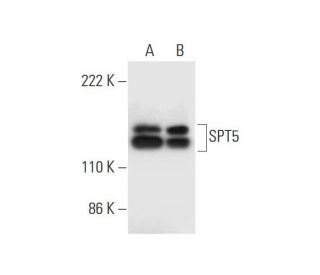


SPT5 Antibody (D-10): sc-390961. CCRF-CEM全細胞溶解液 (A) およびCCRF-CEM核抽出液 (B) におけるSPT5発現のウェスタンブロット解析.
SPT5抗体(D-10): sc-390961
- SPT5抗体 (D-10)はマウスモノクローナルIgG1 κです。200 µg/mlで提供
- human由来のSPT5のC-terminusの辺りのアミノ酸987-1010の間に位置するエピトープに特異的
- mouse, rat と human 由来のSPT5 WB, IP, IF と ELISAでの検出にはお勧めします; 以下追加動物種との反応性もあります: と equine, canine, bovine and porcine
- ChIPアプリケーション用のTransCruz試薬 (sc-390961 X、 200 µg/0.1 ml)
- m-IgG Fc BP-HRPおよび m-IgG1 BP-HRPは、SPT5 Antibody (D-10) for WB applications. の二次検出試薬として推奨されています。これらの試薬は現在、SPT5 Antibody (D-10) とバンドルして提供されています(下記の注文情報を参照)。

SPT4(Suppressor of Ty4およびp14とも呼ばれる)とSPT5(DSIF p160とも呼ばれる)は、酵母からヒトまで高度に保存されたタンパク質である。核内のSPT4とSPT5は、DRB(5,6-dichloro-1-beta-D-ribofuranosylbenzimidazole)が仲介する転写阻害と、HIV-1タンパク質Tatによる転写伸長の活性化の両方に関与している。SPT4はSPT5と結合してDSIF(DRB感受性誘導因子)複合体を形成し、RNAポリメラーゼIIと結合して伸長を直接制御する。しかし、有糸分裂期のHeLa細胞中のSPT5タンパク質は、間期細胞から単離されたSPT5よりもSDS-PAGE上でゆっくりと移動する。SPT5のC末端CTR1ドメインはP-TEFbリン酸化の基質であり、これはSPT5が転写伸長制御因子として機能するために重要である。
試験・研究用以外には使用しないでください。 臨床及び体外診断には使用できません。
Alexa Fluor® はMolecular Probes Inc., OR., USAの商標です。
LI-COR® and Odyssey® はLI-COR Biosciencesの登録商標です。
SPT5抗体(D-10) 参考文献:
- 分裂酵母のmRNAキャッピング酵素と伸長因子Spt5との相互作用。 | Pei, Y. and Shuman, S. 2002. J Biol Chem. 277: 19639-48. PMID: 11893740
- プレmRNAのプロセシングと転写伸長におけるSpt5の二重の役割が, Spt5関連タンパク質の同定によって明らかになった。 | Lindstrom, DL., et al. 2003. Mol Cell Biol. 23: 1368-78. PMID: 12556496
- SPT5のメチル化は、RNAポリメラーゼIIとの相互作用と転写伸長特性を制御している。 | Kwak, YT., et al. 2003. Mol Cell. 11: 1055-66. PMID: 12718890
- Spt5のC末端リピートドメインは、Rad26非依存性転写連鎖修復の抑制に重要な役割を果たしている。 | Ding, B., et al. 2010. J Biol Chem. 285: 5317-26. PMID: 20042611
- 分裂酵母Spt5のカルボキシル末端ドメイン(CTD)のキャッピング酵素結合と転写伸長における分離可能な機能は、RNAポリメラーゼIIのCTDの機能と重なる。 | Schneider, S., et al. 2010. Mol Cell Biol. 30: 2353-64. PMID: 20231361
- 赤血球生成は、転写伸長因子Foggy/Spt5によるgata1遺伝子制御を介して制御されている。 | Taneda, T., et al. 2011. Genes Cells. 16: 231-42. PMID: 21205096
- Pol II CTDキナーゼBur1とKin28は、Spt5 CTR非依存的なPaf1複合体のリクルートを促進する。 | Qiu, H., et al. 2012. EMBO J. 31: 3494-505. PMID: 22796944
- RNAPIIの出口トンネルにおけるMjSpt4p:Spt5複合体のDNA結合様式に関する構造学的および生化学的知見。 | Guo, G., et al. 2015. J Struct Biol. 192: 418-425. PMID: 26433031
- Toxoplasma gondii Spt5-like 転写伸長因子のキャラクタリゼーション。 | Mitra, P., et al. 2019. Biochim Biophys Acta Gene Regul Mech. 1862: 184-197. PMID: 30707945
- CRISPRiを介したSpt4とSpt5の欠損により、HIV潜伏期の制御におけるDSIFの役割が明らかになった。 | Krasnopolsky, S., et al. 2021. Biochim Biophys Acta Gene Regul Mech. 1864: 194656. PMID: 33333262
注文情報
| 製品名 | カタログ # | 単位 | 価格 | 数量 | お気に入り | |
SPT5 抗体 (D-10) | sc-390961 | 200 µg/ml | $322.00 | |||
SPT5 (D-10): m-IgG Fc BP-HRP Bundle | sc-540877 | 200 µg Ab; 10 µg BP | $361.00 | |||
SPT5 (D-10): m-IgG1 BP-HRP Bundle | sc-542435 | 200 µg Ab; 20 µg BP | $361.00 | |||
SPT5 (D-10) 中和ペプチド | sc-390961 P | 100 µg/0.5 ml | $69.00 | |||
SPT5 抗体 (D-10) X | sc-390961 X | 200 µg/0.1 ml | $322.00 |