
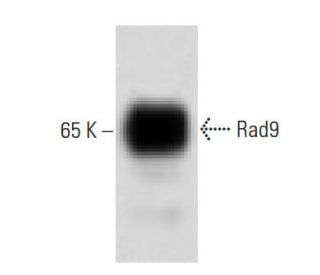

Rad9 Antibody (56): sc-136053
- Rad9 Antibody (56) is a mouse monoclonal IgG1 provided at 50 µg/500 µl
- raised against amino acids 264-370 of Rad9 of human origin
- recommended for detection of Rad9 of mouse, rat and human origin by WB, IP and IF
- At present, we have not yet completed the identification of the preferred secondary detection reagent(s) for Rad9 Antibody (56). This work is in progress.

Rad9 Antibody (56) is a mouse monoclonal IgG1 antibody that detects Rad9 in mouse, rat, and human samples through applications such as western blotting (WB), immunoprecipitation (IP), and immunofluorescence (IF). Rad9 plays a critical role in the DNA damage response by acting as a key regulator of the G2 checkpoint, where Rad9 is involved in the signal transduction cascade that halts cell cycle progression in response to DNA damage or incomplete DNA replication. Rad9 is essential for maintaining genomic stability, as Rad9 directly associates with other checkpoint proteins, including Rad1 and Hus1, to form a complex that facilitates the repair of damaged DNA. Notably, Rad9 is highly phosphorylated in vivo, which enhances Rad9′s interaction with anti-apoptotic Bcl-2 family proteins such as Bcl-2 and Bcl-xL, while Rad9 does not interact with pro-apoptotic proteins like Bax and Bad. This selective interaction suggests that Rad9 may also play a role in regulating apoptosis following DNA damage, highlighting Rad9′s importance not only in cell cycle control but also in the broader context of cellular responses to stress. Anti-Rad9 antibody (56) is therefore a valuable tool for researchers studying the intricate mechanisms of DNA damage response and cell cycle regulation.
Alexa Fluor® is a trademark of Molecular Probes Inc., OR., USA
LI-COR® and Odyssey® are registered trademarks of LI-COR Biosciences
Rad9 Antibody (56) References:
- Human Rad9 is required for the activation of S-phase checkpoint and the maintenance of chromosomal stability. | Dang, T., et al. 2005. Genes Cells. 10: 287-95. PMID: 15773892
- Rad9 has a functional role in human prostate carcinogenesis. | Zhu, A., et al. 2008. Cancer Res. 68: 1267-74. PMID: 18316588
- Rad9 plays an important role in DNA mismatch repair through physical interaction with MLH1. | He, W., et al. 2008. Nucleic Acids Res. 36: 6406-17. PMID: 18842633
- TLK1B promotes repair of DSBs via its interaction with Rad9 and Asf1. | Canfield, C., et al. 2009. BMC Mol Biol. 10: 110. PMID: 20021694
- Rad9 is required for B cell proliferation and immunoglobulin class switch recombination. | An, L., et al. 2010. J Biol Chem. 285: 35267-73. PMID: 20729201
- Checkpoint protein Rad9 plays an important role in nucleotide excision repair. | Li, T., et al. 2013. DNA Repair (Amst). 12: 284-92. PMID: 23433811
- RAD9 deficiency enhances radiation induced bystander DNA damage and transcriptomal response. | Ghandhi, SA., et al. 2014. Radiat Oncol. 9: 206. PMID: 25234738
- Association of the Rad9-Rad1-Hus1 checkpoint clamp with MYH DNA glycosylase and DNA. | Hwang, BJ., et al. 2015. DNA Repair (Amst). 31: 80-90. PMID: 26021743
- TLK1B mediated phosphorylation of Rad9 regulates its nuclear/cytoplasmic localization and cell cycle checkpoint. | Awate, S. and De Benedetti, A. 2016. BMC Mol Biol. 17: 3. PMID: 26860083
- DNMT1 and DNMT3B regulate tumorigenicity of human prostate cancer cells by controlling RAD9 expression through targeted methylation. | Zhu, A., et al. 2021. Carcinogenesis. 42: 220-231. PMID: 32780107
Ordering Information
| Product Name | Catalog # | UNIT | Price | Qty | FAVORITES | |
Rad9 Antibody (56) | sc-136053 | 50 µg/500 µl | $322.00 |