
CRIK Plásmido CRISPR/Cas9 KO (h): sc-417835
- Especies Diana: human
- 20 µg de plásmido de ADN purificado listo para la trasfección; suficiente para 20 transfecciones máximo
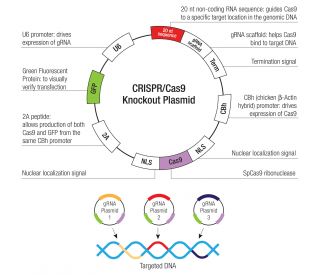
- CRIK El plásmido CRISPR/Cas9 Knockout (KO) (h) es un conjunto de plásmidos, cada uno de los cuales codifica la nucleasa Cas9 y un ARN guía (gRNA) de 20 nt específico para el objetivo, diseñado para lograr la máxima eficiencia de knockout utilizando secuencias derivadas de la biblioteca GeCKO v2
- Las secuencias de gRNA dirigen a Cas9 para que induzca roturas de doble cadena (DSB) específicas en el locus genómico CRIK, lo que da lugar a la inactivación del gen mediante unión de extremos no homólogos (NHEJ)
- Se recomienda el plásmido HDR CRIK (h) (sc-417835-HDR) para la cotransfección con el plásmido CRISPR/Cas9 KO CRIK (h) a fin de permitir la selección de células editadas con éxito mediante la integración mediada por HDR de un casete de resistencia a la puromicina y un gen reportero RFP
- El plásmido HDR CRIK (h) es un conjunto de plásmidos, cada uno de los cuales contiene una plantilla de reparación dirigida por homología (HDR) correspondiente a los sitios diana del ARN guía (gRNA) en el plásmido CRISPR/Cas9 KO CRIK (h)
- Cada plásmido HDR contiene dos brazos de homología de ~800 pb que flanquean los casetes de resistencia a la puromicina y RFP, diseñados para unirse a secuencias de ADN genómico que rodean el sitio de rotura de doble cadena inducida por Cas9 y facilitar la integración precisa mediada por HDR
- Los genes de resistencia a la puromicina y RFP están flanqueados por sitios LoxP, lo que permite la eliminación de los marcadores de selección mediante la recombinasa Cre (Vector Cre: sc-418923) tras el establecimiento de líneas celulares knockout estables
- Tras la transfección, la eficacia del knockout puede comprobarse mediante WB, IF ó IHC utilzando el anticuerpo: CRIK Anticuerpo (E-6): sc-390437

Información sobre pedidos
| Nombre del producto | Número de catálogo | UNIDAD | Precio | CANTIDAD | Favoritos | |
CRIK Plásmido CRISPR/Cas9 KO (h) | sc-417835 | 20 µg | $397.00 | |||
CRIK Plásmido HDR (h) | sc-417835-HDR | 20 µg | $445.00 |
Descripción general
La quinasa de citron (CIT; proteína CRIK) es una quinasa de serina/treonina efectora de RhoA que se localiza en el surco de segmentación y en el cuerpo medio (midbody) para coordinar la contractilidad actomiosínica durante la citocinesis. A través de interacciones con reguladores del citoesqueleto y andamios del cuerpo medio, CRIK contribuye a la organización del anillo contráctil, al control del momento de la abscisión y al mantenimiento de la estabilidad genómica durante la división celular. La alteración de la función de CIT puede provocar fallos en la citocinesis, multinucleación y aneuploidía, lo que vincula esta vía con el control de la proliferación y con fenotipos del ciclo celular relevantes en cáncer. CIT también se estudia en el contexto de procesos del neurodesarrollo, donde la división regulada y la remodelación del citoesqueleto son fundamentales.
El plásmido CRISPR/Cas9 KO CRIK (h) es un conjunto de plásmidos diseñado para la interrupción selectiva del gen CIT en líneas celulares human. Cada plásmido del conjunto coexpresa un ARN guía específico (sgRNA) único, dirigido a un sitio distinto dentro del locus CIT, junto con la nucleasa Cas9 de Streptococcus pyogenes, y codifica GFP para permitir la identificación fluorescente y el enriquecimiento de las células transfectadas con éxito. Esta estrategia multiguía aumenta la probabilidad de inducir desplazamientos de marco de lectura o deleciones que produzcan una inactivación funcional, ofreciendo una alternativa más robusta a los enfoques de guía única. Las DSB inducidas en múltiples sitios se resuelven mediante unión de extremos no homólogos (NHEJ) o, cuando se utiliza con la plantilla donante HDR incluida, mediante reparación dirigida por homología (HDR) en un sitio diana definido dentro del locus.
Cuando se utiliza junto con el donante HDR que expresa RFP, la fluorescencia de GFP y RFP puede utilizarse conjuntamente para distinguir las poblaciones de células transfectadas de las editadas, lo que agiliza los flujos de trabajo de clasificación y selección de clones basados en citometría de flujo.
Donante de reparación dirigida por homología (HDR) — Casete de puromicina con reportero RFP
Para aplicaciones que requieren clones knockout confirmados y seleccionables, el plásmido HDR CRIK (h) incluye un constructo donante HDR que contiene un casete de resistencia a la puromicina (PuroR) y un reportero de proteína fluorescente roja (RFP), flanqueado por brazos de homología específicos de un sitio diana definido CIT.
Cuando se cotransfecciona con el plásmido CRIK CRISPR/Cas9 KO (h):
- El casete PuroR-RFP se integra en el sitio de corte de Cas9 mediante HDR, interrumpiendo el marco de lectura abierto CIT.
La fluorescencia de la RFP proporciona un indicador visual inmediato del éxito de la integración, lo que permite la identificación o clasificación basada en la fluorescencia de las células editadas antes o junto con la selección con puromicina.
Las células editadas con éxito se confirman mediante la resistencia a la puromicina, lo que reduce sustancialmente la carga de cribado de clones.
Esta estrategia de selección es ideal para generar líneas celulares KO clonales estables para estudios funcionales posteriores, cribado de fármacos o desarrollo de modelos.
Sistema de eliminación del casete Cre-lox
La construcción donante HDR cuenta con sitios loxP que flanquean el casete de selección PuroR-RFP para permitir la eliminación limpia del marcador tras la confirmación del clon. La expresión transitoria de la recombinasa Cre a través del vector Cre: sc-418923 incluido extirpa el casete, dejando un sitio loxP residual mínimo dentro del locus CIT y eliminando posibles efectos de confusión en los ensayos posteriores.
Este enfoque en dos pasos:
- Minimiza la alteración de la arquitectura local de la cromatina y de los elementos reguladores vecinos
Restaura un contexto genómico casi nativo en el locus editado
Permite reutilizar la estrategia de selección con puromicina en la misma línea celular para ediciones adicionales
Características principales
- gRNA dirigido a los exones CIT críticos para la función CRIK
Coexpresión de SpCas9 y sgRNA a partir de un único plásmido para una administración simplificada
Donante HDR con resistencia a la puromicina para la selección positiva de clones
Casete PuroR flanqueado por loxP con vector de recombinasa Cre para la eliminación sin fisuras del marcador
Se suministra listo para su uso mediante transfección
Sólo para uso en investigación. No destinado a uso diagnóstico o terapéutico.