
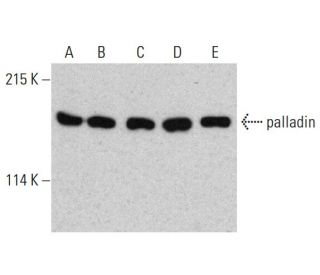
palladin Antibody (E-6): sc-515799
- palladin Antibody (E-6) is a mouse monoclonal IgM κ, cited in 1 publications, provided at 200 µg/ml
- specific for an epitope mapping between amino acids 1107-1136 within an internal region of palladin of human origin
- recommended for detection of palladin of mouse, rat and human origin by WB, IP, IF and ELISA
- m-IgGκ BP-HRP is the preferred secondary detection reagent for palladin Antibody (E-6) for WB applications. This reagent is now offered in a bundle with palladin Antibody (E-6) (see ordering information below). For additional m-IgGκ BP conjugates see our complete list of Mouse IgG Binding Proteins.

QUICK LINKS
SEE ALSO...
Palladin Antibody (E-6) is a mouse monoclonal IgM antibody that detects palladin in mouse, rat, and human samples through applications such as western blotting (WB), immunoprecipitation (IP), immunofluorescence (IF), and enzyme-linked immunosorbent assay (ELISA). Palladin, also known as PALLD, PNCA1, or SIH002, is a 1,383 amino acid protein that plays a crucial role in the organization of the actin cytoskeleton, which is essential for maintaining cell shape, motility, and adhesion. Anti-palladin antibody (E-6) recognizes a protein localized in both the cytoplasm and cytoskeleton featuring five immunoglobulin-like domains, contributing to structural integrity and functional versatility. Palladin is expressed in various tissues, including kidney, prostate, ovary, and colon, and exists as several alternatively spliced isoforms, which may have distinct functional roles. Palladin interacts with key proteins such as Eps8, LASP-1, and VASP, highlighting importance in cytoskeletal scaffolding and actin remodeling. Palladin undergoes post-translational modifications, including phosphorylation on specific serine residues in response to DNA damage, which can influence activity and interactions. Defects in the gene encoding palladin have been linked to increased genetic susceptibility to pancreatic cancer, underscoring potential role in tumorigenesis and making palladin a significant target for cancer research.
Ordering Information
| Product Name | Catalog # | UNIT | Price | Qty | FAVORITES | |
palladin Antibody (E-6) | sc-515799 | 200 µg/ml | $322.00 | |||
palladin Antibody (E-6): m-IgGκ BP-HRP Bundle | sc-552758 | 200 µg Ab; 40 µg BP | $361.00 |