
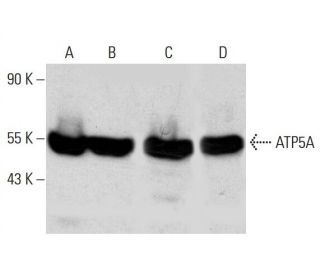


ATP5A Antibody (51): sc-136178
- ATP5A Antibody (51) is a mouse monoclonal IgG2a κ ATP5A antibody, cited in 40 publications, provided at 200 µg/ml
- raised against amino acids 113-220 of ATP5A of human origin
- recommended for detection of ATP5A of mouse, rat, human and Arabidopsis thaliana origin by WB, IP and IF; also reactive with additional species, including canine
- m-IgG Fc BP-HRP and m-IgG2a BP-HRP are the preferred secondary detection reagents for ATP5A Antibody (51) for WB applications. These reagents are now offered in bundles with ATP5A Antibody (51) (see ordering information below).

QUICK LINKS
ATP5A Antibody (51) is a mouse monoclonal IgG2a kappa light chain antibody that detects ATP5A protein of mouse, rat, and human origin by western blotting (WB), immunoprecipitation (IP), and immunofluorescence (IF). Anti-ATP5A antibody (51) is available as the non-conjugated format. ATP5A protein plays a crucial role in cellular energy metabolism as a key component of mitochondrial ATP synthase, which synthesizes adenosine triphosphate (ATP) through oxidative phosphorylation. This process provides energy necessary for various cellular functions, including muscle contraction, nerve impulse propagation, and biosynthetic reactions. ATP5A protein is located in the inner mitochondrial membrane, forming part of the F1F0 ATP synthase complex, consisting of the F1 catalytic core and F0 membrane channel. The F1 component contains three alpha and three beta subunits, along with additional regulatory chains, while F0 component comprises three subunits: a, b, and c. Proper functioning of ATP5A is essential for maintaining the electrochemical gradient across the mitochondrial membrane, which is critical for ATP production. Disruptions in ATP5A function can lead to various metabolic disorders, highlighting ATP5A′s importance in cellular energy homeostasis.
Alexa Fluor® is a trademark of Molecular Probes Inc., OR., USA
LI-COR® and Odyssey® are registered trademarks of LI-COR Biosciences
ATP5A Antibody (51) References:
- Association of ATP synthase alpha-chain with neurofibrillary degeneration in Alzheimer's disease. | Sergeant, N., et al. 2003. Neuroscience. 117: 293-303. PMID: 12614671
- Nucleotide sequence of a cDNA for the alpha subunit of human mitochondrial ATP synthase. | Kataoka, H. and Biswas, C. 1991. Biochim Biophys Acta. 1089: 393-5. PMID: 1830491
- β-amyloid peptide binds and regulates ectopic ATP synthase α-chain on neural surface. | Xing, SL., et al. 2012. Int J Neurosci. 122: 290-7. PMID: 22185089
- Primary structure and subunit stoichiometry of F1-ATPase from bovine mitochondria. | Walker, JE., et al. 1985. J Mol Biol. 184: 677-701. PMID: 2864455
- RGS12 is required for the maintenance of mitochondrial function during skeletal development. | Yuan, G., et al. 2020. Cell Discov. 6: 59. PMID: 32922858
- Micropeptide ASAP encoded by LINC00467 promotes colorectal cancer progression by directly modulating ATP synthase activity. | Ge, Q., et al. 2021. J Clin Invest. 131: PMID: 34591791
- TNK2/ACK1-mediated phosphorylation of ATP5F1A (ATP synthase F1 subunit alpha) selectively augments survival of prostate cancer while engendering mitochondrial vulnerability. | Chouhan, S., et al. 2023. Autophagy. 19: 1000-1025. PMID: 35895804
- MTA1, a Novel ATP Synthase Complex Modulator, Enhances Colon Cancer Liver Metastasis by Driving Mitochondrial Metabolism Reprogramming. | Wang, T., et al. 2023. Adv Sci (Weinh). 10: e2300756. PMID: 37442756
- Atorvastatin rescues vascular endothelial injury in hypertension by WWP2-mediated ubiquitination and degradation of ATP5A. | Yin, Z., et al. 2023. Biomed Pharmacother. 166: 115228. PMID: 37557013
- Proteomic analyses identify HK1 and ATP5A to be overexpressed in distant metastases of lung adenocarcinomas compared to matched primary tumors. | Pasternack, H., et al. 2023. Sci Rep. 13: 20948. PMID: 38016997
- The crystal structure of the nucleotide-free alpha 3 beta 3 subcomplex of F1-ATPase from the thermophilic Bacillus PS3 is a symmetric trimer. | Shirakihara, Y., et al. 1997. Structure. 5: 825-36. PMID: 9261073
- Comparative genomic hybridization analysis of Y79 and FISH mapping indicate the amplified human mitochondrial ATP synthase alpha-subunit gene (ATP5A) maps to chromosome 18q12-->q21. | Godbout, R., et al. 1997. Cytogenet Cell Genet. 77: 253-6. PMID: 9284928
Ordering Information
| Product Name | Catalog # | UNIT | Price | Qty | FAVORITES | |
ATP5A Antibody (51) | sc-136178 | 200 µg/ml | $322.00 | |||
ATP5A Antibody (51): m-IgG Fc BP-HRP Bundle | sc-539899 | 200 µg Ab; 10 µg BP | $361.00 | |||
ATP5A Antibody (51): m-IgG2a BP-HRP Bundle | sc-546814 | 200 µg Ab; 10 µg BP | $361.00 |