
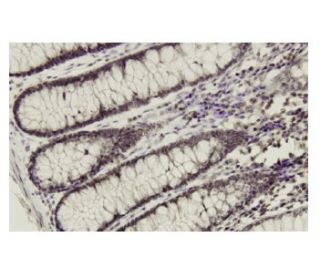

Ribosomal Protein L14 Antibody (KQ-16): sc-100826
- Ribosomal Protein L14 Antibody (KQ-16) is a mouse monoclonal IgG2a κ Ribosomal Protein L14 antibody, cited in 1 publications, provided at 100 µg/ml
- raised against recombinant Ribosomal Protein L14 of human origin
- recommended for detection of Ribosomal Protein L14 of human origin by IF, IHC(P) and ELISA
- At present, we have not yet completed the identification of the preferred secondary detection reagent(s) for Ribosomal Protein L14 Antibody (KQ-16). This work is in progress.

QUICK LINKS
SEE ALSO...
Ribosomal Protein L14 Antibody (KQ-16) is a mouse monoclonal IgG2a kappa light chain antibody that detects Ribosomal Protein L14 (RPL14) of human origin by immunofluorescence (IF), immunohistochemistry with paraffin-embedded sections (IHCP), and enzyme-linked immunosorbent assay (ELISA). Anti-RPL14 antibody (KQ-16) is available as a non-conjugated format. RPL14, also known as L14, RL14, CTG-B33, or CAG-ISL-7, is a crucial component of the 60S ribosomal subunit, which plays a vital role in protein synthesis within the cytoplasm. This 213 amino acid protein belongs to the L14e family of ribosomal proteins and features a basic region-leucine zipper (bZIP)-like domain and a polymorphic polyalanine tract. The polyalanine tract is particularly significant as it helps regulate transcription, influencing gene expression and cellular function. RPL14 is encoded by multigene families that include processed pseudogenes, highlighting its evolutionary importance and regulatory complexity. RPL14′s ability to interact with various other proteins within the ribosomal assembly underscores its essential role in maintaining ribosome integrity and functionality, making RPL14 a critical target for studies related to protein synthesis and cellular metabolism.
Alexa Fluor® is a trademark of Molecular Probes Inc., OR., USA
LI-COR® and Odyssey® are registered trademarks of LI-COR Biosciences
Ribosomal Protein L14 Antibody (KQ-16) References:
- A complete map of the human ribosomal protein genes: assignment of 80 genes to the cytogenetic map and implications for human disorders. | Uechi, T., et al. 2001. Genomics. 72: 223-30. PMID: 11401437
- Autoantibody against ribosomal protein L14 in patients with systemic lupus erythematosus. | Hasegawa, H., et al. 2002. Clin Exp Rheumatol. 20: 139-44. PMID: 12051391
- Silencing the Drosophila ribosomal protein L14 gene using targeted RNA interference causes distinct somatic anomalies. | Enerly, E., et al. 2003. Gene. 320: 41-8. PMID: 14597387
- Alteration of RPL14 in squamous cell carcinomas and preneoplastic lesions of the esophagus. | Huang, XP., et al. 2006. Gene. 366: 161-8. PMID: 16316724
- Polymorphic CUG repeats in human mRNAs and their effects on gene expression. | Tian, B., et al. 2005. RNA Biol. 2: 149-56. PMID: 17114933
- Identification of trinucleotide repeat-containing genes in human pancreatic islets. | Aoki, M., et al. 1996. Diabetes. 45: 157-64. PMID: 8549859
- Distribution of the B33 CTG repeat polymorphism in a subtype of schizophrenia. | Bengel, D., et al. 1998. Eur Arch Psychiatry Clin Neurosci. 248: 78-81. PMID: 9684916
- The binding sites for Xenopus laevis FIII/YY1 in the first exon of L1 and L14 ribosomal protein genes are dispensable for promoter expression. | De Rinaldis, E., et al. 1998. Eur J Biochem. 255: 563-9. PMID: 9738894
- Trinucleotide repeat length variation in the human ribosomal protein L14 gene (RPL14): localization to 3p21.3 and loss of heterozygosity in lung and oral cancers. | Shriver, SP., et al. 1998. Mutat Res. 406: 9-23. PMID: 9920051
Ordering Information
| Product Name | Catalog # | UNIT | Price | Qty | FAVORITES | |
Ribosomal Protein L14 Antibody (KQ-16) | sc-100826 | 100 µg/ml | $339.00 |