
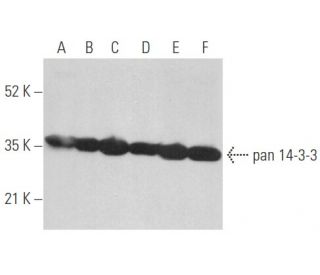
Anticorps pan 14-3-3 (F-1): sc-166061
- L'Anticorps pan 14-3-3 (F-1) est un monoclonal de souris IgG2b (chaîne légère kappa) fourni en 200 µg/ml
- soulevée à l'encontre des acides aminés 1-246 représentant l'intégralité de la 14-3-3 β d'origine human.
- recommandé pour la détection de pan 14-3-3 d'origine mouse, rat et human par WB, IP, IF, IHC(P) et ELISA; également réactif avec d'autres espèces, dont bovine
- Voir pan 14-3-3 (B-8): sc-133233 pour d'autres anticorps conjugués pan 14-3-3, dont AC, HRP, FITC, PE, Alexa Fluor® 488, 594, 647, 680 et 790.
- m-IgG2b BP-HRP et m-IgGκ BP-HRP sont les réactifs secondaires recommandés pour la détection de l'anticorps pan 14-3-3 (F-1) pour des applications de WB and IHC(P). Ces réactifs sont maintenant proposés en kit avec l'anticorps pan 14-3-3 (F-1) (voir Informations pour la commande ci-dessous).

ACCÈS RAPIDE AUX LIENS
VOIR ÉGALEMENT...
Les protéines 14-3-3 régulent de nombreux processus cellulaires pertinents pour la biologie du cancer, notamment l'apoptose, la signalisation mitogénique et les points de contrôle du cycle cellulaire. Sept isoformes composent cette famille d'intermédiaires de signalisation, dénommées 14-3-3 β, γ, ε, ζ, η, θ et Σ. Les protéines 14-3-3 forment des dimères qui présentent deux sites de liaison pour les protéines ligands, réunissant ainsi deux protéines qui ne s'associeraient pas autrement. Ces ligands partagent largement un motif de liaison consensuel 14-3-3 et présentent une phosphorylation sérine/thréonine. Les protéines 14-3-3 régulent largement ces protéines ligands en les séquestrant dans le cytoplasme, en occupant des domaines d'interaction et des séquences d'importation/exportation, en empêchant leur dégradation, en activant/réprimant l'activité enzymatique et en facilitant la modification des protéines ; la perte d'expression contribue donc à une vaste gamme d'activités cellulaires pathogènes.
Informations pour la commande
| Nom du produit | Ref. Catalogue | COND. | Prix HT | QTÉ | Favoris | |
Anticorps pan 14-3-3 (F-1) | sc-166061 | 200 µg/ml | $322.00 | |||
pan 14-3-3 (F-1): m-IgGκ BP-HRP Kit | sc-534701 | 200 µg Ab; 40 µg BP | $361.00 | |||
pan 14-3-3 (F-1): m-IgG2b BP-HRP Kit | sc-549283 | 200 µg Ab; 10 µg BP | $361.00 |