
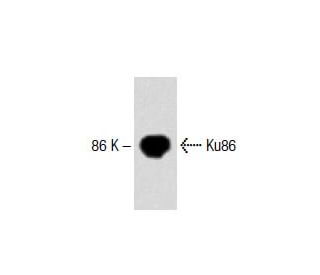


Ku86 Antibody (7): sc-135964
- Ku86 Antibody (7) is a mouse monoclonal IgG1, cited in 1 publications, provided at 50 µg/500 µl
- raised against amino acids 103-315 of Ku86 of human origin
- recommended for detection of Ku86 of human origin by WB, IP and IF
- See Ku86 (B-1): sc-5280 for Ku86 antibody conjugates, including AC, HRP, FITC, PE, Alexa Fluor® 488, 594, 647, 680 and 790.
- At present, we have not yet completed the identification of the preferred secondary detection reagent(s) for Ku86 Antibody (7). This work is in progress.

Ku86 Antibody (7) is a mouse monoclonal IgG1 antibody that detects Ku86 in human samples through applications such as western blotting (WB), immunoprecipitation (IP), and immunofluorescence (IF). Ku86, also known as Ku80 or p80, is a crucial component of the Ku protein complex, which is primarily localized in the nucleus and consists of two subunits: Ku70 (p70) and Ku86 (p86). Anti-Ku86 antibody (7) plays a vital role in studying DNA repair and maintenance, particularly in the non-homologous end joining (NHEJ) pathway, which is essential for repairing double-strand breaks in DNA. Ku86 maintains genomic stability, as deficiencies can lead to increased susceptibility to cancer and other genetic disorders. Additionally, Ku86 regulates transcription by interacting with various transcription factors and RNA polymerases, thereby influencing gene expression. Ku86′s ability to bind to DNA and facilitate the recruitment of repair proteins underscores its significance in cellular responses to DNA damage, making Ku86 (7) monoclonal antibody a valuable tool for research in cancer biology and therapeutic development.
Alexa Fluor® is a trademark of Molecular Probes Inc., OR., USA
LI-COR® and Odyssey® are registered trademarks of LI-COR Biosciences
Ku86 Antibody (7) References:
- A higher micronucleus yield in B-versus T-cells after low-dose gamma-irradiation is not linked with defective Ku86 protein. | Vral, A., et al. 2001. Int J Radiat Biol. 77: 329-39. PMID: 11258847
- Analysis of the DNA replication competence of the xrs-5 mutant cells defective in Ku86. | Matheos, D., et al. 2003. J Cell Sci. 116: 111-24. PMID: 12456721
- Selective inhibition of class switching to IgG and IgE by recruitment of the HoxC4 and Oct-1 homeodomain proteins and Ku70/Ku86 to newly identified ATTT cis-elements. | Schaffer, A., et al. 2003. J Biol Chem. 278: 23141-50. PMID: 12672812
- The expression and the nuclear activity of the caretaker gene ku86 are modulated by somatostatin. | Pucci, S., et al. 2004. Eur J Histochem. 48: 103-10. PMID: 15208076
- Effect of Ku86 and DNA-PKcs deficiency on non-homologous end-joining and homologous recombination using a transient transfection assay. | Secretan, MB., et al. 2004. Mutat Res. 554: 351-64. PMID: 15450431
- Impact of telomerase ablation on organismal viability, aging, and tumorigenesis in mice lacking the DNA repair proteins PARP-1, Ku86, or DNA-PKcs. | Espejel, S., et al. 2004. J Cell Biol. 167: 627-38. PMID: 15545322
- Identification of proteins binding to E-Box/Ku86 sites and function of the tumor suppressor SAFB1 in transcriptional regulation of the human xanthine oxidoreductase gene. | Lin, J., et al. 2008. J Biol Chem. 283: 29681-9. PMID: 18772145
- Radioresistant cervical cancer shows upregulation of the NHEJ proteins DNA-PKcs, Ku70 and Ku86. | Beskow, C., et al. 2009. Br J Cancer. 101: 816-21. PMID: 19672258
- Characterization of a Ku86 variant protein that results in altered DNA binding and diminished DNA-dependent protein kinase activity. | Han, Z., et al. 1996. J Biol Chem. 271: 14098-104. PMID: 8662896
- Double-strand break repair in Ku86- and XRCC4-deficient cells. | Kabotyanski, EB., et al. 1998. Nucleic Acids Res. 26: 5333-42. PMID: 9826756
Ordering Information
| Product Name | Catalog # | UNIT | Price | Qty | FAVORITES | |
Ku86 Antibody (7) | sc-135964 | 50 µg/500 µl | $322.00 |