
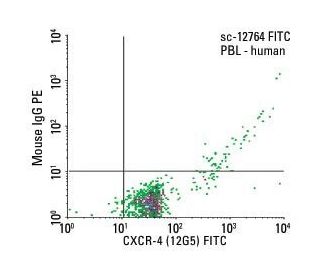

CXCR-4 Antibody (12G5): sc-12764
- CXCR-4 Antibody (12G5) is a mouse monoclonal IgG2a κ, cited in 26 publications, provided at 200 µg/ml
- raised against living CP-MAC-infected SUP-T1 cells
- CXCR-4 Antibody (12G5) is recommended for detection of CXCR-4 of human origin by IP and FCM
- Anti-CXCR-4 Antibody (12G5) is available conjugated to agarose for IP; HRP for WB, IHC(P) and ELISA; and to either phycoerythrin or FITC for IF, IHC(P) and FCM
- also available conjugated to Alexa Fluor® 488, Alexa Fluor® 546, Alexa Fluor® 594 or Alexa Fluor® 647 for WB (RGB), IF, IHC(P) and FCM, and for use with RGB fluorescent imaging systems, such as iBright™ FL1000, FluorChem™, Typhoon, Azure and other comparable systems
- also available conjugated to Alexa Fluor® 680 or Alexa Fluor® 790 for WB (NIR), IF and FCM; for use with Near-Infrared (NIR) detection systems, such as LI-COR®Odyssey®, iBright™ FL1000, FluorChem™, Typhoon, Azure and other comparable systems
- also provided azide-free for blocking of CXCR-4 in functional studies, sc-12764 L, 200ug/0.1 mL
- m-IgG2a BP-HRP is the preferred secondary detection reagent for CXCR-4 Antibody (12G5). This reagent is now offered in a bundle with CXCR-4 Antibody (12G5) (see ordering information below).

QUICK LINKS
SEE ALSO...
CXCR-4 Antibody (12G5) is a mouse monoclonal IgG2a kappa light chain antibody raised against living CP-MAC-infected SUP-T1 cells, specifically targeting the CXCR-4 protein of human origin, and is validated for applications including immunoprecipitation (IP) and flow cytometry (FCM). CXCR-4, a member of the C-X-C chemokine receptor family, is a G protein-coupled receptor characterized by its seven transmembrane domains and its interaction with stromal cell-derived factor-1 (SDF-1). This receptor plays a pivotal role in cellular signaling and migration, acting as a potent chemoattractant for T cells and monocytes. The CXCR-4/SDF-1 axis is critical for numerous physiological processes, including hematopoiesis, immune response, and organogenesis, as well as pathological conditions like cancer metastasis and immune disorders. CXCR-4 is also the primary co-receptor for T-tropic HIV-1, facilitating viral entry into target cells, while its ligand SDF-1 has been shown to inhibit HIV-1 infection, making this receptor-ligand pair an important focus of antiviral and immunological research. Highly homologous to other IL-8 receptors, CXCR-4 shares approximately 37% sequence identity at the amino acid level, yet exhibits distinct ligand specificity and functional roles. CXCR-4 monoclonal antibody (12G5) is available in non-conjugated form as well as a range of conjugated options, including agarose, horseradish peroxidase (HRP), phycoerythrin (PE), fluorescein isothiocyanate (FITC), and Alexa Fluor® conjugates, offering flexibility for diverse research applications.
Alexa Fluor® is a trademark of Molecular Probes Inc., OR., USA
LI-COR® and Odyssey® are registered trademarks of LI-COR Biosciences
CXCR-4 Antibody (12G5) References:
- CXCR-4 expression on bone marrow CD34+ cells prior to mobilization can predict mobilization adequacy in patients with hematologic malignancies. | Dabusti, M., et al. 2003. J Hematother Stem Cell Res. 12: 425-34. PMID: 12965079
- Prognostic significance of CXCR-4 expression in oral squamous cell carcinoma. | Lee, JI., et al. 2009. Oral Surg Oral Med Oral Pathol Oral Radiol Endod. 107: 678-84. PMID: 19272813
- CXCR-4 and COX-2 expression in basal cell carcinomas and well-differentiated squamous cell carcinomas of the skin; their relationship with tumor invasiveness and histological subtype. | Sivrikoz, ON., et al. 2015. Turk Patoloji Derg. 31: 30-5. PMID: 25301050
- Chemokine CXCR-4 and cyclooxygenase-2 in the pathogenesis of pterygium. | Başer, G., et al. 2017. Turk J Med Sci. 47: 1061-1066. PMID: 29152967
- CXCR-4 expression by circulating endothelial progenitor cells and SDF-1 serum levels are elevated in septic patients. | Patry, C., et al. 2018. J Inflamm (Lond). 15: 10. PMID: 29796010
- Abnormal DNA Methylation Induced by Hyperglycemia Reduces CXCR 4 Gene Expression in CD 34+ Stem Cells. | Vigorelli, V., et al. 2019. J Am Heart Assoc. 8: e010012. PMID: 31018749
- Stem Cell Markers CXCR-4 and CD133 Predict Aggressive Phenotype and Their Double Positivity Indicates Poor Prognosis of Oral Squamous Cell Carcinoma. | Caspa Gokulan, R. and Devaraj, H. 2021. Cancers (Basel). 13: PMID: 34885003
- pH-sensitive nanoliposomes for passive and CXCR-4-mediated marine yessotoxin delivery for cancer therapy. | Vieira, AM., et al. 2022. Nanomedicine (Lond). 17: 717-739. PMID: 35481356
- Molecular effects of genistein, as a potential anticancer agent, on CXCR-4 and VEGF pathway in acute lymphoblastic leukemia. | Shahmoradi, M., et al. 2022. Mol Biol Rep. 49: 4161-4170. PMID: 35608747
- CXCR-4, a chemokine receptor, is overexpressed in and required for proliferation of glioblastoma tumor cells. | Sehgal, A., et al. 1998. J Surg Oncol. 69: 99-104. PMID: 9808513
Ordering Information
| Product Name | Catalog # | UNIT | Price | Qty | FAVORITES | |
CXCR-4 Antibody (12G5) | sc-12764 | 200 µg/ml | $322.00 | |||
CXCR-4 Antibody (12G5): m-IgG2a BP-HRP Bundle | sc-545912 | 200 µg Ab; 10 µg BP | $361.00 | |||
CXCR-4 Antibody (12G5) L | sc-12764 L | 200 µg/0.1 ml | $322.00 | |||
CXCR-4 Antibody (12G5) AC | sc-12764 AC | 500 µg/ml, 25% agarose | $424.00 | |||
CXCR-4 Antibody (12G5) HRP | sc-12764 HRP | 200 µg/ml | $322.00 | |||
CXCR-4 Antibody (12G5) FITC | sc-12764 FITC | 200 µg/ml | $336.00 | |||
CXCR-4 Antibody (12G5) PE | sc-12764 PE | 200 µg/ml | $349.00 | |||
CXCR-4 Antibody (12G5) Alexa Fluor® 488 | sc-12764 AF488 | 200 µg/ml | $364.00 | |||
CXCR-4 Antibody (12G5) Alexa Fluor® 546 | sc-12764 AF546 | 200 µg/ml | $364.00 | |||
CXCR-4 Antibody (12G5) Alexa Fluor® 594 | sc-12764 AF594 | 200 µg/ml | $364.00 | |||
CXCR-4 Antibody (12G5) Alexa Fluor® 647 | sc-12764 AF647 | 200 µg/ml | $364.00 | |||
CXCR-4 Antibody (12G5) Alexa Fluor® 680 | sc-12764 AF680 | 200 µg/ml | $364.00 | |||
CXCR-4 Antibody (12G5) Alexa Fluor® 790 | sc-12764 AF790 | 200 µg/ml | $364.00 |