
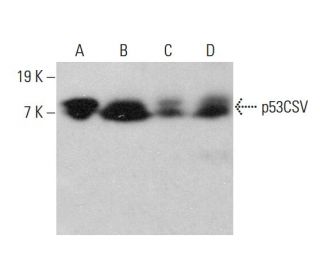


p53CSV Anticuerpo (A-11): sc-515811
- p53CSV Anticuerpo (A-11) es un monoclonal de ratón IgG1 (kappa light chain) proporcionado como 200 µg/ml
- específico para un epítopo localizado entre los amino ácidos 56-76 en el C-terminus de de origen human
- recomendado para detectarp53CSV de mouse, rat y human origen, mediante WB, IP, IF y ELISA
- m-IgG Fc BP-HRP, 1 BP-HRP">m-IgG1 BP-HRP y m-IgGκ BP-HRP son los reactivos de detección secundarios preferidos para p53CSV Anticuerpo (A-11) para aplicaciones WB. Estos reactivos se ofrecen ahora en paquetes con p53CSV Anticuerpo (A-11)(véase la información de pedido más abajo).

ENLACES RÁPIDOS
VER TAMBIÉN ....
El anticuerpo p53CSV (A-11) es un anticuerpo monoclonal IgG1 de ratón que detecta el p53CSV en muestras de ratón, rata y seres humanos mediante aplicaciones como Western blotting (WB), inmunoprecipitación (IP), inmunofluorescencia (IF) y ensayo inmunoenzimático (ELISA). La p53CSV, también conocida como WF-1, HSPC132 o TRIAP1 (inhibidor de la apoptosis regulado por TP53 1), es una proteína de 76 aminoácidos que desempeña un papel crucial en la respuesta celular al estrés localizándose en el citoplasma y la región perinuclear de las células. La p53CSV es esencial para mediar en la supervivencia celular, ya que inhibe la activación de la caspasa-9, impidiendo así la inducción de la apoptosis. En particular, la p53CSV se induce significativamente en condiciones de bajo estrés genotóxico, lo que es vital para mantener la viabilidad celular durante el estrés leve, mientras que la expresión de la p53CSV no aumenta en respuesta al daño grave del ADN. La interacción entre p53CSV y HSP 70 es especialmente importante, ya que esta interacción puede modular la vía apoptótica e inhibir la actividad de Apaf-1 (factor activador de la proteasa de la apoptosis-1), lo que subraya aún más el papel de p53CSV en la regulación de la apoptosis. Regulado por la proteína supresora de tumores p53, el p53CSV está codificado por un gen localizado en el cromosoma humano 12, que alberga más de 1.100 genes y constituye aproximadamente el 4,5% del genoma humano, lo que pone de relieve la importancia del p53CSV en los procesos celulares y sus posibles implicaciones en la biología del cáncer. El anticuerpo anti-p53CSV (A-11) es una herramienta inestimable para los investigadores que estudian los mecanismos de la apoptosis y la supervivencia celular en diversos contextos biológicos.
Alexa Fluor® es una marca registrada de Molecular Probes Inc., OR., USA
REIVEW LI-COR® y Odyssey® son marcas registradas de LI-COR Biosciences.
p53CSV Referencias:
- La red supresora de tumores p53 es una respuesta clave a los componentes microambientales del estrés inflamatorio crónico. | Staib, F., et al. 2005. Cancer Res. 65: 10255-64. PMID: 16288013
- La alta expresión de TRIAP1 en el carcinoma de pene se asocia con un alto riesgo de recurrencia y una mala supervivencia. | Zhang, J., et al. 2019. Ann Transl Med. 7: 330. PMID: 31475200
- La inhibición de TRIAP1 activa la vía de señalización del citocromo c/Apaf-1/caspasa-9 para mejorar la sensibilidad del cáncer de ovario humano al cisplatino. | Zhang, TM. 2019. Chemotherapy. 64: 119-128. PMID: 31661694
- La inhibición de TRIAP1 sensibiliza al cáncer de pulmón de células no pequeñas a la radiación ionizante al alterar la homeostasis redox. | Hao, CC., et al. 2020. Thorac Cancer. 11: 1015-1025. PMID: 32096592
- La regulación al alza de TRIAP1 por el eje lncRNA MFI2-AS1/miR-125a-5p promueve la tumorigénesis del cáncer de tiroides. | Yu, T., et al. 2020. Onco Targets Ther. 13: 6967-6974. PMID: 32764987
- Expresión anormal de TRIAP1 y su papel en las células β pancreáticas relacionadas con la diabetes mellitus gestacional. | Li, L., et al. 2021. Exp Ther Med. 21: 187. PMID: 33488796
- Relevancia del eje TRIAP1/p53 en la proliferación de células de cáncer de colon y la adaptación a la privación de glutamina. | Nedara, K., et al. 2022. Front Oncol. 12: 958155. PMID: 36387192
- La regulación de la señalización inmunitaria innata por CHCHD4-TRIAP1 media la adaptación del músculo esquelético al ejercicio. | Ma, J., et al. 2024. Cell Rep. 43: 113626. PMID: 38157298
- Correlación de la producción de virus de tipo C (WF-1) y la síntesis de hemo en una línea celular fibroblástica de rata. | Ebert, PS. and Pearson, GR. 1974. Proc Soc Exp Biol Med. 145: 298-301. PMID: 4360116
- Características bioquímicas del virus WF-1 de tipo C de la rata. | Bronson, DL., et al. 1976. Proc Soc Exp Biol Med. 152: 116-21. PMID: 57624
Información sobre pedidos
| Nombre del producto | Número de catálogo | UNIDAD | Precio | CANTIDAD | Favoritos | |
p53CSV Anticuerpo (A-11) | sc-515811 | 200 µg/ml | $322.00 | |||
Paquete de p53CSV (A-11): m-IgG Fc BP-HRP | sc-538827 | 200 µg Ab; 10 µg BP | $361.00 | |||
Paquete de p53CSV (A-11): m-IgGκ BP-HRP | sc-536503 | 200 µg Ab; 40 µg BP | $361.00 | |||
Paquete de p53CSV (A-11): m-IgG1 BP-HRP | sc-545899 | 200 µg Ab; 20 µg BP | $361.00 |