
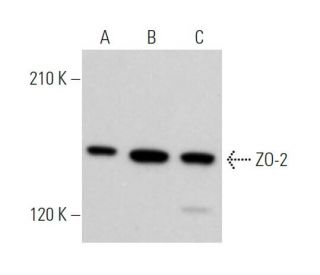


ZO-2 Antikörper (E-3): sc-515115
- ZO-2 Antikörper E-3 ist ein Maus monoklonales IgM κ ZO-2 Antikörper, verwendet in 5 wissenschaftlichen Veröffentlichungen, in einer Menge von 200 µg/ml
- spezifisch für ein Epitop, welches zwischen den Aminosäuren 789-813 am C-terminus von ZO-2 aus der Spezies rat liegt
- Empfohlen für die Detektion von ZO-2 aus der Spezies mouse, rat und human per WB, IP, IF und ELISA; ebenfalls reaktiv mit weiteren Spezies, einschließlich canine
- m-IgGκ BP-HRP ist das bevorzugte sekundäre Nachweisreagenz für ZO-2 Antikörper (E-3) für WB-Anwendungen. Dieses Reagenz wird jetzt in einem Paket mit ZO-2 Antikörper (E-3) angeboten(siehe Bestellinformationen unten). Weitere m-IgGκ BP-Konjugate finden Sie in unserer vollständigen Liste der Maus-IgG-Bindungsproteine.

Der ZO-2-Antikörper (E-3) ist ein monoklonaler IgM-Antikörper aus Maus, der das ZO-2-Protein von Maus, Ratte und Mensch durch Western Blot (WB), Immunpräzipitation (IP), Immunfluoreszenz (IF) und Enzyme-linked Immunosorbent Assay (ELISA) nachweist. Der Anti-ZO-2-Antikörper (E-3) ist als nicht-konjugierte Form erhältlich. ZO-2 spielt eine entscheidende Rolle bei der Bildung und Aufrechterhaltung von Tight Junctions, die für die Regulierung der parazellulären Permeabilität und die Aufrechterhaltung der Integrität der epithelialen und endothelialen Barriere unerlässlich sind. Tight Junctions bestehen aus verschiedenen Proteinen, darunter ZO-2, ZO-1 und Claudine, die zusammen eine selektive Barriere bilden, die die Bewegung von Ionen und Molekülen zwischen den Zellen steuert. Die ordnungsgemäße Funktion von ZO-2 ist für die Gewebehomöostase und die zelluläre Signalübertragung von entscheidender Bedeutung, da Störungen der Integrität der Tight Junctions zu verschiedenen Pathologien führen können, darunter Krebsmetastasen und entzündliche Erkrankungen. ZO-2 ist speziell an den Tight Junctions von Epithelzellen lokalisiert, wo ZO-2 mit anderen Tight-Junction-Proteinen und dem Aktin-Zytoskelett interagiert und so zur strukturellen Stabilität und dynamischen Regulierung dieser Verbindungen beiträgt. ZO-2 und ZO-3 werden in Epithelgeweben exprimiert, während ZO-1 ein breiteres Expressionsprofil aufweist, das auch Herzmuskelzellen umfasst, was die spezialisierte Rolle dieser Proteine in verschiedenen Zelltypen unterstreicht.
Alexa Fluor® ist ein Markenzeichen von Molecular Probes Inc., OR., USA
LI-COR® und Odyssey® sind Markenzeichen von LI-COR Biosciences
ZO-2 Antikörper (E-3) Literaturhinweise:
- Charakterisierung von ZO-2 als Mitglied der MAGUK-Familie, das sowohl mit Tight- als auch mit Adherens Junctions assoziiert ist und eine Bindungsaffinität zu Occludin und Alpha-Catenin aufweist. | Itoh, M., et al. 1999. J Biol Chem. 274: 5981-6. PMID: 10026224
- Alternative Promotoren des zo-2-Gens in normalen und neoplastischen menschlichen Pankreasgangzellen. | Chlenski, A., et al. 1999. Int J Cancer. 83: 349-58. PMID: 10495427
- Art der Interaktion von heterogenen Claudin-Arten innerhalb und zwischen den Tight Junction-Strängen. | Furuse, M., et al. 1999. J Cell Biol. 147: 891-903. PMID: 10562289
- Proteininteraktionen an der Tight Junction. Aktin hat mehrere Bindungspartner, und ZO-1 bildet unabhängige Komplexe mit ZO-2 und ZO-3. | Wittchen, ES., et al. 1999. J Biol Chem. 274: 35179-85. PMID: 10575001
- Direkte Bindung von drei MAGUKs, die mit Tight Junctions assoziiert sind, ZO-1, ZO-2 und ZO-3, an die COOH-Termini von Claudinen. | Itoh, M., et al. 1999. J Cell Biol. 147: 1351-63. PMID: 10601346
- Sorting Nexin 27 (SNX27) assoziiert mit Zonula occludens-2 (ZO-2) und moduliert die epitheliale Tight Junction. | Zimmerman, SP., et al. 2013. Biochem J. 455: 95-106. PMID: 23826934
- ZO-1 und ZO-2 sind für die extraembryonale Endoderm-Integrität, das Überleben des primitiven Ektoderms und die normale Kavitation in Embryoidkörpern, die aus embryonalen Stammzellen von Mäusen gewonnen werden, erforderlich. | Phua, DC., et al. 2014. PLoS One. 9: e99532. PMID: 24905925
- Die Aktivierung des Ca2+-sensitiven Rezeptors und der nachgeschalteten PKC/WNK4-Signalkaskade induziert die Aufnahme von ZO-2 in Tight Junctions und seine Trennung von 14-3-3. | Amaya, E., et al. 2019. Mol Biol Cell. 30: 2377-2398. PMID: 31318316
- Direkte Assoziation von Occludin mit ZO-1 und seine mögliche Beteiligung an der Lokalisierung von Occludin an Tight Junctions. | Furuse, M., et al. 1994. J Cell Biol. 127: 1617-26. PMID: 7798316
- Zellsignalisierung: MAGUK-Magie. | Anderson, JM. 1996. Curr Biol. 6: 382-4. PMID: 8723338
- ZO-3, ein neues Mitglied der MAGUK-Proteinfamilie, das an der Tight Junction zu finden ist, interagiert mit ZO-1 und Occludin. | Haskins, J., et al. 1998. J Cell Biol. 141: 199-208. PMID: 9531559
- Verlust der tight junction MAGUK ZO-1 bei Brustkrebs: Beziehung zur Drüsendifferenzierung und Verlust der Heterozygotie. | Hoover, KB., et al. 1998. Am J Pathol. 153: 1767-73. PMID: 9846967
Bestellinformation
| Produkt | Katalog # | EINHEIT | Preis | ANZAHL | Favoriten | |
ZO-2 Antikörper (E-3) | sc-515115 | 200 µg/ml | $322.00 | |||
ZO-2 (E-3): m-IgGκ BP-HRP Bundle | sc-524939 | 200 µg Ab, 40 µg BP | $361.00 | |||
ZO-2 (E-3) Neutralizing Peptid | sc-515115 P | 100 µg/0.5 ml | $69.00 |