
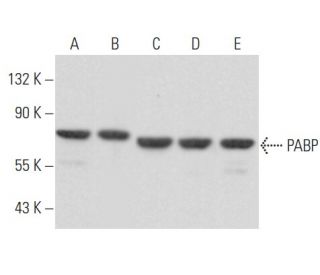
Nicht CRISPR-Daten: Das Bild veranschaulicht die Qualität von Antikörpern zur Visualisierung von CRISPR-Experimentergebnissen.
Nicht CRISPR-Daten: Das Bild veranschaulicht die Qualität von Antikörpern zur Visualisierung von CRISPR-Experimentergebnissen.
PABP CRISPR/Cas9 KO Plasmid (m): sc-422100
- Zielspezies: mouse
- 20 µg transfektionsfertige, aufgereinigte Plasmid DNA; geeignet für 20 Transfektionen
- PABP Das CRISPR/Cas9-Knockout (KO)-Plasmid (m) ist ein Pool von Plasmiden, von denen jedes für die Cas9-Nuklease und eine zielspezifische 20-nt-Guide-RNA (gRNA) kodiert, die für maximale Knockout-Effizienz unter Verwendung von Sequenzen aus der GeCKO v2-Bibliothek entwickelt wurde
- gRNA-Sequenzen lenken Cas9 so, dass es ortsspezifische Doppelstrangbrüche (DSBs) im PABP-Genomlokus induziert, was zu einem Gen-Knockout durch nicht-homologe Endverknüpfung (NHEJ) führt
- Die Puromycin-Resistenz- und RFP-Gene werden von LoxP-Stellen flankiert, was die Entfernung der Selektionsmarker mittels Cre-Rekombinase (Cre-Vektor: sc-418923) nach der Etablierung stabiler Knockout-Zelllinien ermöglicht
- Nach der Transfektion kann die Effizienz des Gen-Knockouts per Western Blot oder histologisch mit folgendem Antikörper überprüft werden: PABP: sc-32318

Bestellinformation
| Produkt | Katalog # | EINHEIT | Preis | ANZAHL | Favoriten | |
PABP CRISPR/Cas9 KO Plasmid (m) | sc-422100 | 20 µg | $397.00 |
Übersicht
Das murine Gen **Pabpc1** kodiert das Poly(A)-bindende Protein (PABP), einen zentralen Regulator des Schicksals zytoplasmatischer mRNAs, der an Poly(A)-Schwänze bindet und die Translationsinitiation, die Stabilisierung von mRNA sowie den deadenylierungsabhängigen Abbau koordiniert. Über Interaktionen mit eIF4G und anderen RNA-bindenden Proteinen trägt PABP dazu bei, die Länge des Poly(A)-Schwanzes mit der Ribosomenrekrutierung zu koppeln, und unterstützt eine effiziente Proteinsynthese während Wachstum, Differenzierung und Stressantworten. PABP ist zudem an posttranskriptionellen Kontrollprogrammen beteiligt, die mit Zellzyklusprogression, Apoptose und angeborenen antiviralen Antworten verknüpft sind, wodurch **Pabpc1** einen relevanten Knotenpunkt in Studien zu fehlregulierter Genexpression darstellt. Störungen PABP-abhängiger mRNA-Regulationsnetzwerke werden häufig im Zusammenhang mit onkogenen Translationsprogrammen sowie neuroentwicklungsbedingten oder neurodegenerativen Phänotypen untersucht, die durch einen veränderten RNA-Stoffwechsel verursacht werden.
Das PABP CRISPR/Cas9-KO-Plasmid (m) ist ein Pool von Plasmiden, die für die gezielte Disruption des Pabpc1-Gens in mouse-Zelllinien entwickelt wurden. Jedes Plasmid koexprimiert eine einzigartige Single-Guide-RNA (sgRNA), die auf eine bestimmte Stelle innerhalb des Pabpc1-Gens abzielt, zusammen mit der Streptococcus pyogenes Cas9-Nuklease. Die Plasmide kodieren zudem für GFP, was die fluoreszente Identifizierung und Anreicherung erfolgreich transfizierter Zellen mittels Fluoreszenzmikroskopie oder Durchflusszytometrie ermöglicht.
Das Multi-Guide-Design erhöht die Wahrscheinlichkeit, dass Insertionen oder Deletionen (Indels) entstehen, die den offenen Leserahmen von Pabpc1 nach der Cas9-vermittelten Bildung von Doppelstrangbrüchen unterbrechen. Durch das CRISPR/Cas9-System verursachte DNA-Brüche werden über endogene NHEJ-Wege (Non-Homologous End Joining) repariert, was häufig zu Frameshift-Mutationen führt, die die PABP-Proteinexpression aufheben.
Dieses CRISPR-Knockout-System ermöglicht die effiziente Erzeugung von Pabpc1-defizienten Zellmodellen zur Untersuchung der PABP-Signalübertragung, für funktionelle Genomstudien, in der Krebsbiologieforschung sowie zur Bewertung therapeutischer Reaktionen in menschlichen Zelllinien.
Hauptmerkmale
- sgRNAs, die auf Pabpc1-Exone abzielen, die für die PABP-Funktion entscheidend sind
Ko-Expression von SpCas9 und sgRNA aus einem einzigen Plasmid zur vereinfachten Verabreichung
GFP-Reporter zur Identifizierung transfizierter Zellen
Pool von Plasmiden, die auf mehrere Pabpc1-Genomstellen abzielen, um die Knockout-Effizienz zu verbessern
Kompatibel mit der Verabreichung durch Transfektion
Designvarianten
CRISPRs +/- HDRs
- gRNAs, die vom PABP CRISPR/Cas9-KO-Plasmid (m) und vom PABP CRISPR/Cas9-KO-Plasmid (m2) kodiert werden, zielen auf unterschiedliche Stellen innerhalb des Pabpc1-Lokus ab. Es kann ein oder beide Targeting-Designs verfügbar sein. Siehe „Verwandte Produkte“ für Verfügbarkeit.
HDR-Donorkonstrukte, kodiert durch das PABP HDR-Plasmid (m) und PABP HDR-Plasmid (m2) kodiert, enthalten eine Puromycin-Resistenzkassette und einen RFP-Reporter, flankiert von Pabpc1-Homologiearmen, um die homologe Reparatur an definierten Pabpc1-Zielstellen entsprechend den CRISPR/Cas9-KO-Designs zu unterstützen. Die Verfügbarkeit von HDR-Donoren kann variieren. Siehe „Verwandte Produkte“ für Verfügbarkeit.
Nur für Forschungszwecke. Nicht für diagnostische oder therapeutische Zwecke bestimmt.