
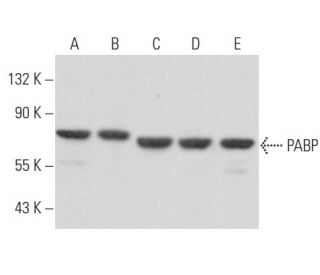
PABP Antikörper (F-2): sc-166027
- PABP Antikörper (F-2) ist ein Maus monoklonales IgG2a κ, verwendet in 8 wissenschaftlichen Veröffentlichungen, in einer Menge von 200 µg/ml
- gegen Aminosäuren gerichtet 1-300 deletion 82-129 (Deletion 82-129) Kartierung bei N-terminus von PABP von human Ursprung
- Empfohlen für die Detektion von PABP1, PABP2, PABP3, PABP4 and PABP5 aus der Spezies mouse, rat und human per WB, IP, IF, IHC(P) und ELISA
- Als Direktkonjugat zur Detektion von PABP wird PABP (A-4): sc-166381 angeboten; Primärantikörper konjugiert mit AC, HRP, FITC, PE, Alexa Fluor® 488, 594, 647, 680 und 790.
- m-IgG Fc BP-HRP und 2a BP-HRP">m-IgG2a BP-HRP sind die bevorzugten sekundären Nachweisreagenzien für PABP Antikörper (F-2) für WB- und IHC(P)-Anwendungen. Diese Reagenzien werden jetzt in Bündeln mit PABP Antikörper (F-2) angeboten(siehe Bestellinformationen unten).

Direktverknüpfungen
Siehe auch...
Poly(A)-bindendes Protein (PABP) ist ein essentielles, gut konserviertes, multifunktionales Protein, das an der translationalen Initiation, der mRNA-Biogenese und -Degradation beteiligt ist. PABP ist erforderlich für die Verkürzung des 3'-Poly(A)-Schwanzes der eukaryotischen mRNA und die Initiation der Translation. Die Interaktion zwischen PABP und dem eukaryotischen Translation-Initiation-Faktor 4G (eIF4G) ermöglicht die translationale Initiation polyadenylierter mRNAs. Diese Interaktion wird zumindest teilweise durch eIF4G vermittelt, das die mRNA-Terminusse durch gleichzeitiges Binden von PABP und dem Cap-bindenden Protein eIF4E verbindet. Mit geringeren Affinitäten kann PABP auch mit nicht-poly(A)-Sequenzen assoziieren. Die physiologischen Konsequenzen dieser PABP/RNA-Interaktionen sind weitgehend unklar, können aber Funktionen wie translationale Silencing umfassen. PABP ist ein modulares Protein mit vier N-terminalen RNA-bindenden Domänen und einem umfangreichen C-Terminus. Während der Infektion mit Poliovirus wurde vorgeschlagen, dass die Spaltung von eIF4GII und PABP zur vollständigen Unterdrückung der Wirts-Translation beitragen. Das humane PABP-Gen liegt auf Chromosom 8q22.2-q23 und kodiert ein Protein aus 633 Aminosäuren.
Alexa Fluor® ist ein Markenzeichen von Molecular Probes Inc., OR., USA
LI-COR® und Odyssey® sind Markenzeichen von LI-COR Biosciences
PABP Antikörper (F-2) Literaturhinweise:
- Das mRNA-Regelkreismodell: Die Funktion von PABP und PABP-interagierenden Proteinen bei der mRNA-Translation. | Kahvejian, A., et al. 2001. Cold Spring Harb Symp Quant Biol. 66: 293-300. PMID: 12762031
- Humanes PABP bindet AU-reiche RNA über die RNA-Bindungsdomänen 3 und 4. | Sladic, RT., et al. 2004. Eur J Biochem. 271: 450-7. PMID: 14717712
- Regulierung des Poly(A)-bindenden Proteins durch PABP-interagierende Proteine. | Derry, MC., et al. 2006. Cold Spring Harb Symp Quant Biol. 71: 537-43. PMID: 17381337
- Modulation der enteroviralen Proteinase-Spaltung des Poly(A)-Bindungsproteins (PABP) durch Konformation und PABP-assoziierte Faktoren. | Rivera, CI. and Lloyd, RE. 2008. Virology. 375: 59-72. PMID: 18321554
- PABP verbessert die Rekrutierung von Freisetzungsfaktoren und die Erkennung von Stoppcodons während der Translationsbeendigung. | Ivanov, A., et al. 2016. Nucleic Acids Res. 44: 7766-76. PMID: 27418677
- Die Translation von Insulin-Granulatproteinen wird durch PDI und PABP reguliert. | Sarwade, RD., et al. 2020. Biochem Biophys Res Commun. 526: 618-625. PMID: 32248978
- De-novo-Varianten in der PABP-Domäne von PABPC1 führen zu Entwicklungsverzögerungen. | Wegler, M., et al. 2022. Genet Med. 24: 1761-1773. PMID: 35511136
- Chemisch modifizierte Poly(A)-Analoga, die auf PABP abzielen: Struktur-Aktivitäts-Beziehung und translationshemmende Eigenschaften. | Perzanowska, O., et al. 2022. Chemistry. 28: e202201115. PMID: 35575378
- Kurze Poly(A)-Schwänze werden durch den LARP1-PABP-Komplex vor Deadenylierung geschützt. | Park, J., et al. 2023. Nat Struct Mol Biol. 30: 330-338. PMID: 36849640
- Poised PABP-RNA-Hubs implementieren den signalabhängigen mRNA-Abbau in der Entwicklung. | Modic, M., et al. 2024. Nat Struct Mol Biol. 31: 1439-1447. PMID: 39054355
Bestellinformation
| Produkt | Katalog # | EINHEIT | Preis | ANZAHL | Favoriten | |
PABP Antikörper (F-2) | sc-166027 | 200 µg/ml | $322.00 | |||
PABP (F-2): m-IgG Fc BP-HRP Bundle | sc-539992 | 200 µg Ab; 10 µg BP | $361.00 | |||
PABP (F-2): m-IgG2a BP-HRP Bundle | sc-546831 | 200 µg Ab; 10 µg BP | $361.00 |