
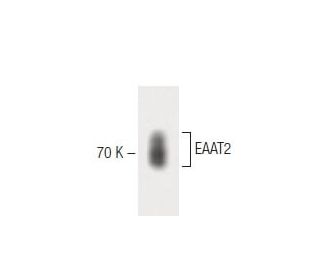

EAAT2 Antibody (20): sc-135892
- EAAT2 Antibody (20) is a mouse monoclonal IgG1, cited in 1 publications, provided at 50 µg/0.5 ml
- raised against amino acids 562-574 of EAAT2 of human origin
- recommended for detection of EAAT2 of mouse, rat and human origin by WB and IP
- See EAAT2 (E-1): sc-365634 for EAAT2 antibody conjugates, including AC, HRP, FITC, PE, Alexa Fluor® 488, 594, 647, 680 and 790.
- At present, we have not yet completed the identification of the preferred secondary detection reagent(s) for EAAT2 Antibody (20). This work is in progress.

QUICK LINKS
EAAT2 Antibody (20) is a mouse monoclonal IgG1 antibody that detects excitatory amino acid transporter 2 (EAAT2) in mouse, rat, and human samples through applications such as western blotting (WB) and immunoprecipitation (IP). EAAT2 plays a crucial role in the central nervous system by facilitating the uptake of the neurotransmitter L-glutamate, which is vital for maintaining synaptic homeostasis and preventing excitotoxicity. Anti-EAAT2 antibody (20) targets this transporter predominantly in astrocytes, where EAAT2 helps regulate extracellular glutamate levels, thereby protecting neurons from damage caused by excessive glutamate accumulation. The proper functioning of EAAT2 is essential for normal neuronal signaling and overall brain health, as dysregulation of glutamate transport can lead to various neurological disorders, including epilepsy and neurodegenerative diseases. EAAT2 is known to interact with several proteins, including the scaffolding protein PSD-95, which is important for synaptic stability and signaling. EAAT2 (20) monoclonal antibody enables researchers to gain insights into the expression and regulation of this critical transporter, furthering our understanding of its role in both physiological and pathological conditions.
Alexa Fluor® is a trademark of Molecular Probes Inc., OR., USA
LI-COR® and Odyssey® are registered trademarks of LI-COR Biosciences
EAAT2 Antibody (20) References:
- Genetic dys-regulation of astrocytic glutamate transporter EAAT2 and its implications in neurological disorders and manganese toxicity. | Karki, P., et al. 2015. Neurochem Res. 40: 380-8. PMID: 25064045
- Glutamate transporter EAAT2: regulation, function, and potential as a therapeutic target for neurological and psychiatric disease. | Takahashi, K., et al. 2015. Cell Mol Life Sci. 72: 3489-506. PMID: 26033496
- EAAT2 and the Molecular Signature of Amyotrophic Lateral Sclerosis. | Rosenblum, LT. and Trotti, D. 2017. Adv Neurobiol. 16: 117-136. PMID: 28828608
- Glutamate transporters, EAAT1 and EAAT2, are potentially important in the pathophysiology and treatment of schizophrenia and affective disorders. | Parkin, GM., et al. 2018. World J Psychiatry. 8: 51-63. PMID: 29988908
- A bioinformatic inquiry of the EAAT2 interactome in postmortem and neuropsychiatric datasets. | Asah, S., et al. 2022. Schizophr Res. 249: 38-46. PMID: 32197935
- Pharmacological induction of AMFR increases functional EAAT2 oligomer levels and reduces epileptic seizures in mice. | Sha, L., et al. 2022. JCI Insight. 7: PMID: 35938532
- The role of excitatory amino acid transporter 2 (EAAT2) in epilepsy and other neurological disorders. | Alijanpour, S., et al. 2023. Metab Brain Dis. 38: 1-16. PMID: 36173507
- HSP90β regulates EAAT2 expression and participates in ischemia‑reperfusion injury in rats. | Liang, T., et al. 2024. Mol Med Rep. 29: PMID: 37975223
- Leat-associated seizures the possible role of EAAT2, pyruvate carboxylase and glutamine synthetase. | Buccoliero, AM., et al. 2024. Epilepsy Res. 199: 107258. PMID: 38086219
- Proteomic profile of extracellular vesicles from plasma and CSF of multiple sclerosis patients reveals disease activity-associated EAAT2. | D'Ambrosio, A., et al. 2024. J Neuroinflammation. 21: 217. PMID: 39223661
Ordering Information
| Product Name | Catalog # | UNIT | Price | Qty | FAVORITES | |
EAAT2 Antibody (20) | sc-135892 | 50 µg/0.5 ml | $322.00 |