
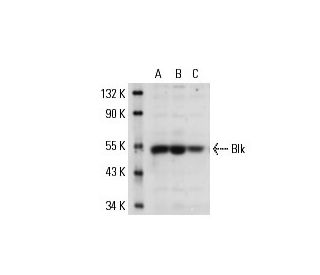

Anticorps Blk (9D10B7H6): sc-65939
- L'anticorps Blk 9D10B7H6 est un monoclonal IgG1 de souris, cité dans 1 publications, fourni en 100 µg/ml
- élevé contre la protéine recombinante Blk d'origine human.
- recommandé pour la détection de Blk d'origine human par WB, IP, IF et IHC(P)
- Nous testons actuellement encore nos anticorps secondaires pour trouver la meilleure protéine de liaison pour cet anticorps primaire Blk (9D10B7H6). Veuillez nous contacter si vous avez des questions concernant les réactifs de détection secondaire appropriés.

ACCÈS RAPIDE AUX LIENS
VOIR ÉGALEMENT...
Src is the human homolog of the v-Src gene of the Rous sarcoma virus, also known as avian sarcoma virus or ASV. Src was the first proto-oncogenic non-receptor tyrosine kinase characterized in human. Based on common structural motifs, the Src family is composed of nine members in vertebrates, including Src, Yes, Fgr, Frk, Fyn, Lyn, Hck, Lck and Blk. Src family kinases transduce signals that are involved in the control of a variety of cellular processes, including proliferation, differentiation, motility and adhesion. Src-family kinases contain an amino terminal cell membrane anchor followed by an SH3 domain and an SH2 domain involved in modular association and activation, respectively. Src family kinases are normally maintained in an inactive state and can be activated transiently during cellular events such as mitosis. Different subcellular localizations of Src-family kinases may be important for the regulation of specific cellular processes such as mitogenesis, cyto-skeletal organization and membrane trafficking. The human B lymphocyte kinase gene maps to chromosome 8p23.1 and encodes a 505 amino acid protein, known as Blk. Blk is expressed exclusively by B lymphocytes.
Alexa Fluor® est une marque déposée de Molecular Probes Inc., OR., USA
LI-COR® et Odyssey® sont marques déposées de LI-COR Biosciences
Anticorps Blk (9D10B7H6) Références:
- Association de IRF5, STAT4 et BLK avec le lupus érythémateux disséminé et d'autres maladies rhumatismales. | Tsuchiya, N., et al. 2010. Nihon Rinsho Meneki Gakkai Kaishi. 33: 57-65. PMID: 20453440
- L'haploinsuffisance de Blk entrave le développement, mais augmente les réponses fonctionnelles des cellules B MZ. | Samuelson, EM., et al. 2012. Immunol Cell Biol. 90: 620-9. PMID: 21894171
- Association entre les polymorphismes BLK et la susceptibilité au LED: Une méta-analyse. | Song, GG. and Lee, YH. 2017. Z Rheumatol. 76: 176-182. PMID: 27067206
- Les variants et interactions BLK et BANK1 sont associés à la susceptibilité au syndrome de Sjögren primaire et à certaines caractéristiques cliniques. | Montúfar-Robles, I., et al. 2021. Cell Immunol. 363: 104320. PMID: 33756160
- Polymorphismes BLK et niveau d'expression dans les troubles du spectre de la neuromyélite optique. | Yin, BW., et al. 2021. CNS Neurosci Ther. 27: 1549-1560. PMID: 34637583
- Découverte d'inhibiteurs irréversibles sélectifs de la tyrosine kinase des lymphocytes B (BLK). | Fu, T., et al. 2022. Eur J Med Chem. 229: 114051. PMID: 34952433
- Signification pronostique de l'expression de BLK dans le lymphome diffus à grandes cellules B traité par R-CHOP. | Choi, S., et al. 2022. J Pathol Transl Med. 56: 281-288. PMID: 36128864
- La phosphorylation tyrosine de l'IRF3 par BLK facilite son activation suffisante et la réponse antivirale innée. | Li, WW., et al. 2023. PLoS Pathog. 19: e1011742. PMID: 37871014
- BLK régule positivement la signalisation TLR/IL-1R en catalysant la phosphorylation de TOLLIP. | Li, WW., et al. 2024. J Cell Biol. 223: PMID: 38078859
- Inhibiteurs des kinases Fyn, Blk et Lyn: Une mini-revue sur les attributs médicinaux, les progrès de la recherche et les perspectives d'avenir. | Kohal, R., et al. 2024. Bioorg Med Chem Lett. 102: 129674. PMID: 38408513
Informations pour la commande
| Nom du produit | Ref. Catalogue | COND. | Prix HT | QTÉ | Favoris | |
Anticorps Blk (9D10B7H6) | sc-65939 | 100 µg/ml | $322.00 |