
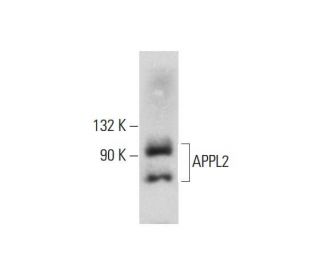


APPL2 Anticuerpo (E-1): sc-271084
- APPL2 Anticuerpo (E-1) es un monoclonal de ratón IgG1 κ, ver las 1 publicaciones, proporcionado como 200 µg/ml
- planteada frente a los aminoácidos 605-664 que corresponden al C-terminus de APPL2 de human origen
- recomendado para detectarAPPL2 de mouse, rat y human origen, mediante WB, IP, IF, IHC(P) y ELISA
- m-IgG Fc BP-HRP, 1 BP-HRP">m-IgG1 BP-HRP y m-IgGκ BP-HRP son los reactivos de detección secundarios preferidos para APPL2 Anticuerpo (E-1) para aplicaciones WB e IHC(P). Estos reactivos se ofrecen ahora en paquetes con APPL2 Anticuerpo (E-1)(véase la información de pedido más abajo).

ENLACES RÁPIDOS
La familia de proteínas APPL está involucrada en la conexión, el tráfico y la señalización aguas abajo de los receptores de tirosina quinasa. APPL1, también designada como proteína adaptadora que contiene dominio de pH, dominio PTB y motivo de cremallera de leucina 1; APPL; o proteína 13α que interactúa con DCC (DIP13α), y APPL2, también designada como proteína adaptadora que contiene dominio de pH, dominio PTB y motivo de cremallera de leucina 2 o proteína 13β que interactúa con DCC (DIP13β), están involucradas en el acoplamiento de la señalización del factor de crecimiento epidérmico (EGF) y la remodelación de la cromatina en el núcleo. Se asocian con la GTPasa Rab 5 y son liberadas de la membrana plasmática y trasladadas al núcleo. En el núcleo, APPL1 y APPL2 se asocian con NuRD/MeCP1 y son esenciales para el crecimiento y la proliferación celular. APPL2 también se asocia con el receptor de la hormona estimulante del folículo (FSHR). APPL2 se expresa en gran medida en el corazón, el cerebro, el músculo esquelético y el riñón. APPL2 comparte un 54% de homología con APPL1.
Alexa Fluor® es una marca registrada de Molecular Probes Inc., OR., USA
REIVEW LI-COR® y Odyssey® son marcas registradas de LI-COR Biosciences.
APPL2 Anticuerpo (E-1) Referencias:
- Orientación a la membrana por APPL1 y APPL2: andamios dinámicos que oligomerizan y se unen a fosfoinositidos. | Chial, HJ., et al. 2008. Traffic. 9: 215-29. PMID: 18034774
- La proteína adaptadora que contiene el dominio PH, el dominio PTB y la cremallera de leucina (APPL1) regula el nivel de proteína del EGFR modulando su tráfico. | Lee, JR., et al. 2011. Biochem Biophys Res Commun. 415: 206-11. PMID: 22037462
- La proteína multifuncional APPL2 contribuye a la supervivencia de las células de glioma humano. | Pyrzynska, B., et al. 2013. Mol Oncol. 7: 67-84. PMID: 22989406
- La proteína 2 que contiene el dominio PH en tándem (TAPP2) regula la reorganización del citoesqueleto inducida por quimioquinas y la migración de células B malignas. | Li, H., et al. 2013. PLoS One. 8: e57809. PMID: 23460911
- Asociación de la variación genética en los loci de la proteína adaptadora APPL1/APPL2 con la enfermedad del hígado graso no alcohólico. | Barbieri, M., et al. 2013. PLoS One. 8: e71391. PMID: 23977033
- La proteína adaptadora APPL2 inhibe la captación de glucosa estimulada por la insulina al interactuar con TBC1D1 en el músculo esquelético. | Cheng, KK., et al. 2014. Diabetes. 63: 3748-58. PMID: 24879834
- Rab31 y APPL2 mejoran la fagocitosis mediada por FcγR a través de la señalización PI3K/Akt en los macrófagos. | Yeo, JC., et al. 2015. Mol Biol Cell. 26: 952-65. PMID: 25568335
- La proteína adaptadora APPL2 afecta a los comportamientos antidepresivos en adultos y a la neurogénesis del hipocampo mediante la regulación de la sensibilidad del receptor de glucocorticoides. | Gao, C., et al. 2018. Mol Neurobiol. 55: 5537-5547. PMID: 28965332
- Ventricular Zone Expressed PH Domain Containing 1 (VEPH1): una proteína adaptadora capaz de modular múltiples vías de transducción de señales durante el desarrollo normal y patológico. | Brown, TJ., et al. 2019. Cell Commun Signal. 17: 116. PMID: 31500637
- La proteína adaptadora APPL2 controla la secreción de insulina estimulada por glucosa a través de la remodelación de la F-actina en las células β pancreáticas. | Wang, B., et al. 2020. Proc Natl Acad Sci U S A. 117: 28307-28315. PMID: 33122440
Información sobre pedidos
| Nombre del producto | Número de catálogo | UNIDAD | Precio | CANTIDAD | Favoritos | |
APPL2 Anticuerpo (E-1) | sc-271084 | 200 µg/ml | $322.00 | |||
Paquete de APPL2 (E-1): m-IgG Fc BP-HRP | sc-537568 | 200 µg Ab; 10 µg BP | $361.00 | |||
Paquete de APPL2 (E-1): m-IgGκ BP-HRP | sc-534868 | 200 µg Ab; 40 µg BP | $361.00 | |||
Paquete de APPL2 (E-1): m-IgG1 BP-HRP | sc-545234 | 200 µg Ab; 20 µg BP | $361.00 |