
Date published: 2026-7-11

1-800-457-3801

SCBT Portrait Logo
Seach Input

TDP1 CRISPR Activation Plasmid (h): sc-405057-ACT

0.0(0)
Write a reviewAsk a question

Datasheets
  • Target species: human
  • 20 µg of transfection-ready, purified plasmid DNA; Suitable for up to 20 transfections
  • TDP1 CRISPR Activation Plasmid (h) is a synergistic activation mediator (SAM) transcription activation system designed to specifically upregulate gene expression
  • TDP1 CRISPR Activation Plasmid (h) consists of three plasmids at a 1:1:1 mass ratio: a plasmid encoding the deactivated Cas9 (dCas9) nuclease (D10A and N863A) fused to the transactivation domain VP64, and a blasticidin resistance gene; a plasmid encoding the MS2-p65-HSF1 fusion protein, and a hygromycin resistance gene; a plasmid encoding a target-specific 20 nt guide RNA fused to two MS2 RNA aptamers, and a puromycin resistance gene
  • The resulting SAM complex binds to a site-specific region approximately 200-250 nt upstream of the transcriptional start site and provides robust recruitment of transcription factors for highly efficient gene activation
  • gRNAs encoded by TDP1 CRISPR Activation Plasmid (h) and TDP1 CRISPR Activation Plasmid (h2) target distinct regulatory regions upstream of the TDP1 transcriptional start site. One or both designs may be available
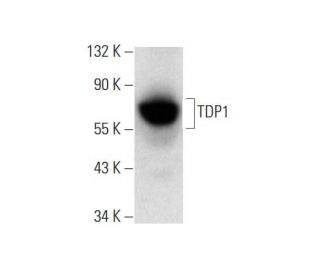
  • Following transfection, gene knockout efficiency can be assayed by WB, IF or IHC using antibody: TDP1 Antibody (C-3): sc-365674
    Gene Editing Promo Banner

    Ordering Information

    Product NameCatalog #UNITPriceQtyFAVORITES

    TDP1 CRISPR Activation Plasmid (h)

    sc-405057-ACT
    20 µg
    $397.00

    Tyrosyl-DNA phosphodiesterase 1 (TDP1) is a DNA repair enzyme that resolves stalled topoisomerase I–DNA covalent complexes by hydrolyzing 3′-phosphotyrosyl linkages, restoring ligatable DNA ends during single-strand break repair. This activity supports genome stability during transcription and replication stress and interfaces with pathways coordinated by PARP1, XRCC1, and DNA ligase III to process oxidative and abortive ligation intermediates. Perturbation of TDP1 function disrupts repair of topoisomerase-induced lesions and has been linked to neurodegeneration and heightened sensitivity to DNA damaging agents, underscoring its relevance to studies of neuronal maintenance and genotoxic stress responses. In cancer biology and chromosome biology research, TDP1 is frequently examined for its role in DNA damage tolerance, replication fork integrity, and transcription-associated DNA break repair.

    TDP1 CRISPR Activation Plasmid (h) provides a targeted, non-destructive approach to upregulating endogenous TDP1 expression without altering the underlying DNA sequence.

    TDP1 CRISPR Activation Plasmid (h) is a three-plasmid synergistic activation mediator (SAM) system engineered for highly efficient, site-specific transcriptional upregulation of the TDP1 locus in human cell lines. The system is built around a catalytically inactive Cas9 (dCas9) carrying two inactivating mutations (D10A and N863A) that eliminate nuclease activity while preserving DNA binding. This dCas9 is fused to VP64, a potent transcriptional activator, and is co-expressed with a blasticidin resistance gene for selection. The second plasmid encodes the MS2-p65-HSF1 fusion protein, a secondary activator complex that works in concert with dCas9-VP64, alongside a hygromycin resistance gene. The third plasmid encodes a target-specific 20 nt sgRNA fused to two MS2 RNA aptamers that recruit the MS2-p65-HSF1 complex to the activation site, accompanied by a puromycin resistance gene. The three plasmids are delivered at a 1:1:1 mass ratio for balanced expression of all system components.

    Once assembled at the target locus, the SAM complex binds within approximately 200 bp upstream of the TDP1 transcriptional start site, where VP64, p65, and HSF1 act in concert to recruit transcriptional machinery and drive upregulation of endogenous TDP1 expression. Unlike nuclease-active Cas9, dCas9 does not introduce double-strand breaks or modify the genomic sequence, preserving the native TDP1 locus and enabling the study of TDP1-dependent transcriptional responses at the endogenous locus, making it a valuable tool for functional studies, target gene identification, and the modeling of TDP1 pathway restoration in tumor cells with silenced or reduced TDP1 expression.

    For Research Use Only. Not Intended for Diagnostic or Therapeutic Use.
