
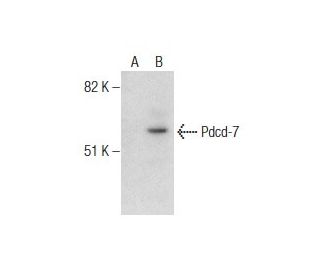


Pdcd-7 Antibody (S-18): sc-101250
- Pdcd-7 Antibody (S-18) is a mouse monoclonal IgG2a κ Pdcd-7 antibody provided at 100 µg/ml
- raised against recombinant Pdcd-7 of human origin
- recommended for detection of Pdcd-7 of mouse, rat and human origin by WB, IP and ELISA
- At present, we have not yet completed the identification of the preferred secondary detection reagent(s) for Pdcd-7 Antibody (S-18). This work is in progress.

QUICK LINKS
Pdcd-7 Antibody (S-18) is a mouse monoclonal IgG2a kappa light chain antibody that detects Pdcd-7 of mouse, rat, and human origin by western blotting (WB), immunoprecipitation (IP), and enzyme-linked immunosorbent assay (ELISA). Anti-Pdcd-7 antibody (S-18) is available as a non-conjugated format. Pdcd-7, also known as programmed cell death protein 7, is a crucial regulator of apoptosis, consisting of 485 amino acids and promoting cell death when overexpressed. Pdcd-7 plays a significant role in the immune system by modulating apoptotic pathways, which is vital for maintaining cellular homeostasis and preventing uncontrolled cell proliferation. Human and mouse versions of Pdcd-7 exhibit 95% homology in overlapping regions, underscoring evolutionary conservation of function across species. Pdcd-7 expression is particularly relevant in immune responses, as induction occurs in stimulated B and T cell lines, suggesting involvement in negative regulation of immune activities. Pdcd-7 serves as a valuable target for research in immunology and cancer therapy, where understanding apoptosis mechanisms can lead to novel therapeutic strategies.
Alexa Fluor® is a trademark of Molecular Probes Inc., OR., USA
LI-COR® and Odyssey® are registered trademarks of LI-COR Biosciences
Pdcd-7 Antibody (S-18) References:
- Characterization of a novel mouse cDNA, ES18, involved in apoptotic cell death of T-cells. | Park, EJ., et al. 1999. Nucleic Acids Res. 27: 1524-30. PMID: 10037816
- Increased expression of apoptosis-linked gene 2 (ALG2) in the rat brain after temporary focal cerebral ischemia. | Li, W., et al. 2000. Neuroscience. 96: 161-8. PMID: 10683420
- PD-L2 is a second ligand for PD-1 and inhibits T cell activation. | Latchman, Y., et al. 2001. Nat Immunol. 2: 261-8. PMID: 11224527
- Induced expression of PD-1, a novel member of the immunoglobulin gene superfamily, upon programmed cell death. | Ishida, Y., et al. 1992. EMBO J. 11: 3887-95. PMID: 1396582
- Alterations of DNA copy number and expression in genes involved in cell cycle regulation and apoptosis signal pathways in gamma-radiation-sensitive SX9 cells and -resistant SR-1 cells. | Koshikawa, T., et al. 2005. Radiat Res. 163: 374-83. PMID: 15799692
- Coordination of intrinsic, extrinsic, and endoplasmic reticulum-mediated apoptosis by imatinib mesylate combined with arsenic trioxide in chronic myeloid leukemia. | Du, Y., et al. 2006. Blood. 107: 1582-90. PMID: 16249384
- Deregulated stress system in non-obese diabetic lymphocyte. | Liu, Z. and Aune, TM. 2006. Genes Immun. 7: 352-8. PMID: 16691184
- Expression of the PD-1 antigen on the surface of stimulated mouse T and B lymphocytes. | Agata, Y., et al. 1996. Int Immunol. 8: 765-72. PMID: 8671665
Ordering Information
| Product Name | Catalog # | UNIT | Price | Qty | FAVORITES | |
Pdcd-7 Antibody (S-18) | sc-101250 | 100 µg/ml | $322.00 |