
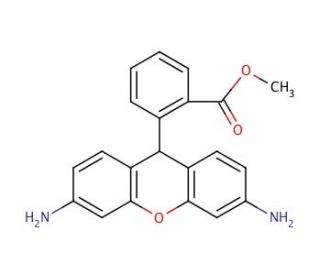


Dihydrorhodamine 123 (CAS 109244-58-8)
See product citations (25)
QUICK LINKS
Dihydrorhodamine 123 (CAS: 109244-58-8) is a chemical compound that has found significant utility in scientific research due to its distinctive characteristics and diverse applications. Primarily utilized as a fluorescent probe, dihydrorhodamine 123 is employed to investigate the presence and activity of reactive oxygen species (ROS) within biological systems. Its mechanism of action involves undergoing oxidation by ROS, resulting in the formation of a highly fluorescent compound known as rhodamine 123. This fluorescence enables researchers to visualize and quantify ROS levels in various experimental samples, providing valuable insights into oxidative stress and redox signaling. In research settings, dihydrorhodamine 123 has been extensively employed to explore the involvement of ROS in a wide range of biological processes. It serves as a valuable tool in studying oxidative damage, cellular aging, and the role of ROS in various diseases. By measuring the intensity of rhodamine 123 fluorescence, scientists can assess the levels of ROS generation and evaluate their impact on cellular function and overall physiological homeostasis. Furthermore, dihydrorhodamine 123′s versatility extends beyond fluorescence-based studies. It has also been utilized in flow cytometry and microplate-based assays to quantify ROS levels in a high-throughput manner, enabling large-scale screening and analysis of oxidative stress in diverse experimental systems.
Dihydrorhodamine 123 (CAS 109244-58-8) References
- Dihydrorhodamine 123 is superior to 2,7-dichlorodihydrofluorescein diacetate and dihydrorhodamine 6G in detecting intracellular hydrogen peroxide in tumor cells. | Qin, Y., et al. 2008. Cell Biol Int. 32: 224-8. PMID: 17920943
- A 700 nm LED Light Activated Ru(II) Complex Destroys Tumor Cytoskeleton via Photosensitization and Photocatalysis. | Dao, A., et al. 2024. Adv Healthc Mater. e2400956. PMID: 38635863
- Resveratrol prevents the release of neutrophil extracellular traps (NETs) by controlling hydrogen peroxide levels and nuclear elastase migration. | de Mattos, TRF., et al. 2024. Sci Rep. 14: 9107. PMID: 38643283
- Donor-Acceptor Modulating of Ionic AIE Photosensitizers for Enhanced ROS Generation and NIR-II Emission. | Yang, X., et al. 2024. Adv Mater. e2402182. PMID: 38663035
- Photosensitive AIEgens sensitize bacteria to oxidative damage and modulate the inflammatory responses of macrophages to salvage the photodynamic therapy against MRSA. | Wu, Y., et al. 2024. Biomaterials. 309: 122583. PMID: 38692148
- Metal-Organic Framework-Based Nanovaccine for Relieving Immunosuppressive Tumors via Hindering Efferocytosis of Macrophages and Promoting Pyroptosis and Cuproptosis of Cancer Cells. | Liu, Y., et al. 2024. ACS Nano. 18: 12386-12400. PMID: 38699808
- Inhibition of succinate:ubiquinone reductase and decrease of ubiquinol in nephrotoxic cysteine S-conjugate-induced oxidative cell injury. | van de Water, B., et al. 1995. Mol Pharmacol. 48: 928-37. PMID: 7476924
- Counterprotective effect of erythrocytes in experimental bacterial peritonitis is due to scavenging of nitric oxide and reactive oxygen intermediates. | Kim, YM., et al. 1996. Infect Immun. 64: 3074-80. PMID: 8757836
- Role of reactive oxygen intermediates in TCR-induced death of T cell blasts and hybridomas. | Williams, MS. and Henkart, PA. 1996. J Immunol. 157: 2395-402. PMID: 8805638
- Dichlorodihydrofluorescein and dihydrorhodamine 123 are sensitive indicators of peroxynitrite in vitro: implications for intracellular measurement of reactive nitrogen and oxygen species. | Crow, JP. 1997. Nitric Oxide. 1: 145-57. PMID: 9701053
Ordering Information
| Product Name | Catalog # | UNIT | Price | Qty | FAVORITES | |
Dihydrorhodamine 123, 10 mg | sc-203027 | 10 mg | $175.00 |