
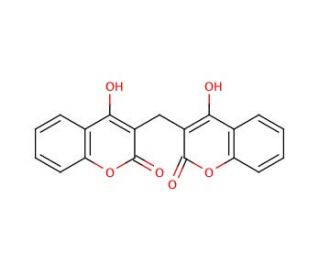

Dicoumarol (CAS 66-76-2)
See product citations (8)
QUICK LINKS
Dicoumarol is a reductase inhibitor possessing anticoagulant properties. Dicoumarol also aids in apoptosis induction via stimulation of SAPK-JNK and NF-κB pathway blocking. This has no effect on the phosphorylation of P38 or activation of AKT. Additionally, Dicoumarol may act to block brefeldin A-dependent mono-ADP-ribosylation in vitro and Golgi disassembly in living cells. Dicoumarol is an inhibitor of NQO1. Dicoumarol is a potent inhibitor of NADH:quinone oxidoreductase (NQO1), exhibiting competitive inhibition with IC50 values of 2.6 nM in the absence of 2 μM BSA, and 404 nM in its presence. This compound demonstrates significant antiproliferative effects on MIA PaCa-2 pancreatic and HCT116 colon carcinoma cells, with IC50 values of 52 μM and 19 μM, respectively, following a 96-hour incubation period.
Dicoumarol (CAS 66-76-2) References
- Quinone reductase inhibitors block SAPK/JNK and NFkappaB pathways and potentiate apoptosis. | Cross, JV., et al. 1999. J Biol Chem. 274: 31150-4. PMID: 10531305
- NAD(P)H:Quinone oxidoreductase activity is the principal determinant of beta-lapachone cytotoxicity. | Pink, JJ., et al. 2000. J Biol Chem. 275: 5416-24. PMID: 10681517
- Transient activation of Jun N-terminal kinases and protection from apoptosis by the insulin-like growth factor I receptor can be suppressed by dicumarol. | Krause, D., et al. 2001. J Biol Chem. 276: 19244-52. PMID: 11278392
- Reactive quinones differentially regulate SAPK/JNK and p38/mHOG stress kinases. | Seanor, KL., et al. 2003. Antioxid Redox Signal. 5: 103-13. PMID: 12626122
- Dicoumarol alters cellular redox state and inhibits nuclear factor kappa B to enhance arsenic trioxide-induced apoptosis. | Jing, YW., et al. 2004. Acta Biochim Biophys Sin (Shanghai). 36: 235-42. PMID: 15202509
- Dicoumarol relieves serum withdrawal-induced G0/1 blockade in HL-60 cells through a superoxide-dependent mechanism. | Bello, RI., et al. 2005. Biochem Pharmacol. 69: 1613-25. PMID: 15896341
- Dicoumarol down-regulates human PTTG1/Securin mRNA expression through inhibition of Hsp90. | Hernández, A., et al. 2008. Mol Cancer Ther. 7: 474-82. PMID: 18347135
- Dicoumarol activates Ca2+-permeable cation channels triggering erythrocyte cell membrane scrambling. | Qadri, SM., et al. 2011. Cell Physiol Biochem. 28: 857-64. PMID: 22178938
- Dicoumarol inhibits rat NAD(P)H:quinone oxidoreductase in vitro and induces its expression in vivo. | Stiborova, M., et al. 2014. Neuro Endocrinol Lett. 35 Suppl 2: 123-32. PMID: 25638376
- Determination of dicoumarol in Melilotus officinalis L. by using molecularly imprinted polymer solid-phase extraction coupled with high performance liquid chromatography. | Hroboňová, K., et al. 2018. J Chromatogr A. 1539: 93-102. PMID: 29395163
- Dicoumarol Inhibits Multidrug Resistance Protein 1-Mediated Export Processes in Cultured Primary Rat Astrocytes. | Raabe, J., et al. 2019. Neurochem Res. 44: 333-346. PMID: 30443714
- Characterization of chemical inhibitors of brefeldin A-activated mono-ADP-ribosylation. | Weigert, R., et al. 1997. J Biol Chem. 272: 14200-7. PMID: 9162051
- Coordinated action of glutathione S-transferases (GSTs) and multidrug resistance protein 1 (MRP1) in antineoplastic drug detoxification. Mechanism of GST A1-1- and MRP1-associated resistance to chlorambucil in MCF7 breast carcinoma cells. | Morrow, CS., et al. 1998. J Biol Chem. 273: 20114-20. PMID: 9685354
Ordering Information
| Product Name | Catalog # | UNIT | Price | Qty | FAVORITES | |
Dicoumarol, 500 mg | sc-205647 | 500 mg | $20.00 | |||
Dicoumarol, 5 g | sc-205647A | 5 g | $40.00 |