
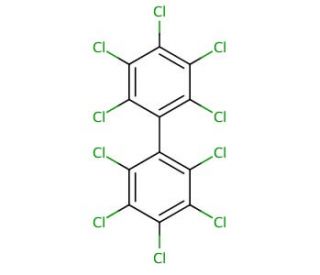

Molecular structure of Decachlorobiphenyl, CAS Number: 2051-24-3
Decachlorobiphenyl (CAS 2051-24-3)
Alternate Names:
Decachlorobiphenyl is also known as PCB 209.
Application:
Decachlorobiphenyl is a polychlorinated biphenyl that bioaccumulates in humans via the food chain.
CAS Number:
2051-24-3
Molecular Weight:
498.66
Molecular Formula:
C12Cl10
Supplemental Information:
This is classified as a Dangerous Good for transport and may be subject to additional shipping charges.
For Research Use Only. Not Intended for Diagnostic or Therapeutic Use.
* Refer to Certificate of Analysis for lot specific data.
QUICK LINKS
Ordering Information
Description
Technical Information
Safety Information
SDS & Certificate of Analysis
Decachlorobiphenyl is a polychlorinated biphenyl. A persistent and lipophilic chemical, Decachlorobiphenyl is found bioaccumulatinh in humans through the food chain. Decachlorobiphenyl can be applied as a surrogate calibration standard in the Gas Chromatography of hydrocarbon impurities found in ethylene.
Decachlorobiphenyl (CAS 2051-24-3) References
- Pathways and products of the degradation of PCBs by the sodium dispersion method. | Noma, Y., et al. 2007. Chemosphere. 68: 871-9. PMID: 17368509
- Debromination of decabrominated diphenyl ether by resin-bound iron nanoparticles. | Li, A., et al. 2007. Environ Sci Technol. 41: 6841-6. PMID: 17969704
- Decabromobiphenyl (PBB-209) activates the aryl hydrocarbon receptor while decachlorobiphenyl (PCB-209) is inactive: experimental evidence and computational rationalization of the different behavior of some halogenated biphenyls. | Alonso, M., et al. 2008. Chem Res Toxicol. 21: 643-58. PMID: 18311929
- Simultaneous determination of decachlorobiphenyl, octachloronaphthalene and decachloro-1,4-dihydronaphthalene in mixtures, by HPLC. | Ivanov, Z., et al. 1983. Talanta. 30: 277-8. PMID: 18963358
- GC/MS determination of incidental PCBs in complex chlorinated-hydrocarbon process and waste streams. | Collard, RS. and Irwin, MM. 1983. Talanta. 30: 811-8. PMID: 18963473
- Non-coplanar 2,2',3,3',4,4',5,5',6,6'-decachlorobiphenyl (PCB 209) did not induce cytochrome P450 enzyme activities in primary cultured rat hepatocytes, was not genotoxic, and did not exhibit endocrine-modulating activities. | Han, X., et al. 2009. Toxicology. 255: 177-86. PMID: 19022331
- Thermal degradation of polybrominated diphenyl ethers over as-prepared Fe3O4 micro/nano-material and hypothesized mechanism. | Li, Q., et al. 2016. Environ Sci Pollut Res Int. 23: 1540-51. PMID: 26377966
- Organochlorine Pesticides in Gonad, Brain, and Blood of Mice in Two Agricultural Areas of Sinaloa. | Perez-Gonzalez, E., et al. 2017. Bull Environ Contam Toxicol. 98: 454-459. PMID: 28110349
- Photochemical formation of hydroxylated polychlorinated biphenyls (OH-PCBs) from decachlorobiphenyl (PCB-209) on solids/air interface. | Li, C., et al. 2019. J Hazard Mater. 378: 120758. PMID: 31207486
- Application of inert gas-mediated ionization for qualitative screening of chlorinated aromatics in house dust by comprehensive two-dimensional gas chromatography-high-resolution time-of-flight mass spectrometry. | Ieda, T., et al. 2021. J Chromatogr A. 1657: 462571. PMID: 34614469
- Cigarette smoke tracers: gas chromatographic analysis of decachlorobiphenyl. | Lewis, CI., et al. 1973. Am Rev Respir Dis. 108: 367-70. PMID: 4720699
- Comparative study on accumulation and elimination of hexachlorobiphenyls and decachlorobiphenyl in mice. | Mizutani, T., et al. 1980. Bull Environ Contam Toxicol. 25: 181-7. PMID: 6775714
- Distribution and excretion of two chlorinated biphenyl isomers: 4-chlorobiphenyl and decachlorobiphenyl in lactating bovine. | Platonow, NS. and Meads, EB. 1975. Can J Comp Med. 39: 104-6. PMID: 803397
Ordering Information
| Product Name | Catalog # | UNIT | Price | Qty | FAVORITES | |
Decachlorobiphenyl, 10 mg | sc-257302 | 10 mg | $89.00 |