
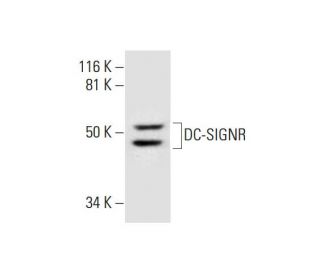


DC-SIGNR Antibody (F-2): sc-390788
- DC-SIGNR Antibody (F-2) is a mouse monoclonal mouse IgM κ κ provided at 200 µg/ml
- specific for an epitope mapping between amino acids 364-390 of DC-SIGNR of human origin
- recommended for detection of DC-SIGNR of human origin by WB, IP, IF and ELISA
- m-IgGκ BP-HRP is the preferred secondary detection reagent for DC-SIGNR Antibody (F-2) for WB applications. This reagent is now offered in a bundle with DC-SIGNR Antibody (F-2) (see ordering information below). For additional m-IgGκ BP conjugates see our complete list of Mouse IgG Binding Proteins.

DC-SIGNR Antibody (F-2) is a mouse monoclonal IgM antibody that detects DC-SIGNR in human samples through applications such as western blotting (WB), immunoprecipitation (IP), immunofluorescence (IF), and enzyme-linked immunosorbent assay (ELISA). DC-SIGNR, also known as CD209L or L-SIGN, is a type II integral membrane protein that shares 77% identity with DC-SIGN and is primarily expressed on sinusoidal endothelial cells. Anti-DC-SIGNR antibody (F-2) recognizes a protein that plays a crucial role in the immune response by binding to the E2 glycoproteins of the hepatitis C virus, facilitating viral entry into host cells. The interaction between DC-SIGNR and hepatitis C virus is significant as DC-SIGNR not only aids in the virus′s evasion of the immune system but also enhances the spread of the virus within the liver and lymphatic tissues. DC-SIGNR (F-2) antibody enables researchers to investigate the mechanisms of viral infection and immune evasion, contributing to the development of targeted therapies and vaccines against hepatitis C.
Alexa Fluor® is a trademark of Molecular Probes Inc., OR., USA
LI-COR® and Odyssey® are registered trademarks of LI-COR Biosciences
DC-SIGNR Antibody (F-2) References:
- Structural basis for distinct ligand-binding and targeting properties of the receptors DC-SIGN and DC-SIGNR. | Guo, Y., et al. 2004. Nat Struct Mol Biol. 11: 591-8. PMID: 15195147
- Determination of DC-SIGN and DC-SIGNR repeat region variations. | Liu, H. and Zhu, T. 2005. Methods Mol Biol. 304: 471-81. PMID: 16061998
- Expression of DC-SIGN and DC-SIGNR on human sinusoidal endothelium: a role for capturing hepatitis C virus particles. | Lai, WK., et al. 2006. Am J Pathol. 169: 200-8. PMID: 16816373
- The polymorphisms in DC-SIGNR affect susceptibility to HIV type 1 infection. | Wichukchinda, N., et al. 2007. AIDS Res Hum Retroviruses. 23: 686-92. PMID: 17530994
- Interactions of LSECtin and DC-SIGN/DC-SIGNR with viral ligands: Differential pH dependence, internalization and virion binding. | Gramberg, T., et al. 2008. Virology. 373: 189-201. PMID: 18083206
- Autonomous tetramerization domains in the glycan-binding receptors DC-SIGN and DC-SIGNR. | Yu, QD., et al. 2009. J Mol Biol. 387: 1075-80. PMID: 19249311
- Functional genetic variants in DC-SIGNR are associated with mother-to-child transmission of HIV-1. | Boily-Larouche, G., et al. 2009. PLoS One. 4: e7211. PMID: 19809496
- Geometry and adhesion of extracellular domains of DC-SIGNR neck length variants analyzed by force-distance measurements. | Leckband, DE., et al. 2011. Biochemistry. 50: 6125-32. PMID: 21650186
- The DC-SIGNR 7/5 genotype is associated with high dendritic cell counts and their subsets in patients infected with HIV-1. | Chaudhary, O., et al. 2013. J Clin Immunol. 33: 788-97. PMID: 23354840
- Kaposi's sarcoma-associated herpesvirus K3 and K5 proteins down regulate both DC-SIGN and DC-SIGNR. | Lang, SM., et al. 2013. PLoS One. 8: e58056. PMID: 23460925
Ordering Information
| Product Name | Catalog # | UNIT | Price | Qty | FAVORITES | |
DC-SIGNR Antibody (F-2) | sc-390788 | 200 µg/ml | $322.00 | |||
DC-SIGNR Antibody (F-2): m-IgGκ BP-HRP Bundle | sc-552539 | 200 µg Ab; 40 µg BP | $361.00 | |||
DC-SIGNR (F-2) Neutralizing Peptide | sc-390788 P | 100 µg/0.5 ml | $69.00 |