
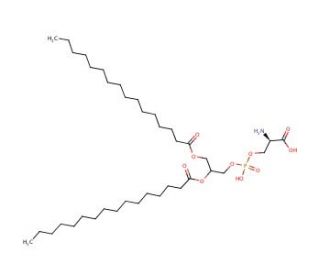

1,2-Dipalmitoyl-rac-glycero-3-phospho-L-serine 的分子结构, CAS编号: 3036-82-6
1,2-Dipalmitoyl-rac-glycero-3-phospho-L-serine (CAS 3036-82-6)
CAS号码:
3036-82-6
分子量:
735.97
分子式:
C38H74NO10P
仅供科研使用。不可用于诊断或治疗。
* 参考分析证明 大量特定数据 (包括水 含量).
快捷链接
订购信息
描述
技术信息
安全信息
安全技术说明书和分析证明书
1,2-二棕榈酰-rac-甘油-3-磷酸-L-丝氨酸是一种具有特殊结构组成的磷脂,在基础生物物理研究中发挥着重要作用。每个分子都由甘油骨架组成,其中第一和第二碳与饱和脂肪酸棕榈酸酯化,第三碳与磷-L-丝氨酸头基键合。这种结构为研究脂质双分子层的特性和行为提供了理想的模型。在研究中,这种磷脂因其能够形成稳定、明确的双分子层而备受重视,成为研究膜动力学、脂质相互作用以及脂质成分对膜的物理性质(如相行为、流动性和渗透性)的影响的绝佳工具。带负电荷的丝氨酸头基的存在使科学家们能够探索电荷对双分子层结构的影响以及与周围环境中阳离子的相互作用。这对于理解膜内的静电相互作用等现象及其对整个膜结构的影响至关重要。此外,1,2-二棕榈酰-rac-甘油-3-磷酸-L-丝氨酸还被用于细胞膜建模,以研究膜不对称的内在机制,以及在非医学背景下脂类和膜相关蛋白质之间的特定相互作用。通过这些研究,可以深入了解细胞膜功能的基本机制,并将这些原理应用于从材料科学到纳米技术等领域,从而开发出先进的材料和设备。
1,2-Dipalmitoyl-rac-glycero-3-phospho-L-serine (CAS 3036-82-6) 参考文献
- 磷脂对牛胰蛋白酶抑制剂(BPTI)及其热稳定性突变体构象结构的影响。 | Izumikawa, N., et al. 2008. Biopolymers. 89: 873-80. PMID: 18521887
- 生物仿生单层的脂质成分对 HIV-1 的 gp41 富色氨酸肽的结构和取向的影响。 | Matar, G. and Besson, F. 2011. Biochim Biophys Acta. 1808: 2534-43. PMID: 21699883
- 离子液体诱导的细胞膜结构变化:从模型到细菌膜 | Bhattacharya, G., et al. 2018. Chem Phys Lipids. 215: 1-10. PMID: 29944866
订购信息
| 产品名称 | 产品编号 | 规格 | 价格 | 数量 | 收藏夹 | |
1,2-Dipalmitoyl-rac-glycero-3-phospho-L-serine, 5 mg | sc-213446 | 5 mg | $353.00 |