
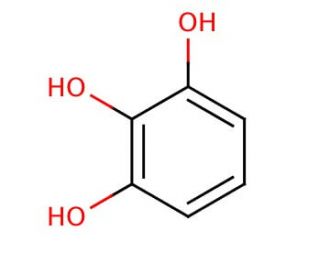

Pyrogallol (CAS 87-66-1)
QUICK LINKS
Pyrogallol, a trihydroxybenzene derivative, is extensively utilized in scientific research due to its strong reducing properties and ability to complex with metals. In the realm of photochemistry, pyrogallol is used to study the dynamics of photo-oxidative processes because it readily undergoes oxidation in the presence of light and oxygen, making it an excellent model compound for understanding the behavior of phenolic substances under environmental conditions. This chemical is also pivotal in analytical chemistry, where it serves as a reagent in the analysis of oxygen and other gases through its role in absorbing gases in solution. Its utility is further extended to the field of materials science, particularly in the development of functional materials with advanced oxidation resistance properties. Researchers employ pyrogallol in the synthesis of innovative polymers and coatings designed to enhance material stability against oxidative stress. Additionally, pyrogallol′s ability to act as a natural chelating agent is exploited in the removal of metal ions from solutions, contributing to studies on water treatment and metal recovery processes. These applications highlight pyrogallol′s versatility and its importance in advancing research in environmental science, materials engineering, and analytical methodologies.
Pyrogallol (CAS 87-66-1) References
- Microbial synthesis of pyrogallol using genetically engineered Escherichia coli. | Wang, J., et al. 2018. Metab Eng. 45: 134-141. PMID: 29247864
- Pyrogallol and Fluconazole Interact Synergistically In Vitro against Candida glabrata through an Efflux-Associated Mechanism. | Yao, D., et al. 2021. Antimicrob Agents Chemother. 65: e0010021. PMID: 33875436
- Identification of pyrogallol as a warhead in design of covalent inhibitors for the SARS-CoV-2 3CL protease. | Su, H., et al. 2021. Nat Commun. 12: 3623. PMID: 34131140
- Pyrogallol downregulates the expression of virulence-associated proteins in Acinetobacter baumannii and showing anti-infection activity by improving non-specific immune response in zebrafish model. | Abirami, G., et al. 2023. Int J Biol Macromol. 226: 853-869. PMID: 36526063
- Exposure to pyrogallol impacts the hemato-biochemical endpoints in catfish (Clarias gariepinus). | Hamed, M., et al. 2023. Environ Pollut. 333: 122074. PMID: 37331582
- Pyrogallol impairs staphylococcal biofilm formation via induction of bacterial oxidative stress. | Roese, KHC., et al. 2023. J Appl Microbiol. 134: PMID: 37974055
- Gallic acid: design of a pyrogallol-containing hydrogel and its biomedical applications. | Weian, W., et al. 2024. Biomater Sci. 12: 1405-1424. PMID: 38372381
- Involvement of the superoxide anion radical in the autoxidation of pyrogallol and a convenient assay for superoxide dismutase. | Marklund, S. and Marklund, G. 1974. Eur J Biochem. 47: 469-74. PMID: 4215654
- Pyrogallol red-molybdate: a reversible, metal chelate stain for detection of proteins immobilized on membrane supports. | Shojaee, N., et al. 1996. Electrophoresis. 17: 687-93. PMID: 8738328
- Nitric oxide synergistically enhances DNA strand breakage induced by polyhydroxyaromatic compounds, but inhibits that induced by the Fenton reaction. | Yoshie, Y. and Ohshima, H. 1997. Arch Biochem Biophys. 342: 13-21. PMID: 9185609
Ordering Information
| Product Name | Catalog # | UNIT | Price | Qty | FAVORITES | |
Pyrogallol, 10 g | sc-203368 | 10 g | $28.00 | |||
Pyrogallol, 50 g | sc-203368B | 50 g | $88.00 | |||
Pyrogallol, 250 g | sc-203368C | 250 g | $270.00 | |||
Pyrogallol, 1 kg | sc-203368D | 1 kg | $392.00 |