
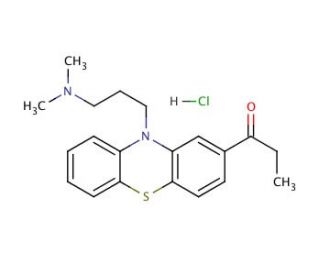

Propionylpromazine hydrochloride 의 분자 구조, CAS 번호: 7681-67-6
Propionylpromazine hydrochloride (CAS 7681-67-6)
대체 이름:
Propiopromazine hydrochloride
적용:
Propionylpromazine hydrochloride 는 D2DR 억제제입니다.
CAS 등록번호:
7681-67-6
순도:
≥93%
분자량:
376.94
분자식:
C20H24N2OS•HCl
연구용으로만 사용가능합니다. 진단이나 치료용으로 사용불가합니다.
* 참조분석증명서대량의 측정 데이터(함수량포함).
빠른 링크
주문정보
설명
기술정보
안전정보
SDS 및 분석 증명서
프로피오닐프로마진염산염은 도파민 수용체 길항제입니다. 중추 신경계의 도파민 수용체를 차단하는 방식으로 작용합니다. 이러한 차단은 도파민의 효과를 감소시켜 진정 및 구토 방지 효과를 가져옵니다. 프로피오닐프로마진 염산염은 도파민 신경전달을 조절하는 능력으로 인해 항정신병 약물이 될 수 있습니다. 이 약의 작용 메커니즘은 도파민 방출을 억제하고 뇌의 도파민 수용체의 민감도를 변화시키는 것입니다. 프로피오닐프로마진 염산염은 또한 항콜린성 및 알파 아드레날린성 차단 특성을 나타내어 약리학적 효과에 기여합니다.
Propionylpromazine hydrochloride (CAS 7681-67-6) 참고자료
- 역상 이온 쌍 소구경 액체 크로마토그래피를 사용하여 제형 매트릭스에서 프로피오닐프로마진 염산염을 측정합니다. | Hurlbut, DB., et al. 1999. J AOAC Int. 82: 1321-8. PMID: 10589483
- 돼지 신장에서 동물용 진정제 및 베타 차단제 카라졸롤에 대한 신속한 스크리닝 테스트 개발(ELISA). | Cooper, J., et al. 2004. Analyst. 129: 169-74. PMID: 14752562
- 혈청 샘플에서 코르티코이드와 진정제를 동시에 측정할 수 있는 고체상 추출 방법 개발. | Quintana, MC., et al. 2004. J Sep Sci. 27: 53-8. PMID: 15335058
- 제형화된 제품에서 진정제 약물인 프로피오닐프로마진 염산염의 안정성. | Primus, TM., et al. 2005. Pest Manag Sci. 61: 605-11. PMID: 15668921
- 흡입된 산화질소는 돼지의 ET-1 의존성 폐 고혈압과 기관지 수축의 균형을 상쇄합니다. | Clement, MG. and Dimori, M. 1994. Mediators Inflamm. 3: 131-5. PMID: 18472931
- PAF에 의한 혈관 및 호흡기 효과에 대한 내인성 산화질소의 역할. | Clement, M. and Albertini, M. 1995. Mediators Inflamm. 4: 124-9. PMID: 18475628
- 모르핀에 의한 cAMP 오버슈트 억제: 고처리량 형식의 세포 기반 분석 모델. | Xia, M., et al. 2011. Cell Mol Neurobiol. 31: 901-7. PMID: 21598037
- 살충제 발견을 위한'게놈-리드' 접근법: Aedes aegypti D(1)형 도파민 수용체의 약리학적 특성 분석 및 스크리닝. | Meyer, JM., et al. 2012. PLoS Negl Trop Dis. 6: e1478. PMID: 22292096
- 꼬마선충의 수명 연장을 위한 약리학 네트워크. | Ye, X., et al. 2014. Aging Cell. 13: 206-15. PMID: 24134630
- 아세나핀은 심근세포에서 산화질소 방출과 칼슘 이동을 조절합니다. | Grossini, E., et al. 2016. J Pharmacol Pharmacother. 7: 6-14. PMID: 27127388
- 세포 기반의 정량적 고처리량 이미지 스크리닝을 통해 새로운 자가포식 조절제를 확인했습니다. | Li, Y., et al. 2016. Pharmacol Res. 110: 35-49. PMID: 27168224
- 말에서 프로피오닐프로마진의 대사 및 약동학 연구. | Park, J., et al. 1989. J Chromatogr. 489: 313-21. PMID: 2753955
- 페노티아진 화합물이 폴리-l-라이신의 이차 구조 및 섬유소 형성에 미치는 영향. | Cieślik-Boczula, K. 2019. Spectrochim Acta A Mol Biomol Spectrosc. 216: 15-24. PMID: 30870786
- 3D 인간 iPSC 유래 피질 스페로이드에서 신경망 활동의 조절자 스크리닝. | Woodruff, G., et al. 2020. PLoS One. 15: e0240991. PMID: 33091047
- 말 소변에서 프로피오닐프로마진 및 그 대사산물의 분석. | Dewey, EA. and Maylin, GA. 1984. Cornell Vet. 74: 38-49. PMID: 6705538
의 억제제:
D2DR.주문정보
| 제품명 | 카탈로그 번호 | 단위 | 가격 | 수량 | 관심품목 | |
Propionylpromazine hydrochloride, 100 mg | sc-250790 | 100 mg | $84.00 |