
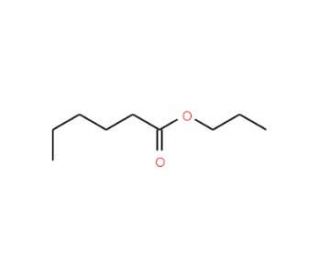

n-Propyl hexanoate (CAS 626-77-7)
QUICK LINKS
n-Propyl hexanoate, a chemical compound of scientific interest, has been extensively studied for its mechanisms of action and diverse applications in scientific research. One area of research focuses on its potential as a flavoring agent in the food industry. The compound possesses a fruity, pineapple-like aroma, making it valuable for enhancing sensory properties in food products. Researchers have investigated its flavor profile and the impact of n-Propyl hexanoate on taste perception, aroma release, and consumer preferences. Additionally, n-Propyl hexanoate has been explored as a precursor in organic synthesis. Its ester functionality and alkyl chain length make it a suitable building block for the synthesis of various organic compounds. Researchers have utilized n-Propyl hexanoate as a starting material for the preparation of pharmaceutical intermediates, fine chemicals, and fragrance compounds. The compound′s reactivity, stability, and compatibility with different reaction conditions have contributed to its usefulness in synthetic chemistry. Furthermore, n-Propyl hexanoate has been studied for its potential applications in biofuel production. Researchers have investigated its utilization as a biofuel additive due to its favorable combustion properties and potential to reduce emissions. The ongoing scientific research on n-Propyl hexanoate continues to deepen our understanding of its mechanisms of action and its potential applications in flavor science, organic synthesis, biofuel research, and related scientific disciplines, contributing to advancements in research and technology.
n-Propyl hexanoate (CAS 626-77-7) References
- Ethylbutyrate, a valproate-like compound, exhibits inositol-depleting effects--a potential mood-stabilizing drug. | Azab, AN., et al. 2009. Life Sci. 84: 38-44. PMID: 19028504
- Quantification of allyl hexanoate in pineapple beverages and yogurts as a case study to characterise a source of uncertainty in dietary exposure assessment to flavouring substances. | Raffo, A., et al. 2012. Food Addit Contam Part A Chem Anal Control Expo Risk Assess. 29: 43-53. PMID: 22043838
- Development of a method for identification and accurate quantitation of aroma compounds in Chinese Daohuaxiang liquors based on SPME using a sol-gel fibre. | Wang, PP., et al. 2015. Food Chem. 169: 230-40. PMID: 25236221
- Study on the drunkenness of Chinese Baijiu with representative flavor based on behavioral characteristics. | Guo, X., et al. 2022. Front Nutr. 9: 1014813. PMID: 36245514
- Minor, Nonterpenoid Volatile Compounds Drive the Aroma Differences of Exotic Cannabis. | Oswald, IWH., et al. 2023. ACS Omega. 8: 39203-39216. PMID: 37901519
- Far-infrared spectra of saturated esters | Saunders, J. E., Lucier, J. J., & Bentley, F. F. 1968. Applied Spectroscopy. 22(6): 697-713.
- Rhagoletis sibling species and host races differ in host odor recognition | Frey, J. E., & Bush, G. L. 1990. Entomologia experimentalis et applicata. 57(2): 123-131.
- Differences in the electroantennal responses of apple-and hawthorn-infesting races of Rhagoletis pomonella to host fruit volatile compounds | Frey, J. E., Feder, J. L., Palma, J., & Bush, G. L. 1998. Chemoecology. 8: 175-186.
- Biocatalytic synthesis of short-chain flavor esters with high substrate loading by a whole-cell lipase from Aspergillus oryzae | Yan, H. D., Zhang, Q., & Wang, Z. 2014. Catalysis Communications. 45: 59-62.
- Heats of combustion of fatty acids and fatty acid esters | Levine, F., Kayea III, R. V., Wexler, R., Sadvary, D. J., Melick, C., & La Scala, J. 2014. Journal of the American Oil Chemists' Society. 91(2): 235-249.
Ordering Information
| Product Name | Catalog # | UNIT | Price | Qty | FAVORITES | |
n-Propyl hexanoate, 25 g | sc-281095 | 25 g | $87.00 | |||
n-Propyl hexanoate, 100 g | sc-281095A | 100 g | $280.00 | |||
n-Propyl hexanoate, 500 g | sc-281095B | 500 g | $602.00 |