
Date published: 2025-12-4

1-800-457-3801

SCBT Portrait Logo
Seach Input

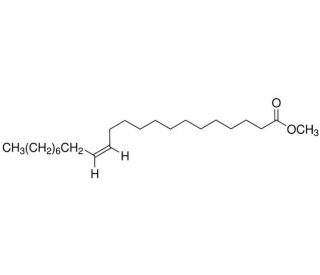
Methyl cis-13-docosenoate (CAS 1120-34-9)

0.0(0)
Write a reviewAsk a question

Alternate Names:
Methyl erucate
CAS Number:
1120-34-9
Purity:
≥98%
Molecular Weight:
352.59
Molecular Formula:
C23H44O2
Supplemental Information:
This is classified as a Dangerous Good for transport and may be subject to additional shipping charges.
For Research Use Only. Not Intended for Diagnostic or Therapeutic Use.
* Refer to Certificate of Analysis for lot specific data.

QUICK LINKS

Methyl cis-13-docosenoate, a methyl ester derivative of cis-13-docosenoic acid, has garnered attention in scientific research for its potential applications in various fields. One of the primary areas of interest lies in its role as a precursor molecule for the synthesis of bioactive compounds. Researchers have investigated the enzymatic or chemical transformation of methyl cis-13-docosenoate into diverse products, including fatty alcohols, fatty acids, and lipid-derived signaling molecules. This chemical serves as a valuable starting material for the synthesis of lipid-based nanoparticles and vesicles, which find applications in drug delivery, gene therapy, and cosmetic formulations. Furthermore, methyl cis-13-docosenoate has been utilized as a substrate in enzymatic reactions to study the specificity and efficiency of lipase enzymes. Its incorporation into lipid bilayers has also been explored to explain membrane structure and dynamics using biophysical techniques such as nuclear magnetic resonance spectroscopy and fluorescence microscopy. Additionally, methyl cis-13-docosenoate serves as a model compound for investigating the metabolism and physiological functions of long-chain unsaturated fatty acids in biological systems, shedding light on their roles in cellular processes and disease development.


Methyl cis-13-docosenoate (CAS 1120-34-9) References

  1. Efficient Conversion of Renewable Unsaturated Fatty Acid Methyl Esters by Cross-Metathesis with Eugenol.  |  Le, D., et al. 2018. ACS Omega. 3: 11041-11049. PMID: 31459214
  2. Two methods for determining erucic acid in edible fats and oils: results from a collaborative study on a rapid, open-tubular (capillary) GLC method and comparison with an isolation TLC procedure.  |  Ackman, RG., et al. 1983. J Chromatogr Sci. 21: 87-93. PMID: 6833445
  3. The preparation and use of aldehyde esters formed by ozonation of the methyl esters of various unsaturated acids.  |  Noller, C. R. and Roger Adams. 1926. Journal of the American Chemical Society. 48.4: 1074-1080.
  4. Fatty acid composition of oil from roasted and unroasted peanuts by gas-liquid chromatography.  |  Iverson, et al. 1963. Journal of the Association of Official Agricultural Chemists. 46.4: 718-725.
  5. Gas-liquid chromatographic determination of docosenoic acid in fats and oils: collaborative study.  |  Conacher and Henry BS. 1975. Journal of the Association of Official Analytical Chemists. 58.3: 488-491.
  6. Brassylic acid: chemical intermediate from high-erucic oils.  |  Carlson, Kenneth D., et al. 1977. Industrial & Engineering Chemistry Product Research and Development. 16.1: 95-101.
  7. Preparation of terminal alkenic esters by an oxidative radical reaction.  |  Cardinale, G., et al. 1985. Tetrahedron. 41.14: 2899-2902.
  8. Nonequilibrium transitions in thermotropic phases of eicosenoic acid methyl esters.  |  Chang, S. P. and J. A. Rothfus. 1996. Journal of the American Oil Chemists' Society. 73.4: 403-410.
  9. Fatty acid derived renewable platform chemicals via selective oxidation processes.  |  von Czapiewski, et al. 2018. ACS sustainable chemistry & engineering. 6.11: 15170-15179.
  10. Seed morphological and biochemical studies in certain wild nutmegs.  |  Waman, Ajit Arun, et al. 2021. Trees. 35: 939-945.

Ordering Information

Product NameCatalog #UNITPriceQtyFAVORITES

Methyl cis-13-docosenoate, 1 ml

sc-211877
1 ml
$36.00