
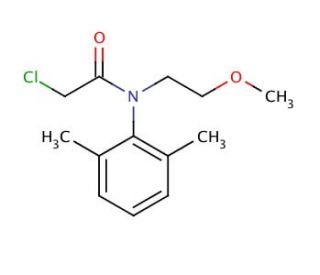

Molecular structure of Dimethachlor, CAS Number: 50563-36-5
Dimethachlor (CAS 50563-36-5)
CAS Number:
50563-36-5
Purity:
≥97%
Molecular Weight:
255.74
Molecular Formula:
C13H18ClNO2
Supplemental Information:
This is as a Dangerous Good for transport and may be subject to additional shipping charges.
For Research Use Only. Not Intended for Diagnostic or Therapeutic Use.
* Refer to Certificate of Analysis for lot specific data.
QUICK LINKS
Ordering Information
Description
Technical Information
Safety Information
SDS & Certificate of Analysis
Dimethachlor is an aromatic amide and organochlorine compound. It is characterized by the substitution of a 2-chloroacetamide with a 2-methoxyethyl group and a 2,6-dimethylphenyl group at the nitrogen atom. This compound exhibits multiple roles, including being a xenobiotic, an environmental contaminant, and a herbicide. Additionally, Dimethachlor falls into the category of ethers and organochlorine compounds.
Dimethachlor (CAS 50563-36-5) References
- Predictability of combined effects of eight chloroacetanilide herbicides on algal reproduction. | Junghans, M., et al. 2003. Pest Manag Sci. 59: 1101-10. PMID: 14561067
- Temporal variations of concentrations of currently used pesticides in the atmosphere of Strasbourg, France. | Schummer, C., et al. 2010. Environ Pollut. 158: 576-84. PMID: 19775790
- The action of herbicides on fatty acid biosynthesis and elongation in barley and cucumber. | Yang, X., et al. 2010. Pest Manag Sci. 66: 794-800. PMID: 20533380
- Monitoring of pesticide residues in market basket samples of vegetable from Lucknow City, India: QuEChERS method. | Srivastava, AK., et al. 2011. Environ Monit Assess. 176: 465-72. PMID: 20632088
- Multiresidue method to quantify pesticides in fish muscle by QuEChERS-based extraction and LC-MS/MS. | Lazartigues, A., et al. 2011. Anal Bioanal Chem. 400: 2185-93. PMID: 21484246
- Pesticide pressure and fish farming in barrage pond in Northeastern France. Part II: residues of 13 pesticides in water, sediments, edible fish and their relationships. | Lazartigues, A., et al. 2013. Environ Sci Pollut Res Int. 20: 117-25. PMID: 22961490
- Accumulation and half-lives of 13 pesticides in muscle tissue of freshwater fishes through food exposure. | Lazartigues, A., et al. 2013. Chemosphere. 91: 530-5. PMID: 23374295
- Dynamics of chloroacetanilide herbicides in various types of mesocosm wetlands. | Chen, Z., et al. 2017. Sci Total Environ. 577: 386-394. PMID: 27823825
- Is pesticide sorption by constructed wetland sediments governed by water level and water dynamics? | Gaullier, C., et al. 2018. Environ Sci Pollut Res Int. 25: 14324-14335. PMID: 28508331
- Degradation studies of dimethachlor in soils and water by UHPLC-HRMS: putative elucidation of unknown metabolites. | López-Ruiz, R., et al. 2020. Pest Manag Sci. 76: 721-729. PMID: 31373749
- The impact of pesticides used at the agricultural land of the Puck commune on the environment of the Puck Bay. | Pazikowska-Sapota, G., et al. 2020. PeerJ. 8: e8789. PMID: 32219029
- Changes in soil microbial community and activity caused by application of dimethachlor and linuron. | Medo, J., et al. 2021. Sci Rep. 11: 12786. PMID: 34140550
- Selective magnetic solid-phase extraction of amide herbicides from fish samples coupled with ultra-high-performance liquid chromatography with tandem mass spectrometry. | Gao, L., et al. 2022. J Sep Sci. 45: 896-907. PMID: 34875128
Ordering Information
| Product Name | Catalog # | UNIT | Price | Qty | FAVORITES | |
Dimethachlor, 250 mg | sc-234712 | 250 mg | $45.00 |