
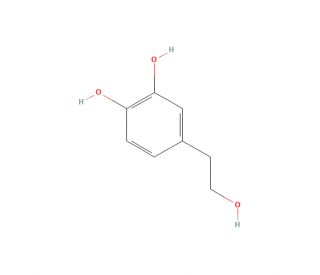

3,4-Dihydroxyphenyl Ethanol (CAS 10597-60-1)
See product citations (6)
QUICK LINKS
3,4-Dihydroxyphenyl Ethanol is a phenolic compound present in olive oil, described to inhibit 5-LO (5-lipoxygenase) and 12-LO (12-lipoxygenase) activity. 3,4-Dihydroxyphenyl Ethanol is demonstrated to inhibit 5-LO (IC50 = 13 muM) in rat polymorphonuclear leukocytes and 12-LO (IC50 = 4.2 muM) in rat platelets. Oxidative damage induced by H2O2 or a xanthine/xanthine oxidase system on human Caco-2 cells was strongly suppressed by exposure to 3,4-Dihydroxyphenyl Ethanol, indicating reactive oxygen species scavenging activity of the compound. 3,4-Dihydroxyphenyl Ethanol is demonstrated to increase cytosolic Ca2+ levels in human lymphomonocytes. 3,4-Dihydroxyphenyl Ethanol is also described to induce growth arrest and apoptosis in human colon carcinoma HT-29 cells through activation of the serine/threonine protein phosphatase 2A.
3,4-Dihydroxyphenyl Ethanol (CAS 10597-60-1) References
- Biological effects of hydroxytyrosol, a polyphenol from olive oil endowed with antioxidant activity. | Manna, C., et al. 1999. Adv Exp Med Biol. 472: 115-30. PMID: 10736621
- Activity of olive oil phenols on lymphomonocyte cytosolic calcium. | Palmerini, CA., et al. 2005. J Nutr Biochem. 16: 109-13. PMID: 15681170
- Dihydroxyphenylethanol induces apoptosis by activating serine/threonine protein phosphatase PP2A and promotes the endoplasmic reticulum stress response in human colon carcinoma cells. | Guichard, C., et al. 2006. Carcinogenesis. 27: 1812-27. PMID: 16524888
- Nutritional benefit of olive oil: the biological effects of hydroxytyrosol and its arylating quinone adducts. | Cornwell, DG. and Ma, J. 2008. J Agric Food Chem. 56: 8774-86. PMID: 18783241
- Spectroscopic studies of intramolecular proton transfer in 2-(4-fluorophenylamino)-5-(2,4-dihydroxybenzeno)-1,3,4-thiadiazole. | Gagoś, M., et al. 2011. J Fluoresc. 21: 1-10. PMID: 20535632
- Naturally occurring hydroxytyrosol: synthesis and anticancer potential. | Bernini, R., et al. 2013. Curr Med Chem. 20: 655-70. PMID: 23244583
- 3,4 dihydroxyphenyl ethanol reduces secretion of angiogenin in human retinal pigment epithelial cells. | Granner, T., et al. 2013. Br J Ophthalmol. 97: 371-4. PMID: 23292926
- Production of a chiral alcohol, 1-(3,4-dihydroxyphenyl) ethanol, by mushroom tyrosinase. | Brooks, SJ., et al. 2013. Biotechnol Lett. 35: 779-83. PMID: 23355036
- Antitumor Perspectives of Oleuropein and Its Metabolite Hydroxytyrosol: Recent Updates. | Imran, M., et al. 2018. J Food Sci. 83: 1781-1791. PMID: 29928786
- Antioxidant Effect of Hydroxytyrosol, Hydroxytyrosol Acetate and Nitrohydroxytyrosol in a Rat MPP+ Model of Parkinson's Disease. | Pérez-Barrón, G., et al. 2021. Neurochem Res. 46: 2923-2935. PMID: 34260002
- Hydroxytyrosol [2-(3,4-dihydroxyphenyl)-ethanol], a natural phenolic compound found in the olive, alters Ca2+ signaling and viability in human HepG2 hepatoma cells. | Cheng, HH., et al. 2022. Chin J Physiol. 65: 30-36. PMID: 35229750
- The protective effect of the olive oil polyphenol (3,4-dihydroxyphenyl)-ethanol counteracts reactive oxygen metabolite-induced cytotoxicity in Caco-2 cells. | Manna, C., et al. 1997. J Nutr. 127: 286-92. PMID: 9039829
- Inhibition of arachidonate lipoxygenase activities by 2-(3,4-dihydroxyphenyl)ethanol, a phenolic compound from olives. | Kohyama, N., et al. 1997. Biosci Biotechnol Biochem. 61: 347-50. PMID: 9058975
Ordering Information
| Product Name | Catalog # | UNIT | Price | Qty | FAVORITES | |
3,4-Dihydroxyphenyl Ethanol, 10 mg | sc-202887 | 10 mg | $112.00 |