
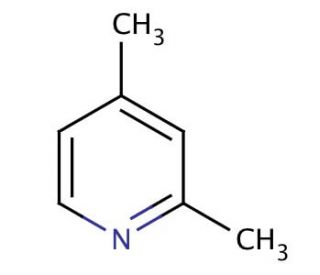

2,4-Lutidine (CAS 108-47-4)
QUICK LINKS
2,4-Lutidine presents itself as an organic compound characterized by a five-member ring housing a single nitrogen atom. This colorless liquid boasts a mild fragrance and serves a dual role as both a solvent and a reagent in the realm of organic synthesis. Its significance goes further as it serves as a foundational component for crafting a diverse array of compounds. With its far-reaching potential, 2,4-Lutidine finds utility across the domains of chemistry and biology. Within the realm of scientific exploration, 2,4-Lutidine finds itself pivotal in various applications. Primarily as a reagent, it plays a central role in catalyzing organic synthesis, while its function as a solvent facilitates chemical reactions. Additionally, it holds importance as a fundamental building block, initiating the creation of a spectrum of other compounds. The versatility extends into catalytic applications, supporting polymer synthesis and contributing to the stabilization of polyurethane foam. Beyond this, it leaves its mark in pesticide synthesis, as well as the formulation of industrial chemicals. The crux of 2,4-Lutidine′s influence lies in its catalytic prowess, catalyzing chemical transformations through the establishment of fresh molecular bonds. Its electron-rich nature empowers it to furnish electrons to neighboring molecules, enabling the forging of novel chemical linkages. The role it assumes as a proton donor further enriches its catalytic potential, as it donates protons to foster the creation of new chemical bonds. In essence, 2,4-Lutidine emerges as a multifaceted catalyst, bridging molecules and fostering innovation across a wide spectrum of chemical processes.
2,4-Lutidine (CAS 108-47-4) References
- Microbial decomposition of 2-ethylpyridine, 2,4-lutidine & 2,4,6-collidine. | Shukla, OP. 1975. Indian J Exp Biol. 13: 574-5. PMID: 1218933
- Weak hydrogen bonding as a basis for concentration-dependent guest selectivity by a cyclophane host. | Apel, S., et al. 2002. Chemistry. 8: 3678-86. PMID: 12203295
- [Study on adductive reaction of Ni[(C4H9O)2PS2]2 with nitrogen base by spectrographic method]. | He, MQ., et al. 2001. Guang Pu Xue Yu Guang Pu Fen Xi. 21: 833-6. PMID: 12958908
- Structural correlations for (1)H, (13)C and (15)N NMR coordination shifts in Au(III), Pd(II) and Pt(II) chloride complexes with lutidines and collidine. | Pazderski, L., et al. 2010. Magn Reson Chem. 48: 417-26. PMID: 20474019
- Prediction of reduced ion mobility constants of organic compounds from molecular structure. | Wessel, MD., et al. 1996. Anal Chem. 68: 4237-43. PMID: 21619334
- Identification of pyridine analogs as new predator-derived kairomones. | Brechbühl, J., et al. 2015. Front Neurosci. 9: 253. PMID: 26283896
- Discovery of small molecules targeting the tandem tudor domain of the epigenetic factor UHRF1 using fragment-based ligand discovery. | Chang, L., et al. 2021. Sci Rep. 11: 1121. PMID: 33441849
- Portable Pen-Probe Analyzer Based on Ion Mobility Spectrometry for in Situ Analysis of Volatile Organic Compounds Emanating from Surfaces and Wireless Transmission of the Acquired Spectra. | Shih, CP., et al. 2021. Anal Chem. 93: 2424-2432. PMID: 33470119
- Tunable thermo-reversible bicontinuous nanoparticle gel driven by the binary solvent segregation. | Xi, Y., et al. 2021. Nat Commun. 12: 910. PMID: 33568668
- Finely tunable dynamical coloration using bicontinuous micrometer-domains. | Xi, Y., et al. 2022. Nat Commun. 13: 3619. PMID: 35750660
- Extraction of sensing data for desired scent impressions using mass spectra of odorant molecules. | Debnath, T. and Nakamoto, T. 2022. Sci Rep. 12: 16297. PMID: 36175481
- E3 Ligases Meet Their Match: Fragment-Based Approaches to Discover New E3 Ligands and to Unravel E3 Biology. | Michaelides, IN. and Collie, GW. 2023. J Med Chem. 66: 3173-3194. PMID: 36821822
- An economical setup for atmospheric pressure chemical ionization drift tube ion-mobility mass spectrometry. | Raju, CM., et al. 2023. Anal Chim Acta. 1268: 341359. PMID: 37268338
Ordering Information
| Product Name | Catalog # | UNIT | Price | Qty | FAVORITES | |
2,4-Lutidine, 5 ml | sc-256324 | 5 ml | $30.00 | |||
2,4-Lutidine, 100 ml | sc-256324A | 100 ml | $103.00 |