
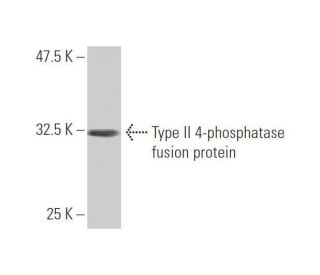

Type II 4-phosphatase Antibody (3F2): sc-293234
- Type II 4-phosphatase Antibody (3F2) is a mouse monoclonal IgG2b λ Type II 4-phosphatase antibody provided at 100 µg/ml
- raised against a recombinant protein mapping within amino acids 1-53 representing full length Type II 4-phosphatase of human origin
- recommended for detection of Type II 4-phosphatase of human origin by WB, IP and ELISA
- At present, we have not yet completed the identification of the preferred secondary detection reagent(s) for Type II 4-phosphatase Antibody (3F2). This work is in progress.

QUICK LINKS
Type II 4-phosphatase Antibody (3F2) is a mouse monoclonal IgG2b antibody that detects Type II 4-phosphatase of human origin by western blotting (WB), immunoprecipitation (IP), and enzyme-linked immunosorbent assay (ELISA). Anti-Type II 4-phosphatase antibody (3F2) is available as a non-conjugated format. Type II 4-phosphatase plays a crucial role in cellular signaling by selectively dephosphorylating phosphatidylinositol 3,4-bisphosphate, inositol 1,3,4-trisphosphate, and inositol 3,4-bisphosphate, generating second messengers that mediate various physiological responses to extracellular signals. Type II 4-phosphatase is predominantly located in the cytoplasm and regulates intracellular calcium levels, which is vital for numerous cellular processes, including muscle contraction, neurotransmitter release, and cell proliferation. Type II 4-phosphatase appears in various tissues, such as human platelets, rat brain, heart, skeletal muscle, and spleen, underscoring its importance in maintaining cellular homeostasis and responding to external stimuli. Both type I and type II 4-phosphatases are alternatively spliced into two isoforms, α and β, which share a conserved motif containing the active site consensus sequence C-X5-R, highlighting their evolutionary significance and functional conservation. Type II 4-phosphatase acts as a signal-terminating enzyme, emphasizing its role in fine-tuning cellular responses and making it a valuable target for research in signal transduction pathways.
Alexa Fluor® is a trademark of Molecular Probes Inc., OR., USA
LI-COR® and Odyssey® are registered trademarks of LI-COR Biosciences
Type II 4-phosphatase Antibody (3F2) References:
- The role of phosphatases in inositol signaling reactions. | Majerus, PW., et al. 1999. J Biol Chem. 274: 10669-72. PMID: 10196133
- Evidence that inositol polyphosphate 4-phosphatase type II is a tumor suppressor that inhibits PI3K signaling. | Gewinner, C., et al. 2009. Cancer Cell. 16: 115-25. PMID: 19647222
- The isolation and characterization of inositol polyphosphate 4-phosphatase. | Bansal, VS., et al. 1990. J Biol Chem. 265: 1806-11. PMID: 2153145
- Identification of inositol polyphosphate 4-phosphatase type II as a novel tumor resistance biomarker in human laryngeal cancer HEp-2 cells. | Kim, JS., et al. 2012. Cancer Biol Ther. 13: 1307-18. PMID: 22895072
- MicroRNA-590-3p promotes cell proliferation and invasion by targeting inositol polyphosphate 4-phosphatase type II in human prostate cancer cells. | Chen, H., et al. 2017. Tumour Biol. 39: 1010428317695941. PMID: 28345464
- Down-regulation of Inositol Polyphosphate 4-Phosphatase Type II Expression in Colorectal Carcinoma. | Sung, JY., et al. 2017. Anticancer Res. 37: 5525-5531. PMID: 28982866
- Inositol polyphosphate-4-phosphatase type II plays critical roles in the modulation of cadherin-mediated adhesion dynamics of pancreatic ductal adenocarcinomas. | Zhang, B., et al. 2018. Cell Adh Migr. 12: 548-563. PMID: 29952716
- Inositol polyphosphate 4-phosphatase type II regulation of androgen receptor activity. | Zhang, M., et al. 2019. Oncogene. 38: 1121-1135. PMID: 30228349
- Expression of inositol polyphosphate 4-phosphatase type II and the prognosis of oral squamous cell carcinoma. | Yang, QC., et al. 2020. Eur J Oral Sci. 128: 37-45. PMID: 32027770
- The isolation and characterization of cDNA encoding human and rat brain inositol polyphosphate 4-phosphatase. | Norris, FA., et al. 1995. J Biol Chem. 270: 16128-33. PMID: 7608176
- Inositol polyphosphate 4-phosphatase is inactivated by calpain-mediated proteolysis in stimulated human platelets. | Norris, FA., et al. 1997. J Biol Chem. 272: 10987-9. PMID: 9110986
- The cDNA cloning and characterization of inositol polyphosphate 4-phosphatase type II. Evidence for conserved alternative splicing in the 4-phosphatase family. | Norris, FA., et al. 1997. J Biol Chem. 272: 23859-64. PMID: 9295334
Ordering Information
| Product Name | Catalog # | UNIT | Price | Qty | FAVORITES | |
Type II 4-phosphatase Antibody (3F2) | sc-293234 | 100 µg/ml | $322.00 |