
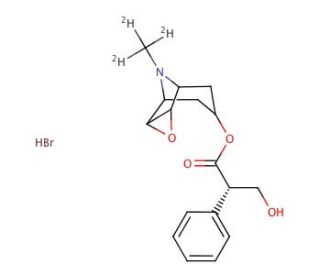

Scopolamine-d3 Hydrobromide Hydrate
QUICK LINKS
Scopolamine-d3 Hydrobromide Hydrate, a chemical compound derived from Scopolamine, a naturally occurring alkaloid found in plants like Datura and Hyoscyamus, is a prominent element in scientific research. In neuroscience studies, Scopolamine-d3 Hydrobromide Hydrate serves as useful to delve into the mechanisms underlying neurotransmitters and neuromodulators. Neuroscience research heavily relies on Scopolamine-d3 Hydrobromide Hydrate to investigate the mechanisms of action of neurotransmitters and neuromodulators. Particularly, it finds widespread use as a competitive antagonist of the muscarinic acetylcholine receptor subtype M1. This receptor plays a vital role in various physiological processes, including learning and memory, attention, and motor control. The mode of action of Scopolamine-d3 Hydrobromide Hydrate revolves around its role as a competitive antagonist of the muscarinic acetylcholine receptor subtype M1. As a G protein-coupled receptor, the M1 receptor gets activated by the neurotransmitter acetylcholine. However, when Scopolamine-d3 Hydrobromide Hydrate binds to this receptor, it hinders the action of acetylcholine, leading to a decrease in the activity of the cholinergic system. This, in turn, unveils important insights into the complex workings of the brain and contributes to a deeper understanding of neural processes.
Scopolamine-d3 Hydrobromide Hydrate References
- Transdermal hyoscine (Scopolamine). A preliminary review of its pharmacodynamic properties and therapeutic efficacy. | Clissold, SP. and Heel, RC. 1985. Drugs. 29: 189-207. PMID: 3886352
- Intramuscular hyoscine in control of motion sickness. | Brand, JJ. and Whittingham, P. 1970. Lancet. 2: 232-4. PMID: 4193688
Ordering Information
| Product Name | Catalog # | UNIT | Price | Qty | FAVORITES | |
Scopolamine-d3 Hydrobromide Hydrate, 1 mg | sc-220095 | 1 mg | $401.00 |